
Custom Packaging
Overview
While EFS provides standard packaging materials for all shipments, you may want to use your own branded packaging to enhance your customer experience. This guide explains the options, costs, and requirements for using custom packaging with EFS.
Table of Contents
1. Standard vs. Custom Packaging
2. Benefits of Custom Packaging
3. Types of Custom Packaging
4. Cost Considerations
5. How to Implement Custom Packaging
6. Custom Packaging Requirements
7. Best Practices
8. Common Custom Packaging Scenarios
9. Dimensional Weight & Shipping Costs
10. Inventory Management for Packaging
11. Quality Control
12. Switching from Standard to Custom Packaging
13. Troubleshooting Common Issues
14. Cost-Benefit Analysis
15. Frequently Asked Questions
16. Getting Started Checklist
17. Need Help with Custom Packaging?
Standard vs. Custom Packaging
Standard Packaging (Included)
EFS provides these packaging materials at no additional cost (beyond the rates listed in your pricing agreement):
Cartons:
- Multiple box sizes to fit different order volumes.
- Sturdy corrugated cardboard.
- Plain brown eco friendly boxes without branding.
Envelopes:
- Poly mailers for smaller, non-fragile items.
- Padded envelopes for lightweight items needing protection.
- Various sizes available (see packaging list).
Packing Materials:
- Packing paper for void fill.
- Bubble wrap for fragile items.
- Standard packing tape.
View Available Sizes: See the Standard Packaging List with DIM Weights for dimensions and weight information.
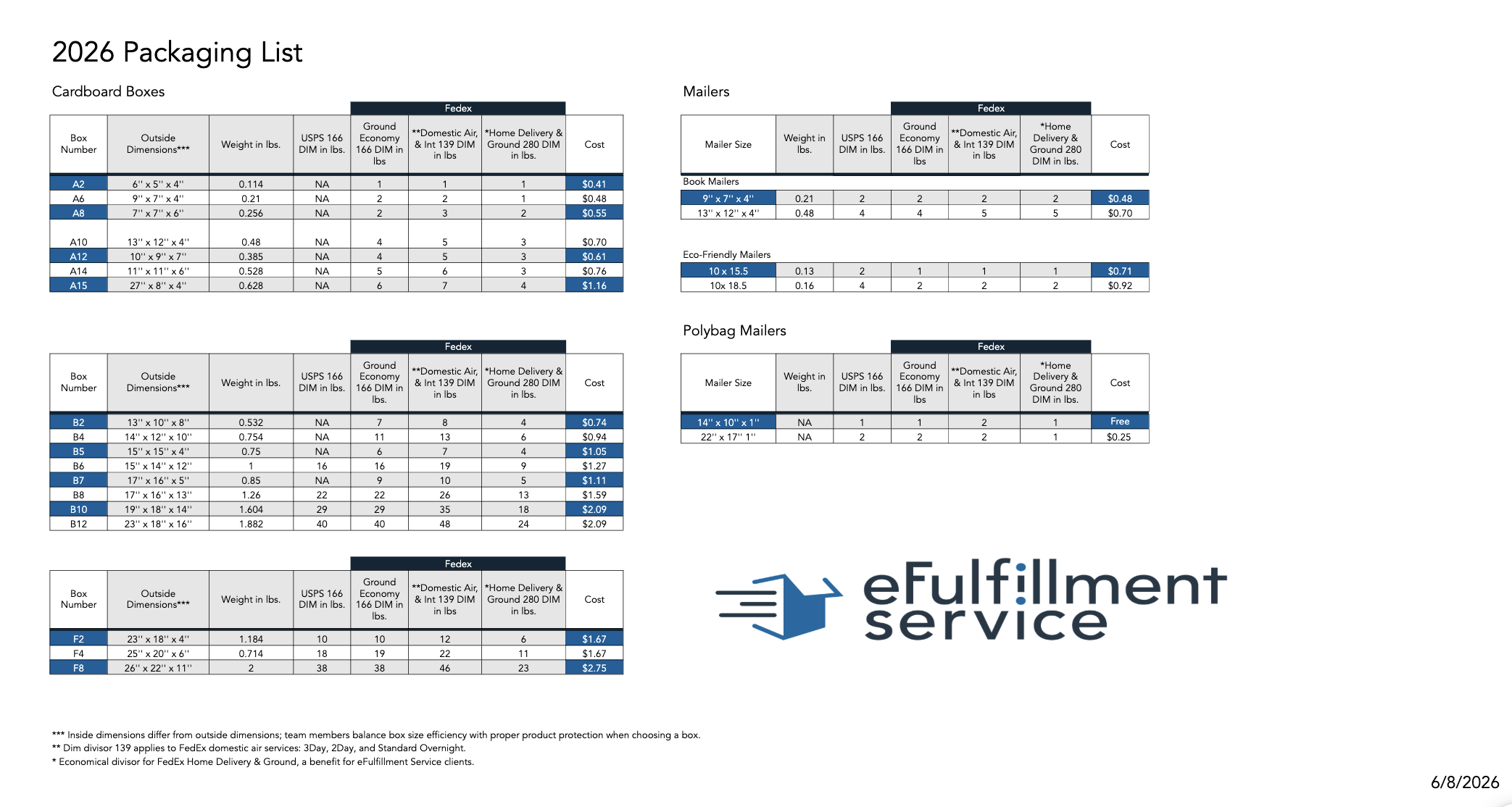
Custom Packaging (Optional)
Custom packaging includes:
- Branded boxes with your logo or design.
- Custom printed poly mailers.
- Specialty packaging materials.
- Branded tissue paper, stickers, or inserts.
- Custom interior packaging.
- Gift boxes or presentation packaging.
Benefits of Custom Packaging
Brand Recognition
- Customers see your branding immediately upon delivery.
- Creates a memorable unboxing experience.
- Reinforces your brand identity.
Professional Appearance
- Elevates perceived product value.
- Shows attention to detail.
- Differentiates from competitors.
Marketing Opportunity
- Include promotional materials or inserts.
- Display social media handles or website.
- Encourage repeat purchases.
Customer Experience
- Creates excitement during unboxing.
- Can lead to social media sharing.
- Improves overall brand perception.
Types of Custom Packaging
1. Custom Printed Boxes
What it includes:
- Your logo, branding, and design printed on boxes.
- Choice of printing styles (full color, single color, etc.).
- Various box sizes and styles.
Considerations:
- Minimum order quantities typically required.
- Lead time for production.
- Storage space at EFS facility.
- Cost per unit.
2. Custom Poly Mailers
What it includes:
- Branded poly mailers with your logo and colors.
- Various sizes available.
- Professional appearance for lightweight items.
Considerations:
- Lower minimum quantities than boxes (typically).
- Less expensive than custom boxes.
- Good for apparel and soft goods.
3. Branded Inserts & Materials
What it includes:
- Tissue paper with your branding.
- Thank you cards or postcards.
- Promotional flyers.
- Branded stickers or tape.
- Business cards.
Considerations:
- Easier to implement than full packaging changes.
- Can be used with standard EFS boxes.
- Lower cost way to add branding.
4. Specialty Packaging
What it includes:
- Gift boxes for premium products.
- Rigid setup boxes.
- Tubes for posters or artwork.
- Custom-designed packaging solutions.
Considerations:
- Higher cost per unit.
- May require special handling.
- Best for high-value or premium products.
Cost Considerations
Material Costs
What you’ll pay:
- Cost of purchasing custom packaging materials.
- Shipping costs to send packaging to EFS.
- Storage fees for packaging materials at EFS.
Storage Rates: Custom packaging materials stored at EFS are subject to standard storage fees:
- Bin storage rate: Speak with your Client Care Account Specialist for current pricing.
- Materials counted as part of your overall inventory.
Tip: Order packaging materials in quantities that balance:
- Bulk pricing discounts.
- Storage costs at EFS.
- Projected usage over time.
Labor Costs
Additional charges may apply for:
Complex Packaging Assembly:
- If custom packaging requires more time to pack than standard packaging.
- Multiple inserts or components.
- Special folding or assembly.
Rate: Varies based on complexity
- Contact your Client Care Account Specialist for a quote.
- Quote provided based on time study of packing process.
Kitting Services:
- Pre-assembling packaging components.
- Adding inserts to boxes in advance.
- Bundling promotional materials.
Rate: $22.50 per half-hour labor
Per-Order Charges
Standard pick and pack fees apply, but may increase if:
- Custom packaging takes significantly longer to pack.
- Multiple components need assembly.
- Special care or handling required.
Important: Discuss potential labor impacts with your Client Care Account Specialist before implementing custom packaging.
How to Implement Custom Packaging
Step 1: Plan Your Custom Packaging
Determine:
- What type of packaging (boxes, mailers, inserts).
- Sizes needed based on your products.
- Design and branding elements.
- Quantity needed.
- Budget available.
Consider:
- How often you’ll reorder.
- Storage space requirements.
- Seasonal variations in packaging needs.
Step 2: Find a Packaging Supplier
Options:
- Online packaging companies (Premier Packaging, and Eco-Packables.)
- Local print shops.
- Wholesale packaging distributors.
- Specialty packaging manufacturers.
What to ask suppliers:
- Minimum order quantities.
- Lead times for production.
- Pricing at different quantities.
- Shipping costs to Michigan.
- Sample availability.
Step 3: Contact Your Client Care Account Specialist
Before ordering packaging, discuss:
- Sizes and types of packaging you’re considering.
- Estimated packing time compared to standard packaging.
- Any special handling requirements.
- Storage logistics.
- Implementation timeline.
They will provide:
- Confirmation that packaging will work with our operations.
- Labor cost estimates if applicable.
- Storage cost projections.
- Implementation recommendations.
Step 4: Order Samples
Always order samples first:
- Test packaging with your actual products.
- Verify sizing is correct.
- Check print quality and colors.
- Ensure durability for shipping.
Send samples to EFS:
- Your Client Care Account Specialist can review samples.
- We’ll confirm compatibility with our packing process.
- Identify any potential issues before full production.
Step 5: Place Your Order
Once approved:
- Order your custom packaging materials.
- Plan for adequate lead time.
- Order enough to last 2-3 months initially.
Step 6: Ship Packaging to EFS
Shipping requirements:
- Complete an ASN (Advance Ship Notice) for the packaging shipment.
- Include a packing list with quantities.
- Ship to standard EFS receiving address.
- Label clearly as “PACKAGING MATERIALS”.
Shipping Address:
[Your Company Name]
c/o EFS Receiving Department – PACKAGING MATERIALS
807 Airport Access Road, Unit D
Traverse City, MI 49686
Step 7: Setup in Fulfillment Control Panel
Work with your Client Care Account Specialist to:
- Create SKUs for packaging materials in your FCP.
- Link packaging to specific products (if using different packaging for different items).
- Set up any special packing instructions.
- Configure custom packing notes.
Step 8: Test Orders
Before going live:
- Place test orders to verify packing is correct.
- Check that all inserts are included.
- Confirm packaging quality.
- Review customer experience.
Custom Packaging Requirements
Size Specifications
Your custom packaging must:
- Be appropriate sizes for your products.
- Not create excessive dimensional weight charges.
- Fit within carrier size restrictions.
- Allow for adequate product protection.
Important: Oversized packaging leads to higher shipping costs. Work with your packaging supplier to optimize sizes.
Durability Standards
Packaging must:
- Withstand normal handling and shipping conditions.
- Protect products adequately.
- Meet carrier requirements for shipping.
- Not tear or break easily.
Test before full production:
- Ship samples to yourself.
- Verify packaging arrives intact.
- Check for damage or weak points.
Packing Instructions
Must be clear and documented:
- Which products use which packaging.
- Order of inserting items and inserts.
- Any special folding or assembly steps.
- Placement of packing materials.
Complex instructions may require:
- Photos or diagrams.
- Training time for packing staff.
- Additional labor charges.
Storage Considerations
Plan for:
- Flat storage vs. pre-assembled storage.
- Space requirements at EFS.
- Reorder points and inventory management.
- Seasonal packaging variations.
Best Practices
Sizing
✅ DO:
- Measure your products carefully before ordering packaging.
- Allow some room for packing materials.
- Consider dimensional weight in sizing decisions.
- Test with actual products before bulk ordering.
❌ DON’T:
- Order packaging before confirming dimensions.
- Use excessively large packaging “to be safe”.
- Forget to account for inserts and packing materials.
- Ignore dimensional weight impact on shipping costs.
Design
✅ DO:
- Keep designs clean and professional.
- Use high-quality printing.
- Include essential information (website, social media).
- Test colors on actual packaging material.
❌ DON’T:
- Overcomplicate designs that increase printing costs.
- Use low-resolution images.
- Include information that may change frequently (prices, seasonal promotions).
- Forget about inside vs. outside printing.
Ordering
✅ DO:
- Order samples first.
- Plan for 2-3 month supply initially.
- Track usage rates.
- Reorder before running out.
❌ DON’T:
- Order a year’s supply initially (designs may change).
- Wait until you’re completely out to reorder.
- Forget to account for lead times.
- Order without cost analysis.
Implementation
✅ DO:
- Communicate clearly with your Client Care Account Specialist.
- Provide detailed packing instructions.
- Test thoroughly before launch.
- Monitor initial orders closely.
❌ DON’T:
- Implement during peak season.
- Rush implementation without testing.
- Forget to update packing instructions in FCP.
- Assume everything will work perfectly without testing.
Common Custom Packaging Scenarios
Scenario 1: Branded Boxes Only
Setup:
- Use custom printed boxes.
- Standard EFS packing materials inside.
- No special inserts.
Cost Impact:
- Material cost of custom boxes.
- Storage fees for boxes.
- Minimal to no additional labor charges.
- Best for: Businesses wanting brand recognition without complexity.
Scenario 2: Standard Boxes + Branded Inserts
Setup:
- Use EFS standard boxes.
- Add branded tissue paper, thank you cards, stickers.
- Simple insert process.
Cost Impact:
- Lower material costs than custom boxes.
- Storage fees for inserts.
- Possible small labor charge for inserts.
Best for: Budget-conscious businesses wanting some branding.
Scenario 3: Full Custom Experience
Setup:
- Custom printed boxes.
- Multiple branded inserts.
- Tissue paper, stickers, promotional materials.
- Special assembly or presentation.
Cost Impact:
- Higher material costs.
- Higher storage fees.
- Labor charges for assembly.
- Potentially higher pick/pack fees.
Best for: Premium brands, high-value products, special occasions.
Scenario 4: Product-Specific Packaging
Setup:
- Different packaging for different products.
- Standard for some items, custom for others.
- Fragile items get specialty packaging.
Cost Impact:
- Variable material costs.
- More complex FCP setup.
- Need clear rules for which products use which packaging.
Best for: Businesses with diverse product lines.
Dimensional Weight & Shipping Costs
What is Dimensional Weight?
Carriers charge based on either actual weight or dimensional weight, whichever is greater.
Dimensional Weight Formula:
(Length x Width x Height) / DIM Divisor = Dimensional Weight.
DIM Divisors:
- USPS: 166
- FedEx: 280
- UPS: 139
How Custom Packaging Affects Costs
Larger packaging = Higher dim weight charges
Example:
- Product weighs 1 lb.
- Standard EFS box: 10″ x 8″ x 4″ = 2 lb dim weight.
- Oversized custom box: 12″ x 10″ x 6″ = 3 lb dim weight.
Result: Oversized packaging could double shipping costs.
Learn More: Online Seller’s Guide to Dimensional Weight
Optimizing Custom Packaging Size
Work with your packaging supplier to:
- Right-size boxes for your products.
- Minimize void space.
- Consider foldable designs.
- Test dim weight calculations before ordering.
Inventory Management for Packaging
Tracking Packaging Inventory
In your Fulfillment Control Panel:
- Packaging materials are tracked as SKUs.
- Monitor inventory levels regularly.
- Set low stock alerts.
- Plan reorders in advance.
Reorder Points
Calculate based on:
- Average monthly usage.
- Lead time from supplier.
- Shipping time to EFS.
- Safety stock buffer.
Example:
- Usage: 500 boxes/month.
- Lead time: 3 weeks.
- Shipping: 1 week.
- Reorder point: 800 boxes (1 month buffer).
Seasonal Variations
Consider:
- Holiday packaging variations.
- Seasonal design changes.
- Peak season volume increases.
- Special promotion packaging.
Plan ahead:
- Order seasonal packaging 2-3 months in advance.
- Communicate timing to EFS.
- Update FCP with seasonal packaging SKUs.
Quality Control
Initial Receipt
When custom packaging arrives at EFS:
- We’ll verify quantities received.
- Note any visible damage.
- Store in designated location.
- Notify you of receipt.
You should:
- Monitor receiving notifications.
- Confirm quantities match your order.
- Address any quality issues with supplier.
Ongoing Monitoring
Regularly check:
- Packaging quality holds up during shipping.
- Customer feedback on packaging.
- Damage rates with custom packaging.
- Whether sizing is optimal.
Make adjustments:
- Change suppliers if quality issues persist.
- Modify sizes if dim weight is too high.
- Update designs based on feedback.
- Improve packing instructions as needed.
Switching from Standard to Custom Packaging
Timeline
Plan for 6-8 weeks minimum:
- Week 1-2: Design and sampling
- Week 3-4: Approval and ordering
- Week 5-6: Production
- Week 7: Shipping to EFS
- Week 8: Setup and testing
Implementation Steps
- Design Phase (1-2 weeks)
- Create designs
- Order samples
- Test with products
- Approval Phase (1 week)
- Get EFS approval
- Finalize with supplier
- Place order
- Production Phase (2-3 weeks)
- Supplier manufactures packaging
- Quality control
- Packaging preparation
- Shipping Phase (1 week)
- Transit time to EFS
- Receiving at warehouse
- Verification
- Setup Phase (1 week)
- Create FCP entries
- Configure packing instructions
- Train packing staff (if needed)
- Testing Phase (1 week)
- Place test orders
- Verify quality
- Make adjustments
- Go live
Communication Plan
Keep your Client Care Account Specialist informed:
- When you’re starting the process
- When samples are ready
- When final order is placed
- Expected delivery date to EFS
- Go-live date for custom packaging
Troubleshooting Common Issues
Issue: Packaging Arrives Damaged
Solution:
- Document damage immediately
- Contact supplier for replacement
- File insurance claim if applicable
- Order from different supplier if pattern persists
Issue: Packaging Doesn’t Fit Products
Solution:
- Verify product measurements
- Order sample boxes in different sizes
- Consider different box style
- Work with supplier on custom sizing
Issue: Running Out of Packaging
Solution:
- Set up low stock alerts in FCP
- Create reorder schedule
- Keep safety stock on hand
- Order earlier in process
Issue: Packing Takes Too Long
Solution:
- Simplify packaging design
- Reduce number of inserts
- Pre-assemble components
- Review packing process with EFS
Issue: High Shipping Costs with Custom Packaging
Solution:
- Reduce packaging size
- Eliminate unnecessary void space
- Consider lighter weight materials
- Optimize for dimensional weight
Issue: Packaging Quality Issues
Solution:
- Document specific problems
- Contact supplier immediately
- Request quality improvements
- Consider alternative suppliers
Cost-Benefit Analysis
Calculate ROI on Custom Packaging
Costs to Consider:
- Material costs per unit
- Storage fees
- Additional labor charges (if any)
- Design and setup costs
- Shipping to EFS
Benefits to Measure:
- Increased customer satisfaction
- Higher repeat purchase rate
- Social media mentions/shares
- Reduced customer service inquiries
- Premium pricing justification
- Brand differentiation
Break-Even Example:
Custom packaging adds $2.50 per order
If it increases repeat purchase rate by 15%
And average order value is $50
Customer lifetime value increase = $7.50
ROI = Positive after 1 order
Frequently Asked Questions
Can I use different packaging for different products?
Yes. You can specify which products use which packaging in your FCP. Work with your Client Care Account Specialist to set this up.
What if my packaging doesn’t arrive in time?
We can temporarily use standard EFS packaging until your custom materials arrive. Always communicate delays as soon as possible.
Can EFS help me design packaging?
EFS provides fulfillment services, not design services. We can recommend packaging suppliers, but design work should be done with a packaging company or designer.
How much inventory should I keep at EFS?
Generally 2-3 months’ worth initially. Monitor usage and adjust based on lead times and storage costs.
Can I change packaging seasonally?
Yes. Plan seasonal changes well in advance and communicate timing to your Client Care Account Specialist.
What happens if I want to stop using custom packaging?
Simply stop sending custom packaging to EFS and we’ll revert to standard packaging. Any remaining custom materials will need to be removed or disposed of (fees may apply).
Do I need custom packaging to be successful?
No. Many successful businesses use standard packaging. Custom packaging is a branding choice, not a requirement.
Can I include promotional materials without custom boxes?
Yes. You can use standard EFS boxes with custom inserts like postcards, flyers, or branded tissue paper.
Getting Started Checklist
Ready to implement custom packaging? Use this checklist:
Planning Phase
- [ ] Determine packaging type needed
- [ ] Measure products accurately
- [ ] Calculate dimensional weight impact
- [ ] Set budget for materials
- [ ] Research packaging suppliers
Design Phase
- [ ] Create packaging design
- [ ] Order samples from supplier
- [ ] Test samples with actual products
- [ ] Send samples to EFS for approval
- [ ] Finalize design with supplier
Ordering Phase
- [ ] Confirm pricing and quantities
- [ ] Place order with supplier
- [ ] Confirm production timeline
- [ ] Arrange shipping to EFS
- [ ] Complete ASN for packaging shipment
Implementation Phase
- [ ] Notify Client Care Account Specialist of incoming shipment
- [ ] Create packaging SKUs in FCP
- [ ] Document packing instructions
- [ ] Setup testing for initial orders
- [ ] Monitor first orders closely
Ongoing Management
- [ ] Track usage rates
- [ ] Monitor inventory levels
- [ ] Set reorder reminders
- [ ] Collect customer feedback
- [ ] Adjust as needed
Need Help with Custom Packaging?
Contact your Client Care Account Specialist via Zendesk to discuss:
- Whether custom packaging is right for your business
- Cost estimates for your specific situation
- Implementation timeline
- Supplier recommendations
- Any questions about the process
Related Resources:
Remember: Custom packaging is an investment in your brand. Take time to plan carefully, test thoroughly, and implement strategically for the best results.