
Order fulfillment sits at the heart of e-commerce, even if it’s not the exciting part. It’s how your products get from a shelf to your customer’s door. And it affects everything…your reviews, your cash flow, how fast you can grow!
Most founders start by doing it themselves. You buy boxes and print labels in your kitchen. You stack packed orders by the door. It works. Then, you hear about third-party logistics (3PL) service providers. These companies handle storage, packing, shipping, and returns for you.
Understanding Garage Shipping vs. 3PL Provider
What is garage shipping?
Garage shipping is exactly what it sounds like. You store inventory at home or in a small local space. Then, you personally pick and pack as well as ship every order. Early-stage brands and bootstrapped startups do this because every dollar counts.
There are advantages:
- You’re not paying warehouse fees or meeting minimums.
- You control the unboxing experience completely (handwritten notes, custom packaging, last-minute tweaks)
- You see every order before it goes out.
But things get messy as you grow:
- You run out of space fast.
- Your living room becomes a maze of tape guns and poly mailers.
- You’re printing labels at 11 PM and dropping off boxes on weekends.
Inventory management gets harder when you’re juggling suppliers and trying to predict demand from your home office.
Tom Rockwell, CEO of Concrete Tools Direct, has seen firsthand the challenges of garage shipping. After handling the delivery of his concrete tools and materials, he recommends partnering with a 3PL provider.
Rockwell explains, “Garage shipping works…until it doesn’t. When orders suddenly spike, you can’t add space or staff overnight. Something has to give…usually your sleep, your service quality, or both.”
He adds, “That’s when it’s time to bring in a third-party logistics partner. A 3PL can take on key operational functions and help you scale without the chaos.”
What is a 3PL provider?
A 3PL runs the operational side of fulfillment for you. Most offer:
- Smarter warehousing and inventory storage
- Picking and packing
- International shipping across multiple carriers
- Branded packaging and kitting
- Real-time inventory tracking and analytics
- Returns processing and exchanges
- Freight, B2B/wholesale, or FBA prep when needed
The global 3PL market is growing fast. It’s expected to grow from about $1.26 trillion in 2025 to $2.5 trillion by 2033, at a steady 9.1% annual growth rate. This growth is due to the following:
- Better transport infrastructure (in regions like Asia and the Middle East)
- Rapid rise of e-commerce
- New logistics technologies
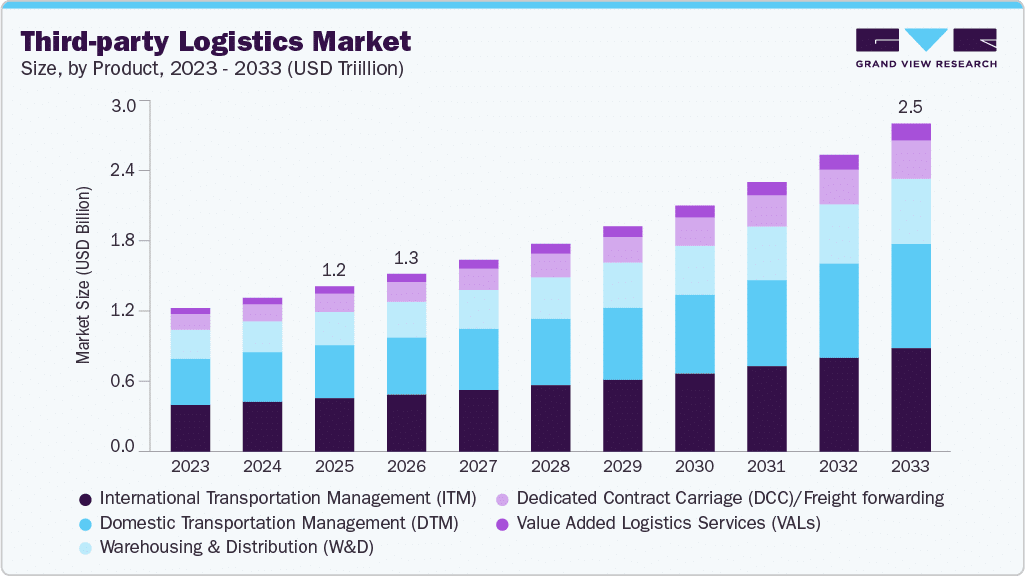
The market is huge and varied. But you cannot underestimate the value of a global or local 3PL.
Some focus on startups with flexible minimums and easy 3PL integration. Others handle larger volumes and/or regulated products. Ultimately, finding the right match depends on your catalog and order patterns. Not to mention where you want to be in a year.
Is Your Business Ready for Professional Order Fulfillment Services?
Take our 3-minute assessment to discover if partnering with a fulfillment service could help scale your business.
Storage Solutions
Optimize your inventory management
Scale Operations
Support your business growth
Save Time
Focus on core business activities
Improve Accuracy
Enhance customer satisfaction
Takes 3 minutes • Get instant results • Free analysis
Business Metrics
Assessment Questions (1-4)
Assessment Questions (5-8)
Assessment Results
Signs It’s Time To Switch to a 3PL
There’s no magic number, but certain patterns repeat.
- Your orders are getting more complex. Bundles, seasonal spikes, wholesale orders, and multi-SKU packages. They turn simple workflows into daily puzzles.
- You’re out of room. When you’re dodging pallets to reach the coffee maker, something needs to change.
- Customer expectations have shifted. Three- to five-day ground shipping used to be fine. Now people expect faster delivery and real-time tracking. And when you can’t deliver, they let you know in the reviews.
- You’re stuck in the weeds. If your best ideas sit on the back burner because you’re printing labels all afternoon, that’s a real cost even if it never shows up on your P&L.
Wade O’Shea, Founder of BusCharter.com.au, understands how logistics complexity increases as operations scale. While his company focuses on transport services, the same operational pressure applies to fulfillment.
O’Shea explains, “As volume increases, logistics becomes less about moving items and more about managing systems and expectations. Delays and inefficiencies start to compound, especially when processes aren’t built to scale.”
He adds, “That’s usually the tipping point: when businesses realize they need structured support. Bringing in a 3PL helps create consistency in delivery and frees up time to focus on growth instead of daily operations.”
Key Benefits and Possible Challenges of Moving to a 3PL
Pros
A good 3PL expands what you can do almost immediately.
- Capacity grows with you. Peak season and promotions don’t require signing a new lease or hiring temps. You also get better shipping options: more carriers, smarter rate shopping, faster delivery through multi-node networks. That speed translates to happier customers and more repeat purchases.
- Technology is a big piece. Real-time inventory visibility, automated reorder points, lot tracking, and integrations with Shopify, WooCommerce, and marketplaces. These tools would cost a fortune to build yourself. If you’ve oversold during a weekend rush because your spreadsheet was outdated, you’ll appreciate the upgrade.
- Returns matter more than people think. Processing them quickly keeps revenue from getting stuck in limbo and lets you restock what’s resellable. The National Retail Federation (NRF) reported that US retailers handled $743 billion in returns in 2023, with a return rate of 14.5%. Even a small improvement in handling returns adds up.

Image source: Generated by the author via ChatGPT
Learn from Jesse White, General Manager at Balance Point Heating, Cooling & Plumbing. He has his fair share of experience working with a 3PL provider.
White says, “3PLs give you capabilities garage operations can’t match. Multiple carriers, automated tracking, same-day fulfillment across the country. That shows up in customer satisfaction and margins.”
He adds, “A strong 3PL doesn’t just speed up fulfillment. It removes operational drag across your entire business. That shift lets founders focus on growth instead of daily logistics fires.”
Cons
- The biggest hurdle is cost. You’ll add new line items: receiving fees, storage, pick/pack, packaging materials, account management. But you’re usually swapping chaotic variable costs for predictable ones. Model both scenarios, and don’t forget to value your time.
- Choosing the right partner is harder than it looks. Not every 3PL fits every business. Mismatches usually show up in service levels, tech integration, or communication. The transition takes planning. You’re moving inventory, mapping SKUs, integrating systems, and training your support team on new SLAs. Don’t try to flip the switch overnight.
Take it from Adrian Iorga, Founder and President of Stairhopper Movers. While he recognizes the benefits of working with a 3PL partner, he understands the challenges that come with it.
Iorga suggests, “Start by mapping your current process, then work backward from your go-live date. Budget for overlap. Tell customers what’s changing. Test everything. Proper planning saves you months of headaches.”
He recommends a few practical tips:
- Run a pilot first. Send a subset of SKUs or one region to test workflows.
- Communicate early and often. Let customers know you’ve upgraded fulfillment.
- Keep safety stock. Hold a buffer at the 3PL until you trust the data sync.
Fulfillment with a Personal Touch.
See How Using a 3PL like eFulfillment Service sellers saves time. Get a Free Quote from eFulfillment Service Today!
How To Choose the Right 3PL Partner
- Start with fit. You want a provider that works with businesses like yours (similar size, category, order profile, etc). Ask about their experience with your specific needs: average units per order, seasonality, subscription boxes, fragile items, wholesale routing. Plus, factor in the 3PL costs, so you can save up.
- Technology helps big time. Look for native integrations with your sales channels, real-time inventory tracking, transparent billing, and an easy-to-use portal. Request a demo environment so your team can test-drive it.
- People and processes matter. They are just as important as software. Meet your account manager. Ask how they handle exceptions (shipping delays, carrier problems, damaged inventory, etc.). Get references from similar brands and actually call them.
For example:
Imagine you are a manufacturing supplier working with an electrical contractor in St. Louis, MO. Your orders may include mixed SKUs, such as wiring components and replacement parts. They need to be delivered in precise combinations within specific timelines.
In this case, a strong 3PL would not only need accurate multi-SKU picking but also reliable tracking and coordination with job-site delivery schedules. If the provider can’t handle that level of operational detail, it becomes a bottleneck instead of a solution.
The best 3PL fits your current needs but also supports growth. Look beyond pricing. Check their tech stack, integrations, track record, and all. A provider that grows with you becomes an asset, not just a vendor.
Questions to ask your shortlist:
- What SLAs do you commit to for receiving, pick/pack, and same-day cutoffs?
- Which carriers and service levels do you support? How do you rate-shop?
- How do you manage inventory accuracy and cycle counts?
- What does onboarding look like (think timeline, data mapping, testing, etc.)?
- How do you handle returns and value-added services like kitting or custom packaging?
- What are your minimums, pricing model, and policies on annual increases?
FAQs:
Can a business switch back to garage shipping after using a 3PL?
Yes. Some brands bring fulfillment back in-house for specific product lines, local markets, or to protect margins. It takes work and planning, but it's doable if you have realistic expectations about capacity.
What are the cost implications of using a 3PL?
You'll pay for storage, receiving, pick/pack, materials, shipping, and sometimes account fees. Compare these to your true in-house costs. Your time, space, packing supplies, labor, and the growth opportunities you're missing. Many brands find that the total cost per order remains similar or even improves when they factor in faster delivery, greater accuracy, and fewer customer service issues.
How long does it typically take to transition to a 3PL?
Plan on a few weeks to a couple of months, depending on how many SKUs you have, what integrations you need, and how your inbound freight works. Build in time for data mapping, test orders, and running both systems in parallel so you can catch problems before going all in.
Summary
Garage shipping has launched many great brands. It’s personal, scrappy, and it works…until it doesn’t. On the flip side, a 3PL can give you the scale, speed, structure, and systems to keep customers happy while freeing up your time for what actually grows the business.
To get started, watch the signals and run the numbers. Likewise, talk to your partners early. With all these crucial steps, you can ultimately make the switch on your terms, rather than in the middle of a crisis!
That said, consider leveraging eFulfillment Service as your 3PL partner. They can help with your e-commerce operations, from order processing to warehousing to shipping returns. To get started, request a free quote today!

About the Author
Brooke Webber is a passionate advocate for a people-first strategy in HR. Her major focus areas are workplace psychology and employee listening, where she has already accumulated five years of writing experience.
0 Comments