
Ever get an email from a supplier that says “your cargo is delayed,” then your forwarder says “your shipment is booked,” then your 3PL asks for “shipment details”?
Same products. Three different words. And if you use the wrong one in the wrong place, you can end up with messy tracking, confusing paperwork, or a claim that drags on longer than it should.
This guide keeps it simple: what each term means, when sellers use it, and where the wording actually matters.
Cargo vs. Shipment: The TLDR

Cargo = the goods as a load.
Think: what’s sitting in the container, on the plane, or in the trailer.
Shipment = one specific move of goods.
Think: a booked move with a tracking number, reference number, and paperwork trail.
Cargo vs. shipment comparison table (tracking, paperwork, liability)
|
Question |
What you’re pointing at |
Use this word |
|
“What’s on the ship/plane?” |
The loaded goods (often consolidated) |
Cargo |
|
“What has the tracking number?” |
One booked move with an ID |
Shipment |
|
“What did customs clear?” |
A specific entry tied to invoice docs |
Shipment |
|
“What got damaged?” |
The physical goods |
Cargo (common in claims language) |
What Is Cargo in Shipping? Definition, Container Types, and Examples

Cargo is the physical payload. Think “what’s loaded and carried.”
For ecommerce sellers, you’ll see “cargo” most often in these spots:
1) Ocean and air contexts
- Ocean: “cargo vessel,” “marine cargo,” containers, manifests.
- Air: “air cargo” as the industry term, with ULDs (Unit Load Devices) used to group goods on aircraft.
2) Container language (real specs)
A lot of “cargo” talk turns into container talk:
- 20-foot container (TEU)
- 40-foot container (FEU)
When carriers plan space, they often think in containers and weight, not your Shopify order numbers.
3) Cargo types you might hear on supplier calls
You don’t need a maritime degree, but these might come up:
- Containerized cargo: goods loaded into standard containers.
- Break-bulk cargo: oversized items that can’t fit containers (machinery, coils, lumber).
- Bulk cargo: loose commodity (grain, coal, liquids) measured by ton, not “boxes.”
What Is a Shipment? Definition, Tracking IDs, and Seller Use Cases

A shipment is the order movement as a unit, tied to an ID (tracking number, PRO, house bill, etc.).
Even if your products are still sitting on a shelf, a shipment can “exist” once it’s booked in a system.
Shipment lifecycle: booking to POD
This is the version sellers actually care about:
- Booking: space is reserved; a record is created.
- Pack + label: weight, dimensions, piece count get locked in.
- Main transit: your shipment may be grouped with others as carrier cargo.
- Arrival + breakdown: consolidated loads get split back out.
- Final delivery: POD closes it out.
Parcel vs freight shipments (the 150 lb cutoff)
A common cutoff you’ll hear:
- Parcel shipment: typically under 150 lbs in carrier networks.
- Freight shipment: pallets/crates moving via LTL or FTL.
Is Your Business Ready for Professional Order Fulfillment Services?
Take our 3-minute assessment to discover if partnering with a fulfillment service could help scale your business.
Storage Solutions
Optimize your inventory management
Scale Operations
Support your business growth
Save Time
Focus on core business activities
Improve Accuracy
Enhance customer satisfaction
Takes 3 minutes • Get instant results • Free analysis
Business Metrics
Assessment Questions (1-4)
Assessment Questions (5-8)
Assessment Results
Cargo vs. Shipment Examples: 3 Real Ecommerce Scenarios (Imports, 3PL, DTC)

Example A: You import 2 pallets from a supplier (ocean)
- Your supplier books one shipment (their order movement).
- The forwarder may consolidate it into a container with other customers.
- The ocean carrier treats the container as cargo on the vessel.
Example B: You ship 400 DTC orders in a day
- Each package is a shipment with its own tracking number.
- The truck leaving your 3PL is carrying freight (US term), while you still refer to each order as a shipment.
Example C: Customs hold happens
Customs usually reviews the shipment-level docs (invoice, HTS code entry per shipment), not “the whole vessel’s cargo as one blob.”
Fulfillment with a Personal Touch.
See How Using a 3PL like eFulfillment Service sellers saves time. Get a Free Quote from eFulfillment Service Today!
Freight vs Cargo vs Shipment: Simple Definitions for Sellers
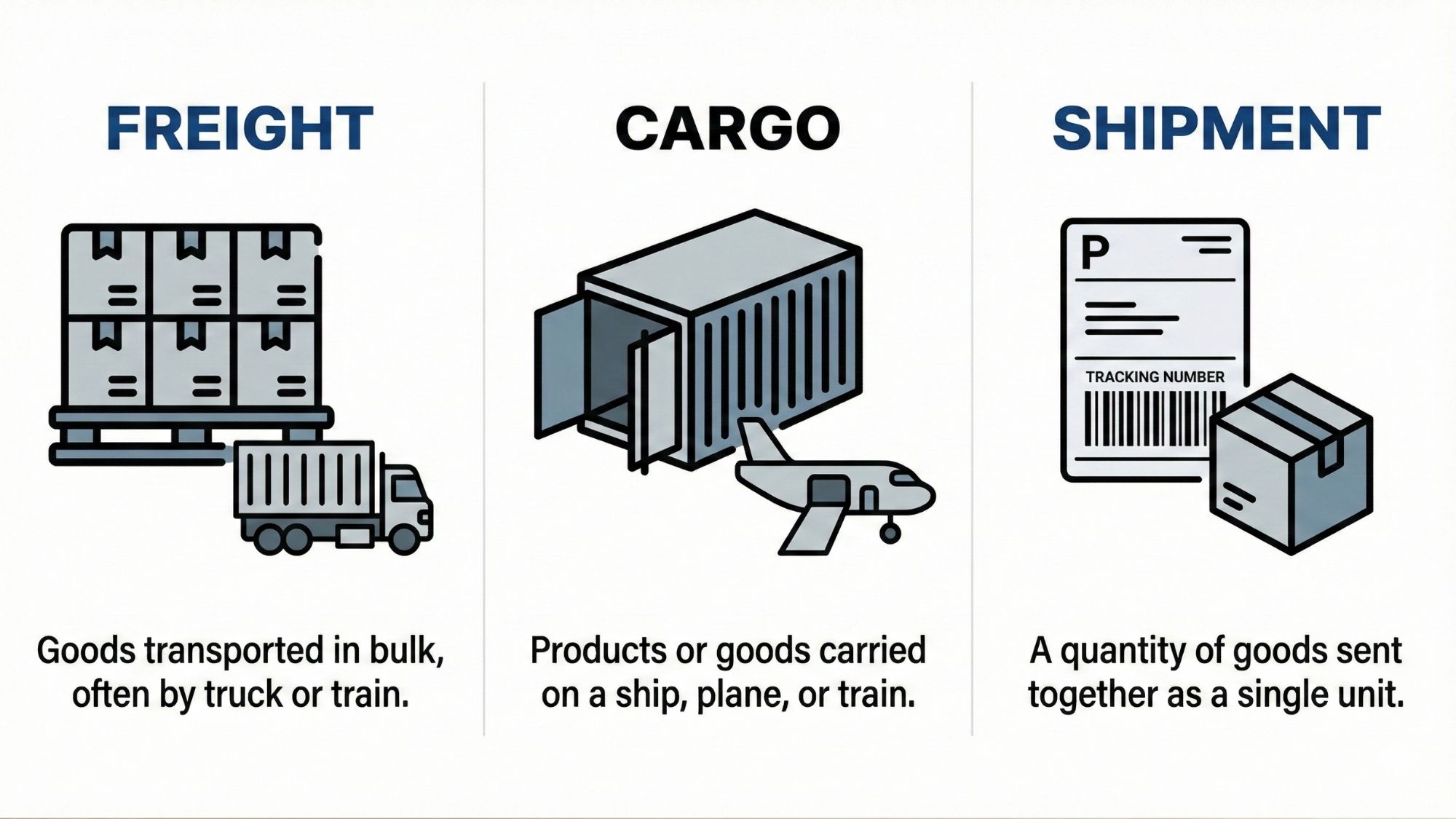
| Term | What it usually points to | Where you’ll see it |
| Freight | Land transport and/or transport charges | LTL/FTL quotes, freight bills |
| Consignment | Custody + who it’s addressed to | Delivery docs; receiver details |
| Parcel | Small package shipments | UPS/FedEx/DHL flows |
| Drayage | Short-haul container moves near ports/ramps | Port to warehouse container moves |
Shipping Paperwork Where “Cargo” vs “Shipment” Matters (Bills, Claims, Incoterms)
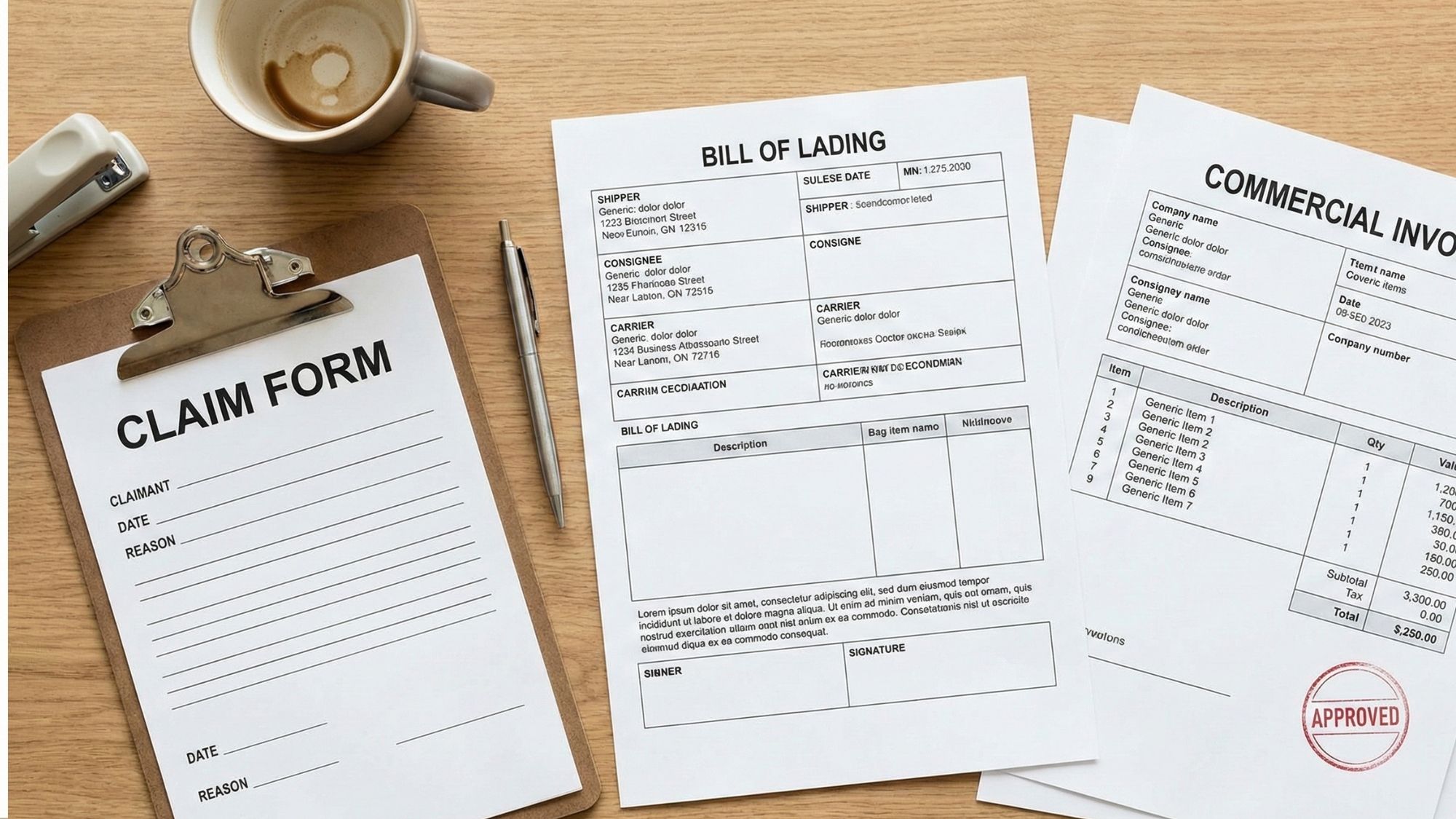
1) Bill of Lading vs Waybill (big difference)
A Bill of Lading can act as:
- Receipt for the cargo
- Contract for the shipment
- Document of title (ownership control)
A waybill is often just the shipment contract piece, not the ownership lever.
2) Incoterms: who pays vs who carries risk
Some terms separate “who pays for the move” from “who carries the risk once handed to the first carrier.”
Also: using FOB for containerized goods is a common mistake; FCA is often the cleaner fit in container workflows.
3) Common doc mistakes that cause delays (and fees)
A few real ones worth taping to your monitor:
|
Mistake |
What happens |
|
Writing a vague description like “Parts” |
Cargo gets flagged; shipment delivery slips |
|
Weight mix-up (gross vs net) |
Carrier fees or SOLAS VGM issues |
|
Wrong Incoterm on docs |
Big coverage gaps if something is lost |
|
Outdated or wrong HTS code |
Entry rejected; storage fees stack up |
Cargo vs. Shipment Checklist: Which Term Should You Use?
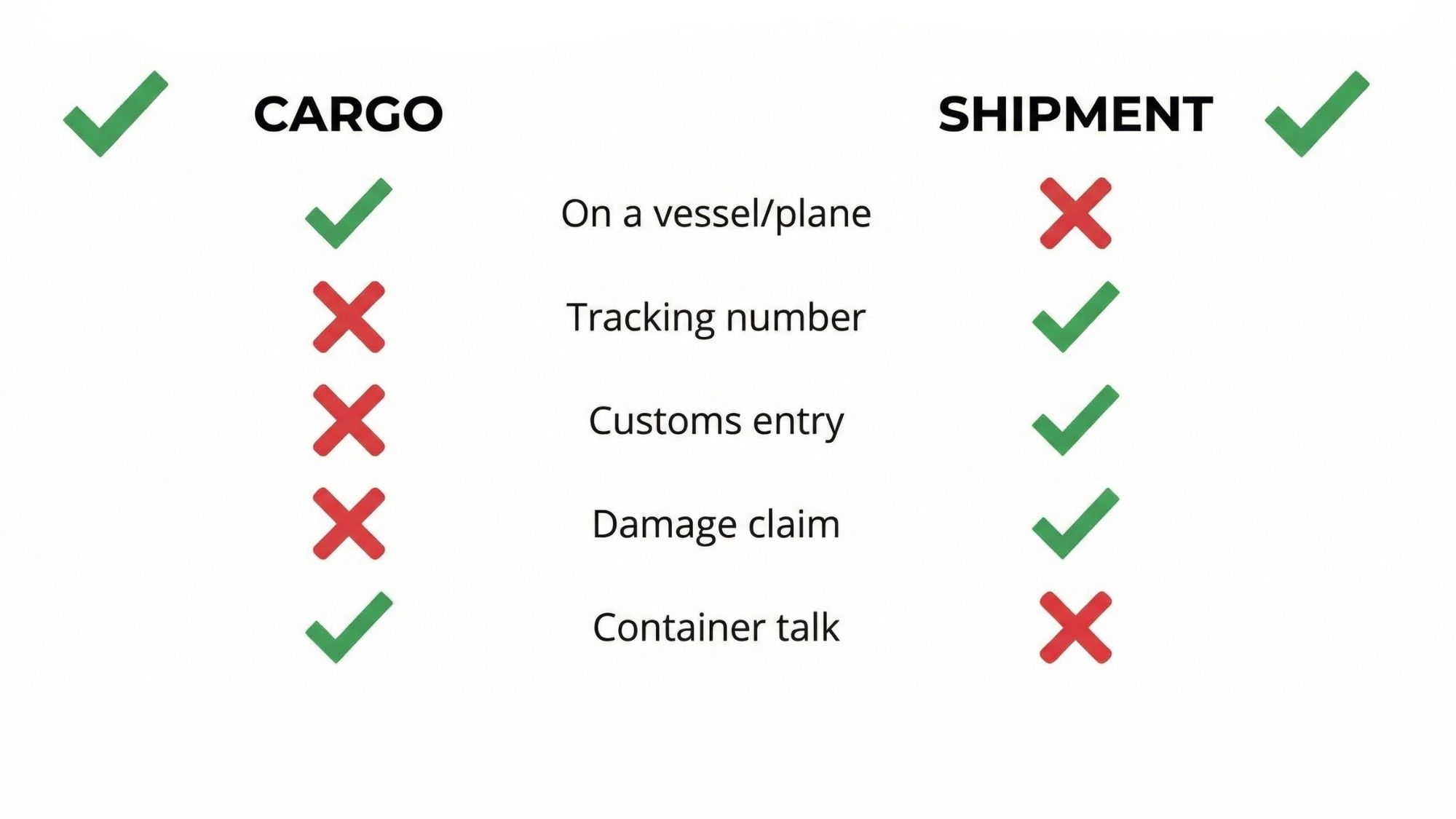
Use shipment if you’re talking about:
- A tracking number
- One customer order
- One bill/waybill
- Customs entry tied to an invoice
Use cargo if you’re talking about:
- Goods loaded on a vessel or aircraft
- Containers (20-foot, 40-foot)
- Consolidated loads or manifests
Fast “sanity check” questions
- Can I count it? “3 shipments.”
- Is it sitting in a hold/container as part of a bigger load? “cargo.”
- Is there one buyer/receiver tied to it with a tracking ID? “shipment.”
Cargo vs. Shipment Summary + Next Step for Sellers
If you remember one line, make it this:
- Cargo = the goods as a load.
- Shipment = the specific order movement (plus its IDs and docs).
Next step: pick one internal standard and stick to it in your SOPs. Use “shipment” in customer-facing ops (tracking, order support). Use “cargo” in inbound freight convos (containers, ocean/air moves). It cuts back on email ping-pong and quote confusion fast.



0 Comments