

The first time a video does two million views overnight, and you wake up to 4,000 orders you cannot ship, you learn something no course teaches: the hard part of selling physical products on social platforms was never the selling.
It’s everything after.
Most creator brands are built backwards. Audience first, product second, operations around month four when the complaints start. That works fine at a hundred orders a month.
What separates the brands that survive their second year is unglamorous: inventory sizing, fulfillment model, returns, compliance, liability, and attribution. That’s what this article covers.
The Order Doesn’t Start at Checkout
It starts about six weeks earlier, in a comment section, and if you’re not reading that signal, you’re forecasting blind.
Every creator brand that has scaled well treats engagement data as inventory data. Saves on a product-teaser video predict order volume better than likes do, and comments asking about a specific colorway predict that colorway’s sell-through with unsettling accuracy.
What to actually track before you commit to a PO:
- Saves and shares per view, not raw view count. A video with 400k views and 900 saves converts differently than one with 400k views and 90 saves.
- Named-variant comments. Count them. If 60% of colorway questions are about the sage green, don’t order equal quantities of four colorways because the supplier’s MOQ made it convenient.
- Waitlist-to-email conversion, tracked per traffic source. A waitlist filled from Instagram Stories behaves nothing like one filled from a TikTok in your bio.
- Repeat commenter overlap across your last three product-adjacent posts. These are your day-one buyers, and they’re worth counting individually.
The pre-order question
Pre-orders solve your cash flow problem and create your reputation problem. Both are real.
If you run them, cap the window hard, fourteen days maximum, and put the actual ship date in the checkout flow, not the FAQ.
The brands that get destroyed on pre-orders are the ones that shipped late and had communicated a date nobody could find in writing.
Inventory Math for People Who Sell in Spikes
Traditional retail forecasting assumes a curve. Creator commerce has a cliff followed by a plateau followed by another cliff whenever the algorithm decides to resurface something you posted in March.
Buffer stock is not a percentage
The standard advice, hold 20% buffer, is retail advice written for businesses with predictable demand. It’s actively wrong here.
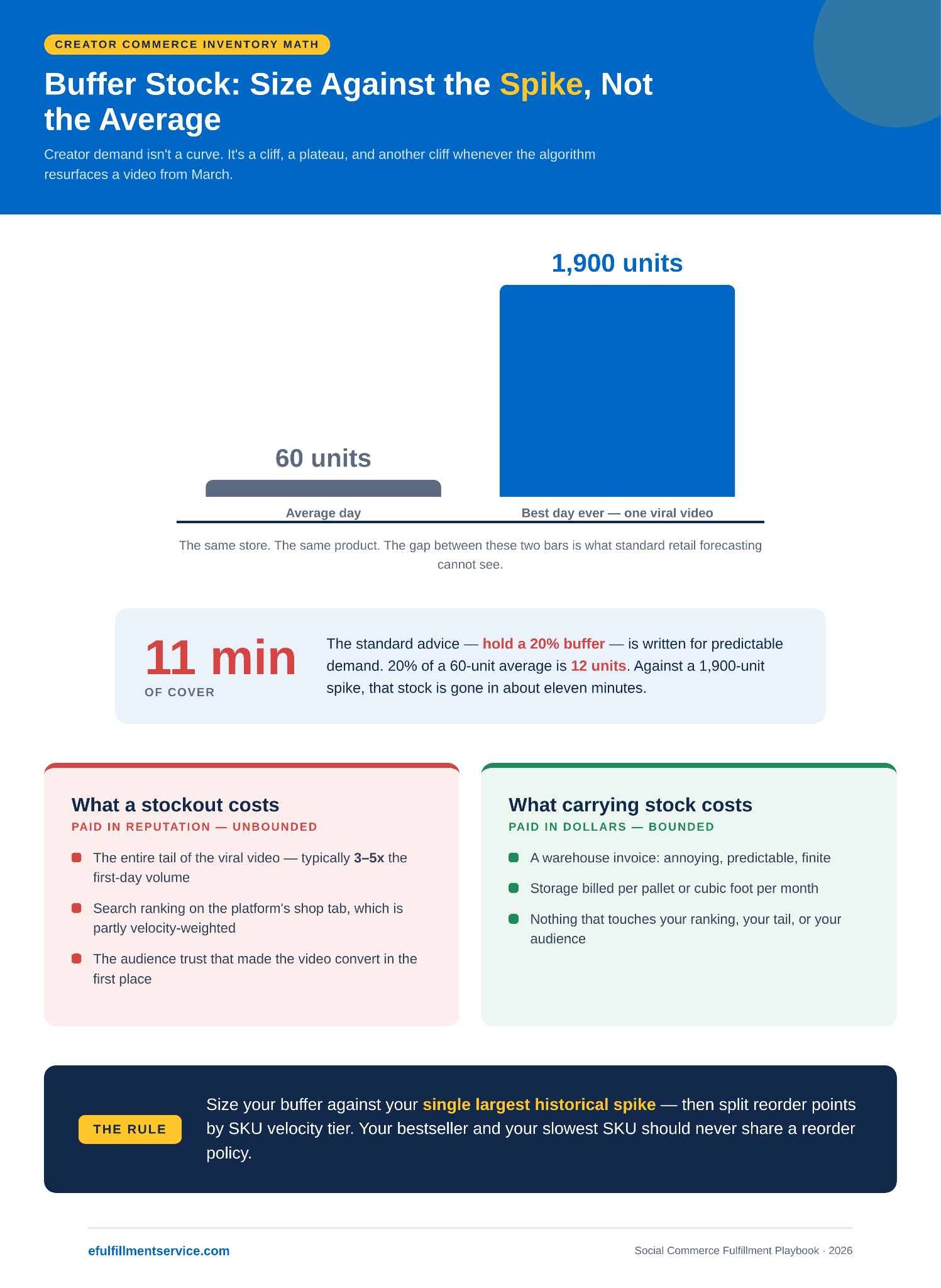
What you want instead is buffer sized against your single largest historical spike, not your average. If your best day ever moved 1,900 units and your average day moves 60, holding 20% of average gets you twelve units of cover. You will run out in about eleven minutes.
Size against the spike. Accept the carrying cost. The carrying cost is cheaper than the stockout, and this is not close:
- A stockout on a viral video costs you the entire tail of that video, which is typically 3–5x the first-day volume
- It costs you the search ranking on the platform’s shop tab, which is partly velocity-weighted
- It costs you the audience trust that made the video convert in the first place
- Carrying cost, meanwhile, is a warehouse invoice, annoying, bounded, and paid in dollars rather than in reputation
Lead time is the number that kills you
Everything upstream of your warehouse runs on lead time you don’t control.
Overseas manufacturing at 45-90 days, ocean freight at 30-45, customs clearance at whatever customs feels like that week.
So the real planning horizon isn’t “how much do I need.” It’s “what did I need to have ordered four months ago based on a video I hadn’t posted yet.”
That’s an uncomfortable position, and the only genuine mitigations are dull ones: dual-sourcing your top three SKUs, keeping a domestic backup supplier at a worse unit price for emergency runs, and holding safety stock at a forward warehouse rather than in transit.
Split your reorder points by SKU velocity tier. Your top SKU and your slowest SKU should not share a reorder policy.
Most brands discover this the month they’re simultaneously out of their bestseller and sitting on 4,000 units of a product nobody wanted.
Fulfillment with a Personal Touch.
See How Using a 3PL like eFulfillment Service sellers saves time. Get a Free Quote from eFulfillment Service Today!
Fulfillment Models
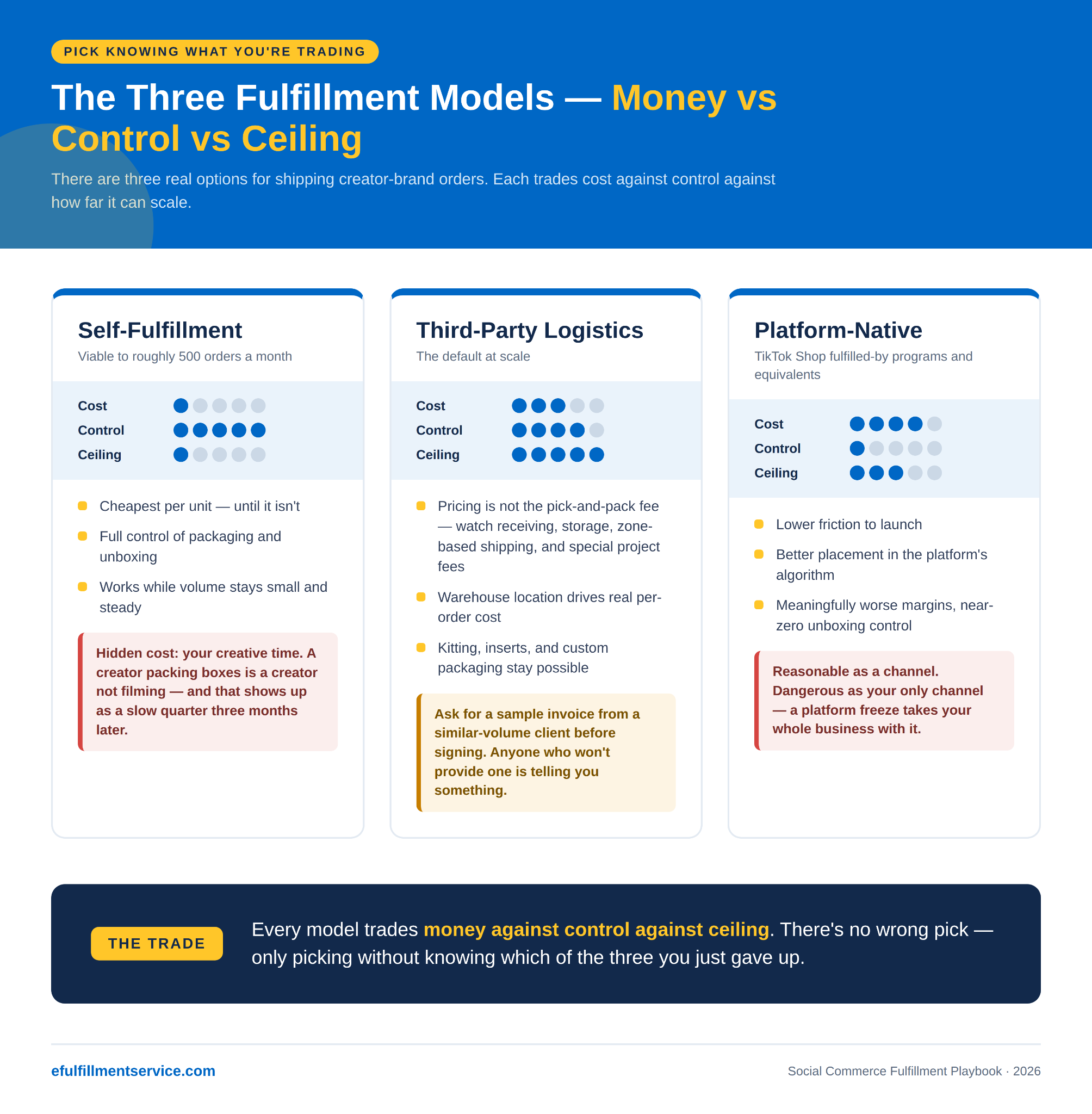
There are three real options. Each model trades money against control against ceiling. Pick knowing which you’re trading.
Self-fulfillment
Cheapest per unit until it isn’t. Viable to roughly 500 orders a month if you or someone you employ can physically do it.
The hidden cost is your time, and specifically your creative time, the thing that generates the demand in the first place. A creator packing boxes on Sunday is a creator not filming, and the revenue impact of that is invisible on any P&L. It shows up three months later as a slow quarter.
Third-party logistics
The default at scale, and the thing to understand is that 3PL pricing is not really about the pick-and-pack fee. It’s about:
- Receiving fees charged per pallet or per unit, and per-unit receiving on a 10,000-unit inbound will surprise you
- Storage, billed per pallet or cubic foot per month, which is where slow SKUs quietly bleed you
- Zone-based shipping, where warehouse location matters enormously. A single East Coast warehouse serving a West Coast-heavy audience adds real cost to every order
- Special project fees for anything non-standard, which for creator brands is most things: kitting, inserts, signed cards, custom packaging
Ask for a sample invoice from an existing client of similar volume before signing. Anyone who won’t provide one is telling you something.
Platform-native fulfillment
TikTok Shop’s fulfilled-by programs and equivalents. Lower friction, better placement in the algorithm, meaningfully worse margins and near-zero control over the unboxing experience.
Reasonable as a channel. Dangerous as your only channel.
The Categories That Will Get You Frozen
Some product categories carry compliance weight that has nothing to do with whether your product is good, and creator brands walk into this constantly because the platform lets you list before it tells you no.
Supplements, skincare with active ingredients, anything ingestible, anything making a performance claim. The rules differ by platform and by jurisdiction, and they change without much notice.
Ryan Beattie, Director of Business Development at UK SARMs, works across a research compound catalogue where labelling and distribution requirements govern every shipment.
He says, “Creators launching into the UK almost always underestimate what the labelling side demands, because they’ve only ever operated under US rules where the bar sits lower.
If you’re shipping into multiple markets, your compliance floor is set by the strictest country you deliver to, not the one your business is registered in. That catches people out after they’ve already printed 5,000 labels.”
Practical version:
- Get your claims reviewed before your product page goes live, not after a takedown
- Keep certificates of analysis accessible for every batch, not just the first one
- Assume any before/after imagery in your ad creative will be scrutinised harder than the product page itself
- Have a second sales channel that doesn’t depend on the platform that might freeze you
Returns Are a Fulfillment Problem, Not a Customer Service One
Retailers processed $890 billion in returns in 2024, about 16.9% of total sales. For apparel and for anything bought impulsively off a video, the real number runs higher.
Creator commerce has a specific return profile: high impulse, low research, high expectation gap. Someone who buys after ninety seconds of watching has formed a picture of the product that your product may not match.
That’s a structural feature of the channel, and you should price returns into your unit economics from day one rather than treating each one as a failure.
The operational fix is mostly upstream. Better sizing data, more honest video, dimensional references in the content itself.
A creator who films the product next to a hand or a standard object cuts size-related returns noticeably, and it costs nothing.
Downstream, decide early what happens to returned units. Restock, liquidate, or write off, pick per SKU and automate the decision, because the default of “figure it out later” produces a corner of your warehouse full of unsellable inventory you’re paying storage on.
When a Product Actually Hurts Someone
You are a manufacturer in the eyes of the law, or close enough to it, even if you’ve never touched the production line.
Private-label means your name is on the liability. A skincare product that causes a reaction, a supplement with a contaminated batch, a piece of equipment that fails under load, the claim lands on you, not the factory in Shenzhen.
In the UK, claimants harmed by a product have well-established routes through personal injury and, where subsequent clinical treatment made things worse, through medical negligence claims that can run alongside the product claim. In the US, product liability varies by state, and the exposure is often larger. Neither system cares that you’re a creator rather than a corporation.
As businesses grow, they often rely on specialists across different legal disciplines. Commercial contracts, intellectual property, and family law each address very different issues, making it important to seek advice that’s appropriate to the situation.
What this means operationally:
- Product liability insurance sized to your category, in place before your first sale, not after your first incident
- Batch traceability: you need to be able to identify every unit from a given production run and reach the customers who bought them
- A recall plan that exists in writing, including how you’d contact buyers across every channel you sell on
- Supplier indemnification in your manufacturing agreement, which is worth exactly as much as the supplier’s ability to pay
Most creator brands have none of these. Most creator brands are fine, right up until they aren’t.
Attribution After the Sale
Here’s the thing that breaks in creator commerce specifically: the sale and the demand generation are separated by so many steps that most attribution models give up.
Someone sees a TikTok, doesn’t buy, searches your brand three days later, lands on your site through organic, and converts. Every dashboard you own credits organic search. The video that actually did the work shows a 0.4% conversion rate, and you kill it.
For brands where a meaningful share of orders come in by phone, the gap widens further, and call tracking software closes the part of it that web analytics structurally cannot. Assigning dynamic numbers to your social placements is unglamorous, and it recovers attribution that would otherwise vanish.
Post-purchase surveys are the other half. One question at checkout: where did you first hear about us, with a free text field. Noisy, self-reported, imperfect, and still more accurate than your last-click model for this channel.
The Unglamorous Infrastructure
SKU naming conventions. Barcode assignment. A single source of truth for inventory across every channel you sell on.
Nobody wants to spend a week on this. Everyone who didn’t spend a month later untangling why their TikTok Shop inventory says 200 and their Shopify says 40 and the warehouse has 12.
Set the conventions before you have SKUs to name. Sequential, human-readable, category-prefixed, rather than whatever your supplier’s internal code happens to be.
What to Do in the Next Thirty Days
Pull your last six months of order data and find your single biggest day. Multiply it by three. That’s your spike planning number, and if your current buffer stock can’t absorb it, that’s the first thing to fix.
If the answer to the spike question is that you can’t absorb it, that’s the point where fulfillment stops being a cost line and starts being the thing that determines whether the next viral video makes you money or makes you a cautionary thread.
eFulfillment Service works with creator and influencer brands at exactly that threshold, with no minimums, no setup fees, and no long-term contracts, which matters when your volume is spiky by design.

About the Author
Jesse Galanis is a professional writer whose aim is to make complex concepts easy to understand. He strives to provide quality content that assists people in everyday life.



0 Comments