
You’re closing out last month’s numbers and the shipping line is off. You pull up the postage report, sort by cost per package, and there it is: a stack of routine backlist orders, the kind you fulfill on autopilot, went out Priority Mail. Books that weigh a pound and a half, wrapped and taped, ship at a cost that can consume or exceed the margin on the sale.
When you set up your store and printed your first label, Media Mail likely wasn’t part of the onboarding. Media Mail can move books for meaningfully less than Priority Mail, but most new sellers either don’t know it’s there or are using it wrong.
This guide covers what qualifies for Media Mail, what doesn’t, how the rate compares to your other shipping options, and the mistakes that get sellers’ accounts flagged. It’s one detail within the larger fulfillment operation most new booksellers are building from scratch.
Already know you need a book-specialist 3PL?
eFulfillment Service has shipped millions of books for indie authors, small presses, and subscription boxes with ISBN-level inventory tracking, Media Mail routing, and street date enforcement built in.
What Media Mail actually is
Media Mail is a USPS shipping class created for educational and informational materials. USPS designed it for a specific content category, and sellers who treat it as a general discount class risk misclassification penalties. It grew out of a decades-old “Book Rate” predecessor, and the pricing logic has remained largely the same since: media that spreads information should cost less to move through the mail than a package of arbitrary retail goods.
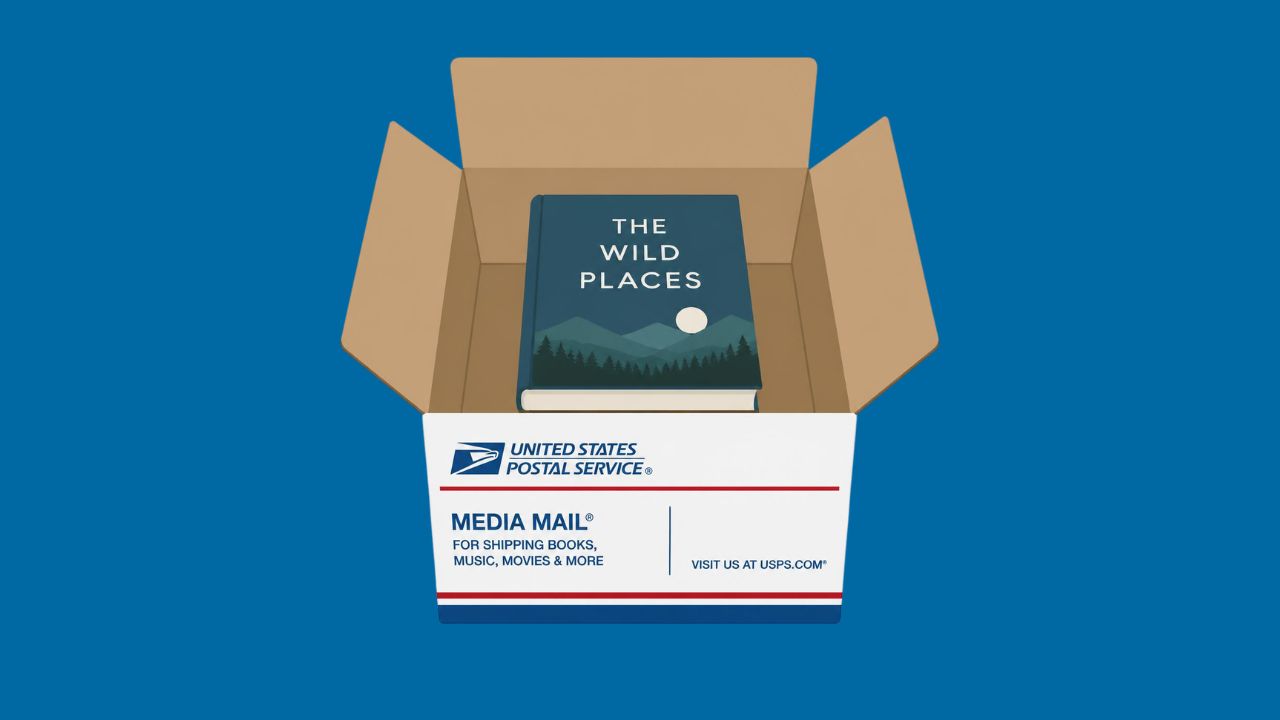
That history matters because it explains the restrictions. USPS ties the discount to a specific category of item, not to any package that happens to contain a book, and it actively polices that line.
For a bookseller, the practical version is simple: if what you’re shipping is a book, and only a book (plus a few narrowly defined companion items), it likely qualifies. If it’s a book bundled with anything else, such as merchandise, a promotional item, or a small gift stapled or taped in, the whole package may not qualify.
What actually qualifies for Media Mail
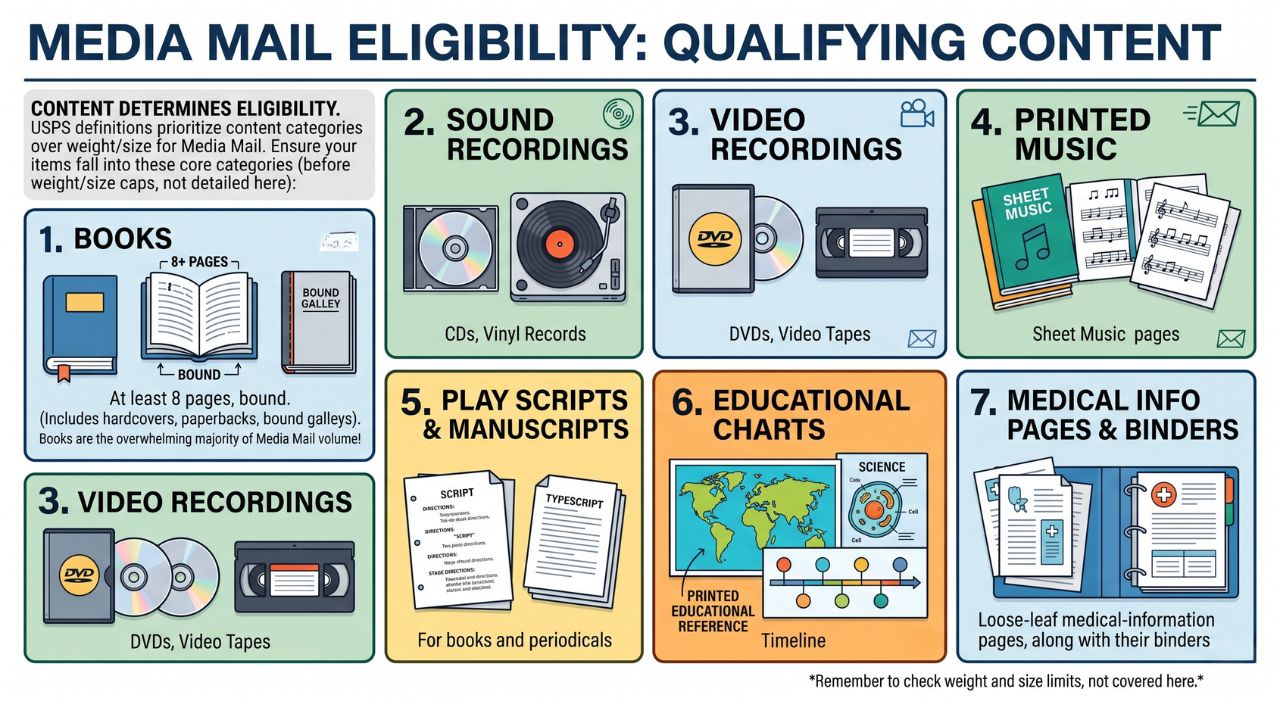
USPS defines Media Mail eligibility by content category first, ahead of weight or size. A package still has to fall under Media Mail’s own weight and size caps, covered later in this guide, but content is what determines whether it’s allowed to use the class at all. The core eligible categories:
- Books (at least 8 pages, bound)
- Sound recordings: CDs, vinyl records
- Video recordings: DVDs, video tapes
- Printed music
- Play scripts and manuscripts for books and periodicals
- Printed educational reference charts
- Loose-leaf medical-information pages, along with their binders
Books are the overwhelming majority of Media Mail volume, and for a bookseller that’s the whole point. Hardcovers, paperbacks, and bound galleys all qualify on their own.
The gray areas that trip sellers up
A few categories sit right on the line, and getting them wrong is where most Media Mail problems start:
| Item | Media Mail eligible? |
|---|---|
| Paperback or hardcover book, no extras | Yes |
| Book + bookmark (paper, flat) | Generally yes |
| Book + signed bookplate (paper insert) | Generally yes |
| Book + enamel pin, sticker sheet, or other merchandise | No — disqualifies the package |
| Audiobook on CD | Yes |
| Journal or notebook (blank pages, no text) | No — not informational content |
| Advertising material included in the package | No |
| E-reader, tablet, or any electronic device | No |
The rule of thumb: flat paper inserts that are part of the book experience (bookplates, bookmarks) are usually fine. Anything three-dimensional, or anything that functions as merchandise rather than reading material, is not.
Save Time and Let us Handle Your Book Fulfillment!
See How Using a 3PL for saves Amazon sellers time. Get a Free Quote from eFulfillment Service Today!
What disqualifies a shipment from Media Mail

This is where special editions get expensive. If your special edition includes a book plus an enamel pin, a printed art card, and a signed bookplate, that package is no longer eligible for Media Mail rates as a whole. USPS treats the entire package by its most restrictive content: one disqualifying item disqualifies the box.
Sellers who want to include both handle it by mailing the merchandise separately, in a small envelope alongside the Media Mail book package, timed to arrive together. That’s the correct approach: two compliant packages instead of one non-compliant one. The tradeoff is packing labor and postage overhead that need to be priced into the special edition.
Special editions are also where multi-SKU kitting complexity turns into an operational problem. Getting the right pin into the right envelope, matched to the right book, matched to the right customer, at volume, is a process problem before it’s a postage problem.
USPS can open your package
Because Media Mail eligibility is content-based, USPS retains the right to open and inspect Media Mail packages to confirm what’s inside. USPS inspects individual retail shipments infrequently, but it does happen, especially on packages that look heavier or bulkier than a typical book parcel.
If a package is opened and found to contain ineligible content, USPS can charge the sender the difference between the Media Mail rate paid and the correct-class rate, sometimes with an additional penalty. For a seller shipping at volume, an audit of even a handful of misclassified packages can result in a substantial additional charge.
Shipping special editions without the Media Mail guesswork
If your book releases regularly include bonus items, kitting them correctly and mailing them compliantly is exactly the kind of detail eFulfillment Service handles for author and publisher clients every day.
Media Mail vs. your other shipping options

Media Mail’s appeal is cost, but cost isn’t the only variable that matters when you’re promising readers a delivery window.
| Shipping method | Typical transit time | Cost for a 1-lb book | Best for |
|---|---|---|---|
| Media Mail | 2–10 business days (no guarantee) | Lowest of standard USPS options | Backlist orders, no rush |
| USPS Ground Advantage | 2–5 business days | Moderate | General retail orders, any content |
| USPS Priority Mail | 1–3 business days | Highest of the three | New releases, launch-week orders, time-sensitive gifts |
Media Mail’s transit window is the tradeoff most sellers underestimate. USPS does not guarantee a delivery date on Media Mail, and packages can occasionally take longer than the stated range, particularly around holidays or regional mail volume spikes. A reader who pre-ordered for a specific release date and receives a ‘still in transit’ update a week later will leave a negative review regardless of what your stated delivery window said at checkout.
Ground Advantage carries no content restrictions, so it can ship a book alongside merchandise in the same box, and it lands in a similar delivery window to Media Mail in many cases, for a rate that is frequently comparable to Media Mail on standard book weights. It’s worth comparing both on your package weight before defaulting to Media Mail out of habit, and a broader look at how booksellers choose between shipping methods covers the tradeoffs beyond just Media Mail.
When Media Mail is the right call
Media Mail fits a specific slice of your order volume. The rest of your orders need a different shipping call.

Good fit for Media Mail:
- Backlist orders with no delivery-date promise attached
- Book club or subscription shipments where the customer already expects a mail-class delay
- International readers ordering domestically-fulfilled backlist, since Media Mail can cover the U.S. leg of that shipment even though the class itself never crosses the border
- Bulk orders to schools or reading groups where speed isn’t the deciding factor
Poor fit for Media Mail:
- Launch week pre-orders where readers are watching a release date
- Kickstarter or crowdfunding reward fulfillment with a promised delivery window
- Special editions bundled with any non-paper item
- Any order where a customer has paid for expedited shipping
The order that should never go Media Mail
If a customer selects and pays for faster shipping at checkout, and the package ships Media Mail anyway to save on postage, that’s a service failure the customer will notice, and that reader will leave a negative review about delivery speed, and the book’s quality will not prevent it.
Efficiency Tip: Partnering with an 3PL can free up your time to focus on what you do best, sell great products!
Get a Free Quote from eFulfillment Service and see how we can simplify your selling!
How to actually use Media Mail correctly
- Confirm a SKU’s content eligibility before it ships, rather than after a customer complains. If a SKU includes any merchandise, flag it as ineligible in your shipping rules so it never defaults to Media Mail automatically.
- Set customer expectations at checkout. If Media Mail is your standard shipping option, say so, and give a realistic delivery window rather than a specific date.
- Weigh and measure accurately. Media Mail has its own weight and size limits separate from other USPS classes; packages exceeding them get rejected or re-rated at the counter or by your shipping software.
- Separate merchandise from book shipments when a special edition includes both, rather than combining them into one non-compliant package.
- Reserve a faster class for anything time-promised, including pre-orders and any order where the customer paid for speed.
Sellers doing this by hand, order by order, are the ones most likely to make a costly mistake during a launch week rush. It’s the same manual-process ceiling that eventually pushes self-published authors selling direct toward a fulfillment partner in the first place. A fulfillment partner with book-specific experience applies these rules automatically at the point of pack-and-ship, so the eligibility check happens before the label prints instead of after a package gets flagged.
eFulfillment Service is built specifically for books.
We handle ISBN-level pick accuracy, USPS Media Mail optimization, damage-protective packaging, and street date embargoes all from one warehouse. Trusted by independent publishers and authors nationwide.
FAQs: USPS Media Mail
Does Media Mail work for international orders?
No. Media Mail is a domestic-only USPS class. International book shipments need a different mail class, and there's no single figure that captures how much more international shipping costs, since it swings too widely by country and weight to generalize.
Can I ship an audiobook on a USB drive via Media Mail?
Flash storage doesn't qualify. The eligible sound-recording formats are physical media like CDs and vinyl; A USB drive is classified as an electronic storage device regardless of its contents and does not qualify.
Will USPS catch a misclassified package?
USPS doesn't inspect every package, but it reserves the right to open Media Mail parcels, and packages that look heavier or bulkier than a typical book parcel draw more attention. The financial risk comes from a pattern getting flagged across your account, not from the odds on any single package. There's no published figure on inspection rates, so treat this as a real but hard-to-quantify risk rather than a fixed percentage.
Is Media Mail cheaper than Ground Advantage for every book?
Not always. At certain weights, particularly for lighter single-book orders, the cost difference between Media Mail and Ground Advantage can be small enough that the faster, restriction-free option is worth choosing instead. Compare both on your package weights rather than assuming Media Mail always wins.
Can I combine a book order with promotional postcards or bookmarks?
Flat paper items like bookmarks and postcards are generally fine alongside a book. Anything beyond flat paper, such as pins or small objects, moves the package out of Media Mail eligibility.
What happens if my Media Mail package gets rejected at the counter?
It depends on the post office and the reason for rejection. Sometimes it's re-rated to a compliant class on the spot; sometimes it's returned to sender. Either way, it costs you time and, often, a second postage payment. Getting eligibility right before the package reaches the counter avoids the problem entirely.
Key Takeaways
- Media Mail is content-restricted more than weight-restricted. It covers books, physical sound and video recordings, and printed music, but not merchandise, electronics, or blank journals.
- One disqualifying item disqualifies the whole package. A book bundled with an enamel pin or sticker sheet loses Media Mail eligibility entirely, even though the book itself would qualify alone.
- USPS can open and inspect Media Mail packages. Misclassification risk carries genuine cost exposure at volume, beyond the odds on any one package.
- There’s no delivery guarantee. Media Mail typically takes 2 to 10 days, but USPS sets no fixed cap, so it’s wrong for any order where a customer is expecting a specific delivery date.
- Mail bonus items separately when they don’t qualify. Combining a book with merchandise in one package voids Media Mail eligibility for the whole box, so pack and ship them apart instead.
- The cost gap versus Ground Advantage varies by weight. Check both rates on your package rather than defaulting to Media Mail out of habit.



0 Comments