
You publish an $18 paperback on Amazon and walk away with roughly $6.20 after printing costs (~$4.60) and Amazon’s cut. Sell that same book from your own website and you keep $13 or more.
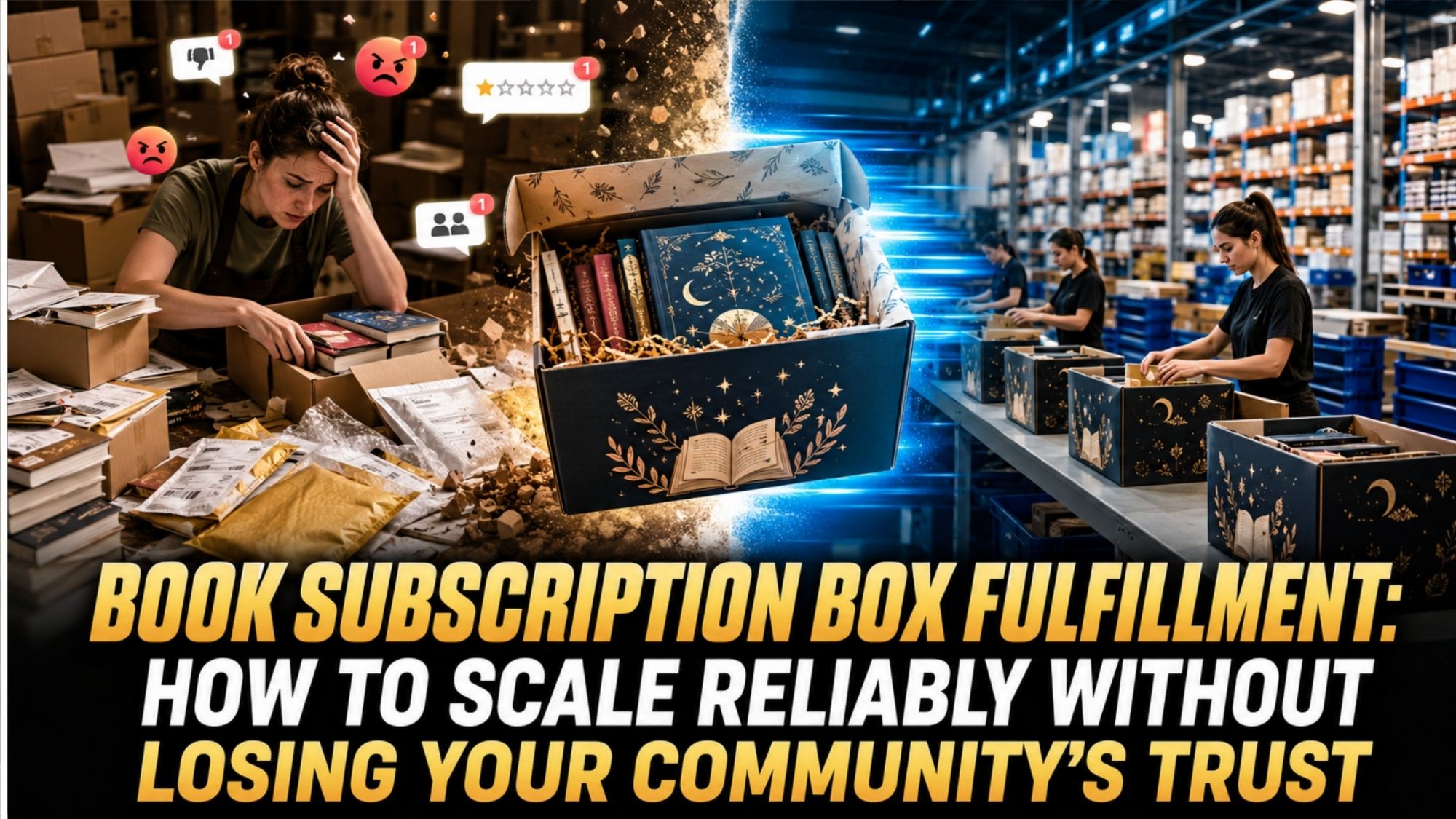
A subscriber posts in your Discord at 9pm on a Tuesday: “Got my box but the insert has someone else’s name on it.” Within twenty minutes, forty people have replied. Half are checking their own boxes. Three are asking if it’s a spoiler. One has already emailed you. That moment — when a single packing error becomes a community event — is what makes book subscription box fulfillment categorically different from any other ecommerce operation.
You didn’t start this to run a warehouse. You started it because you love books, you know how to build a reading community, and you wanted to put something beautiful in subscribers’ hands every month. But somewhere between 100 and 200 subscribers, the Sunday packing sessions stopped feeling sustainable. The bubble mailers multiplied. The insert spreadsheet got complicated. And the curation work — the part that actually makes your box worth subscribing to — started happening at midnight, if at all.
The global book subscription box market is growing from $737M in 2025 to $1.58B by 2032 at 11.8% CAGR, driven heavily by BookTok. The opportunity is real and accelerating. But so are the stakes of getting fulfillment wrong.
The sections below cover where DIY book subscription box fulfillment breaks down, what professional fulfillment actually involves, and how to make the outsourcing decision without losing the handcrafted, community-rooted identity that makes your box worth subscribing to.
Selling direct comes down to three paths: ship orders yourself from home (DIY), use a print-on-demand platform, or hand fulfillment off to a third-party warehouse (3PL). Each has a different cost, time commitment, and ceiling. This guide covers all three, plus how to build your store, price your book, and drive traffic to it.
Already know you need a book-specialist 3PL?
eFulfillment Service has shipped millions of books for indie authors, small presses, and subscription boxes with ISBN-level inventory tracking, Media Mail routing, and street date enforcement built in.
Why book box fulfillment breaks down faster than you expect

The 150-subscriber wall: when weekends stop being enough
At 75 subscribers, packing night is kind of fun. You put on a playlist, maybe a friend helps, and you’re done in a few hours. At 150 subscribers, that same night takes twice as long — but it’s not just the volume. It’s the decisions. Did this subscriber get the standard insert or the collector’s edition card? Is this the address that had a failed delivery last month? Did you remember to hold the box for the subscriber who’s traveling?
Every edge case you’re managing manually is a tax on your time and your error rate. At 150 boxes, you have enough edge cases to make every pack night feel like controlled chaos.
Kitting complexity doesn’t scale linearly — it compounds
A standard 7-item book box isn’t 7 tasks. It’s 7 items multiplied by the number of variations you offer, multiplied by the number of special requests you’ve said yes to, multiplied by the probability of one item arriving short from a supplier. Subscription box kitting complexity doesn’t scale with volume, it scales faster than volume.
Add a single personalization tier (readers vs. non-readers edition, for example) and you’ve just doubled your sorting logic. Add a second tier and you’re running a small warehouse operation out of a space that was never designed for it.
The hidden cost: hours spent packing are hours not spent on curation
The author partnership you’ve been meaning to pitch. The annotated edition you want to negotiate. The Discord event you keep pushing back because you don’t have the bandwidth to plan it.
Those aren’t optional extras. They’re the reason your subscribers chose your curated book box over a bigger competitor. Every hour you spend on fulfillment is an hour you’re not spending on the part of the business only you can do.

When a fulfillment mistake becomes a community trust problem
Subscription box churn averages 12.71% monthly — the highest among all physical subscription categories. In most ecommerce categories, a shipping mistake costs you one customer. In a book subscription community, it costs you a conversation thread that 400 people read before you’ve even seen the original complaint.
The churn risk isn’t just the subscriber who got the wrong insert. It’s the six subscribers who saw the post, started questioning whether their box was right, and quietly reconsidered their subscription at the next billing cycle. Book subscription box fulfillment errors don’t resolve quietly. They become community events.
How fulfillment failures directly drive churn in book subscription boxes
Fulfillment reliability directly impacts churn in book subscription boxes because late or incorrect shipments don’t just disappoint one subscriber — they disrupt a shared reading experience. When boxes arrive out of sync with a community reading event or BookTok moment, subscribers lose the social reason to stay subscribed. A single bad ship cycle can trigger a wave of cancellations visible to your entire community before you have a chance to respond.

The churn math: what one bad ship cycle actually costs
At 500 subscribers with 12.71% monthly churn, you’re already losing roughly 63 subscribers every month in a normal cycle. Now add a ship cycle where 10% of boxes go out five days late. Some of those subscribers were already on the fence. The delayed box is the deciding factor.
If even 20 extra subscribers cancel that month (4% above your baseline) and your box is priced at $35/month, that’s $700 in recurring monthly revenue lost from a single operational failure. Over a year, that’s $8,400 from one bad month of fulfillment.
Book communities are different: spoilers, embargoes, and shared reading windows matter
A book subscription community isn’t just a customer list. It’s a group of people who chose your curation and then agreed to read together. When your featured title has a street date and your boxes arrive a week late, subscribers miss the live annotation challenge. They’re excluded from the “first reaction” thread. They feel behind — and being behind is a reason to cancel.
This is unique to book boxes. A candle subscription that ships late is annoying. A book subscription that ships late during a community reading sprint is a broken promise.
Save Time and Let us Handle Your Book Fulfillment!
See How Using a 3PL for saves Amazon sellers time. Get a Free Quote from eFulfillment Service Today!
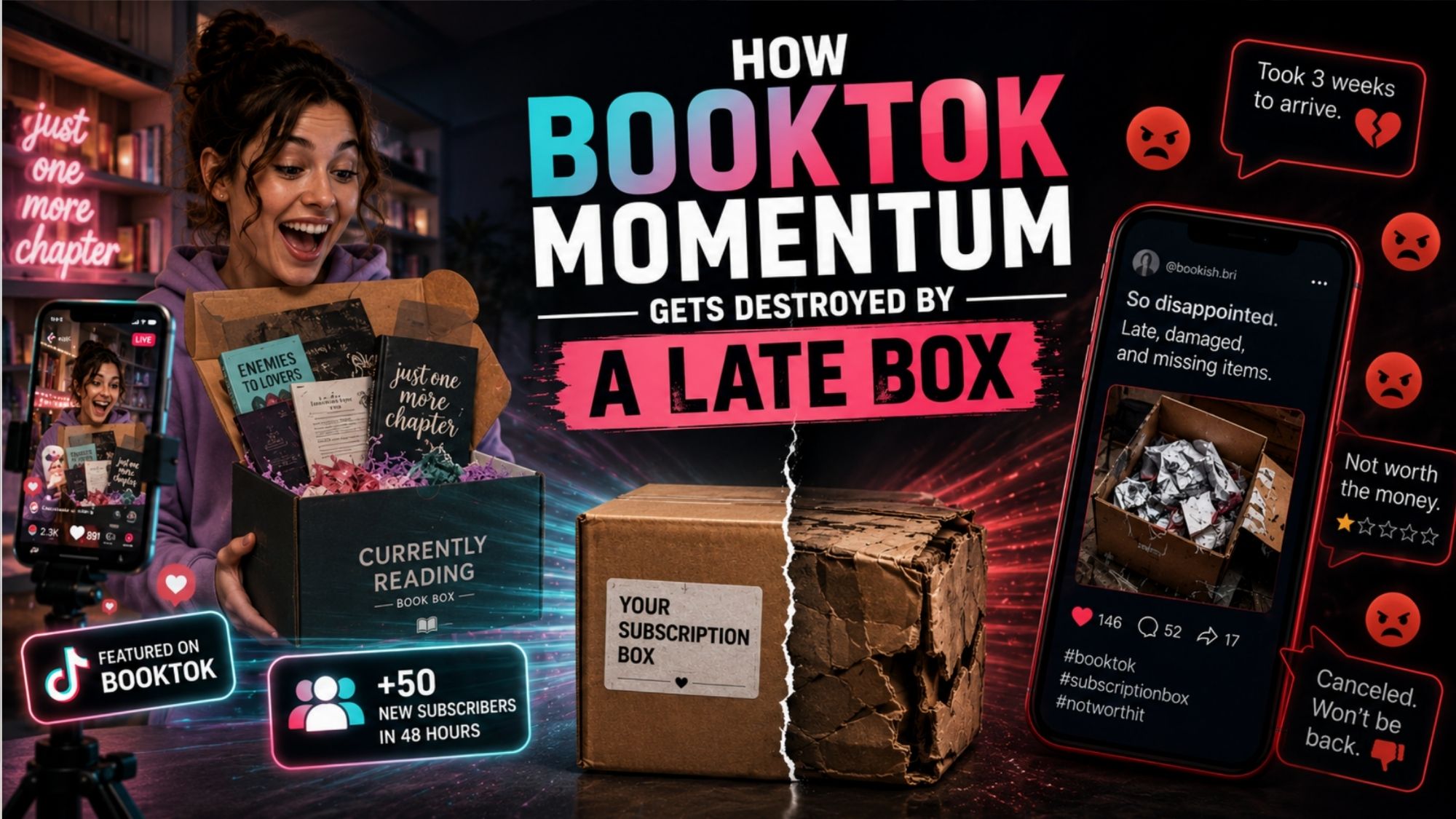
How BookTok momentum gets destroyed by a late box
The book subscription box market is growing at 11.8% CAGR driven heavily by BookTok. A BookTok creator features your box, posts an unboxing, and 50 new subscribers sign up in 48 hours. Those subscribers are primed. They’re excited. They came in through a hype cycle.
If their first box arrives late, damaged, or incomplete, they don’t just cancel quietly. They post. And the same platform that drove them to you is the platform where their disappointment will live.
The subscriber who almost canceled vs. the one who already did
There are two categories of at-risk subscribers after a bad ship cycle: the one who almost canceled and the one who did. The first group is recoverable — with a proactive communication, a discount on next month, a genuine apology. The second group is gone, and some percentage of them have already told people about it.
The gap between those two outcomes is almost always fulfillment speed. How fast did you know about the problem? How fast did you communicate? How fast did you fix it? A 3PL with proper tracking and error reporting gives you faster answers to all three questions than a DIY operation where you’re personally packing boxes and hoping nothing went wrong.
Shipping more than 50 orders a month from your garage?
That’s the point where most publishers find a 3PL pays for itself. eFulfillment Service offers simple, transparent per-order pricing with no long-term contracts, so you can make the switch without the risk.
The anatomy of a book subscription box fulfillment operation
Most book box operators don’t have a clear picture of what their fulfillment operation actually involves until something breaks. Here’s the full process, mapped out.

Step 1: Receiving and storing books and ancillary items
Inventory arrives from multiple suppliers — the featured book from the publisher, the custom candle from an indie maker, the print from an artist, the enamel pin from a manufacturer. These don’t arrive at the same time, and they don’t arrive in quantities that are exactly right.
Receiving means checking quantities against purchase orders, identifying damaged units, and flagging short shipments before they become a packing-night problem. Storage means organized, trackable inventory — not boxes stacked in a hallway.
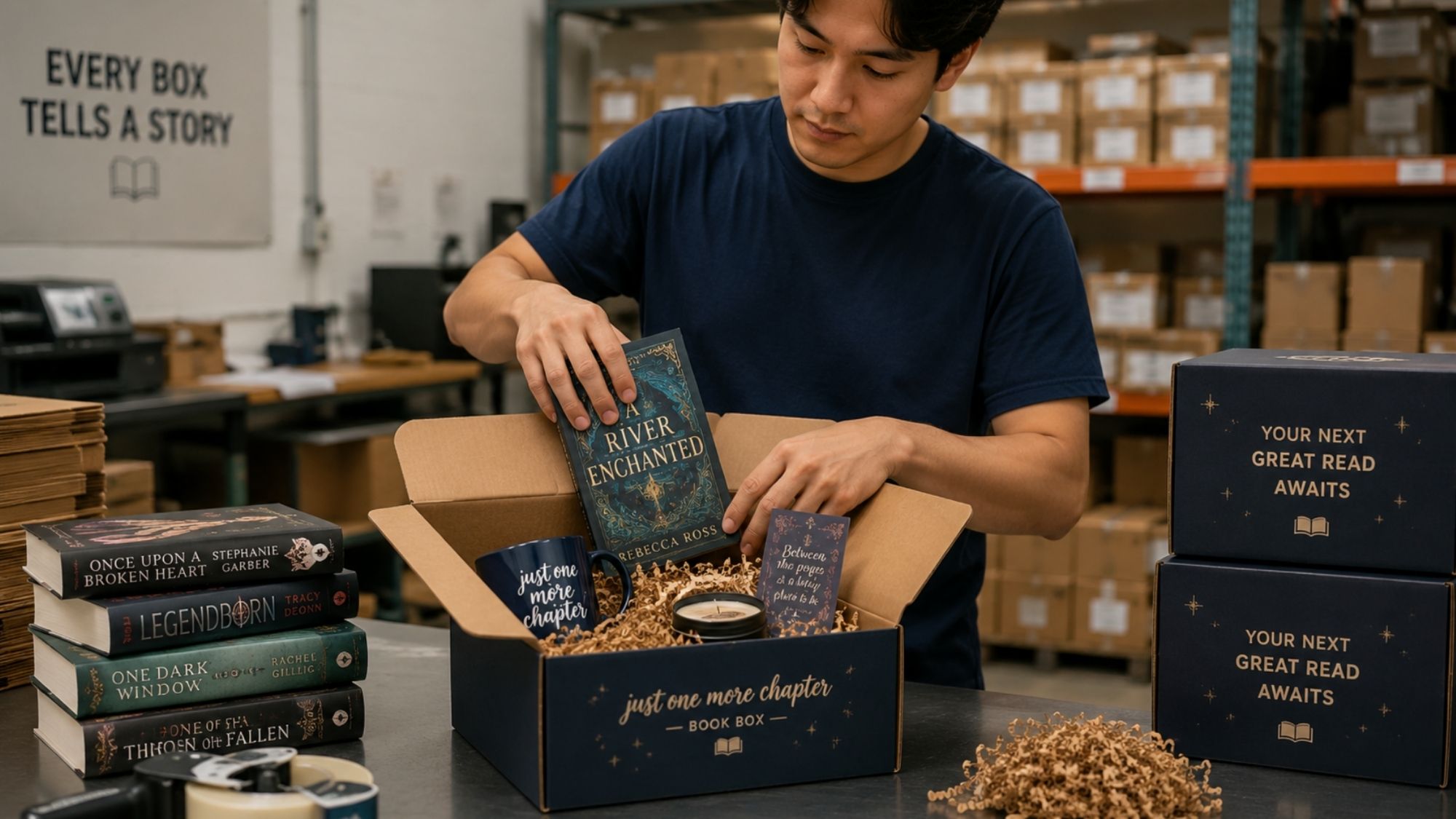
Step 2: Kitting — assembling a 6–8 item box at scale without errors
Subscription box kitting is the process of assembling individual components into a finished, shippable unit. For a 7-item curated book box, that means pulling the correct items for each subscriber tier, assembling in the right order (presentation matters for unboxing), inserting the right personalized materials, and sealing and labeling without errors.
At 500 boxes, a 1% error rate means 5 wrong boxes — five subscribers posting in Discord about incorrect contents, five individual customer service conversations, five potential cancellations. Error rate management is not a luxury. It’s math.
Efficiency Tip: Partnering with an 3PL can free up your time to focus on what you do best, sell great products!
Get a Free Quote from eFulfillment Service and see how we can simplify your selling!
Step 3: Managing publisher embargoes and coordinating ship windows
When your featured title has a street date of the 15th and your ship window opens the 12th, your 3PL needs a clear protocol for holding inventory and releasing on your timeline — not theirs. Publisher embargoes are a real operational constraint that generic 3PLs don’t think about and subscription-specialist fulfillment partners account for by default.
This means your fulfillment partner needs to receive the book, store it, and hold it until your authorized release date, then execute the full kitting and ship-out within your target window. That coordination requires communication systems that most DIY operations don’t have.

Step 4: Custom inserts, author letters, and personalization at volume
The author letter, the curator’s note, the reading guide, the personalized message for a subscriber’s anniversary month — these are the elements that make your box feel like a curated book box rather than a product shipment.
At scale, these need to be designed for assembly, not spontaneity. That means standardized insert formats, pre-sorted personalization materials, and clear assembly instructions that a fulfillment team can execute without your direct oversight on every box.
Step 5: Outbound shipping — carrier selection, tracking, and delivery confirmation
Outbound subscription box shipping involves selecting the right carrier and service level for your timeline and budget, generating tracking numbers, and confirming delivery. A box that shipped is not a box that arrived.
Your fulfillment operation needs to be able to answer “where is this subscriber’s box?” at any moment. In a community where subscribers talk to each other, that question will come up publicly.
DIY fulfillment vs. 3PL for subscription boxes: an honest comparison
Handing off packing feels like losing control. That feeling is real, and it’s worth naming. You’ve been the person who touched every box. You know exactly how the tissue paper sits, how the note reads, how it smells when it’s right. Outsourcing that feels like a compromise.
But what you’re actually weighing isn’t control versus no control. It’s constrained growth versus designed growth. Here’s the honest comparison.

What DIY fulfillment actually costs at 200, 500, and 1,000 subscribers
At 200 subscribers with a 7-item box, assume 3 hours of pack time per 100 boxes. That’s 6 hours of packing per cycle, plus receiving, sorting, labeling, and shipping coordination. Call it 10–12 hours per month of pure fulfillment labor, not counting the hours you spent managing supplier deliveries and handling errors.
At 500 subscribers, that same math becomes 25–30 hours. At 1,000 subscribers, you’re looking at a part-time job’s worth of fulfillment labor before you’ve hired anyone, rented space, or accounted for the months when something goes wrong.
The pricing model matters as much as the headline rate. Generic 3PLs that price per-pick treat a 7-item book box as 7 separate line items — one charge per individual item pulled. Subscription-specialist 3PLs quote a single per-kit rate for the fully assembled box. Operators consistently underestimate this distinction and experience sticker shock when comparing quotes from the wrong type of provider.

What you give up when you hand off packing (and what you get back)
You give up direct, hands-on control of each box. You give up spontaneous last-minute additions. You give up the option to re-pack on instinct.
You get back the hours. The curation. The author relationships. The Discord events you keep postponing. The newsletter you write at midnight because it’s the only time left. Outsourcing fulfillment doesn’t make your box less yours — it makes the part that is yours more possible.
When a 3PL makes financial sense for a book box operator
The tipping point is different for every operator, but the math generally starts to favor a subscription-specialist 3PL around 200–300 subscribers when you factor in your own time at a realistic hourly rate. Most operators undervalue their own time until they price it honestly.
If you’re spending 15 hours a month on fulfillment and you value that time at $50/hour, that’s $750/month in opportunity cost. Request a per-kit quote from a subscription-specialist 3PL and run that number against your current time investment — most operators are surprised by how close the math already is, before accounting for error reduction and scalability.
The hybrid model: what to outsource first
If full outsourcing feels premature, start with the physical kitting and outbound shipping. Maintain your receiving and inventory management locally until you’re confident in the 3PL relationship. Then migrate receiving.
The key is not to wait for a crisis to make the decision. The operators who transition smoothly are the ones who evaluated 3PL options before they needed one.
|
Criteria |
DIY |
Generic 3PL |
Subscription-Specialist 3PL |
|
Cost per kit (7-item box) |
Labor + materials |
Higher (per-pick model) |
Lower (per-kit model) |
|
Time demand on operator |
High (15–30+ hrs/month) |
Low |
Low |
|
Error rate |
Variable, often undocumented |
Low |
Low with kit-specific QC |
|
Scalability |
Hits wall at ~200–300 subs |
Scalable but costly |
Scalable and cost-efficient |
|
Curation flexibility |
Full control |
Limited accommodation |
Designed for customization |
|
Embargo/timing handling |
Manual, ad hoc |
Unlikely to accommodate |
Typically supported |
eFulfillment Service is built specifically for books.
We handle ISBN-level pick accuracy, USPS Media Mail optimization, damage-protective packaging, and street date embargoes all from one warehouse. Trusted by independent publishers and authors nationwide.
What to look for in a book subscription box fulfillment partner

Subscription-native kitting vs. generic pick-and-pack: why it matters
A generic 3PL is optimized for high-volume, low-variation ecommerce: pull one item, pack it, ship it. A subscription-native operation is built for multi-item assembly with variation — different tiers, personalized inserts, specific assembly sequences, and spoiler-sensitive timing. These are fundamentally different operational skills.
Ask any 3PL you evaluate: “Do you quote subscription assembly as a per-kit rate or per-pick?” If they can’t give you a per-kit rate, they’re not built for subscription box kitting and assembly. That’s a hard stop.
Flexibility for embargo dates, ship-window coordination, and rush cycles
Your 3PL needs to be able to receive inventory, hold it against an embargo date, and execute a full kitting run within a tight ship window. Ask specifically: “How do you handle inventory that can’t be kitted until a specific release date?” A partner who has done this before will have a clear answer. A partner who hasn’t will pause.
No minimums and contract flexibility: why this matters under 1,000 subscribers
At 300 subscribers, you cannot commit to monthly volume minimums that assume your operation is already at 1,000. A fulfillment partner that charges for minimums you haven’t hit yet is a partner that punishes your growth stage. At this scale, you need pay-as-you-go pricing and the ability to scale up or pull back without penalty.
How to evaluate a 3PL’s error rate and damage handling
Ask for documented error rates. Ask what happens when a box is incorrectly assembled and the subscriber reports it: who absorbs the cost of reshipment? Ask how they handle books that arrive damaged from the publisher. These are not hypotheticals. They will happen. How a 3PL answers them tells you everything.
Questions to ask every 3PL before you sign
- Do you quote subscription assembly per-kit or per-pick?
- What is your documented kitting error rate?
- Can you hold inventory against an embargo or street date?
- What are your minimums, and what happens in months I fall below them?
- Do you have experience with book subscription boxes specifically, or general ecommerce?
- How do you handle damaged inbound inventory before I’ve seen it?
- What does your subscriber-level tracking look like — can I see individual box delivery confirmation?
- What is your onboarding process for communicating assembly instructions and brand standards?
If you want a starting point that checks most of these boxes for indie operators, eFulfillmentService is worth a look: no minimums, pay-as-you-go pricing, no long-term contracts, and direct experience with subscription box kitting. It’s built for the 300-subscriber operator the same way it works for the 1,500-subscriber operator.
Scaling book subscription box fulfillment without losing your handcrafted feel

What “handcrafted feel” actually means to subscribers (and what it doesn’t)
Your subscribers don’t know whether you packed the box yourself. They don’t know if your hands touched the tissue paper. What they know is whether it felt considered — whether the book was wrapped with intention, whether the note felt personal, whether the objects inside had a coherent point of view.
Handcrafted feel is not about who assembled the box. It’s about whether the box expresses a curatorial intelligence. That intelligence is yours. It travels through your instructions, your designs, your insert copy, your selection of every item. A 3PL executes your vision. They don’t replace it.
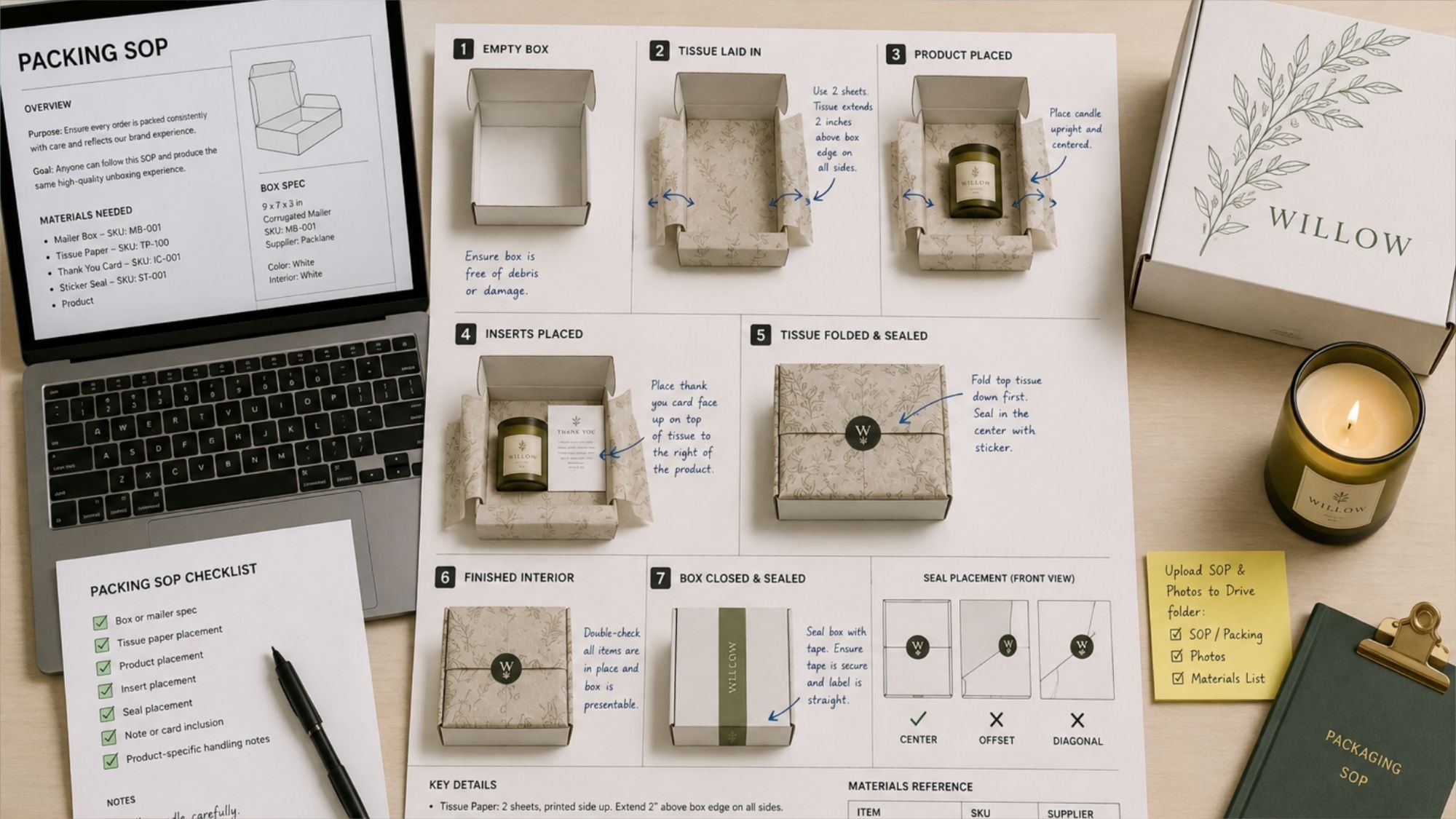
Designing your unboxing experience so it survives the handoff
The unboxing experience needs to be documented before it can be replicated. That means:
- A written assembly sequence
- A visual guide showing item placement
- Specified tissue colors and folding method
- A clear description of the finished state
This documentation protects your curated book box identity regardless of who is physically doing the assembly. Think of it like a recipe: the chef who created it doesn’t have to be in the kitchen every time for the dish to taste right.
Author letters, custom inserts, and personal touches at 1,000 boxes
An author letter pre-printed on branded stock with a signature facsimile is not a compromise — it’s a design decision. At 1,000 boxes, a handwritten note from you is not possible, but a letter that reads like you wrote it, formatted beautifully and inserted in the right position, is absolutely achievable.
Work with your 3PL to establish an insert management system: pre-sorted by subscriber tier, clearly labeled, and included in the kitting instructions as a required component — not an afterthought.
How to brief a 3PL on brand standards without writing a 40-page manual
A one-page visual brand brief and a 5-minute video walkthrough of your ideal assembled box will communicate more than any written document. Show them what right looks like. Show them one or two examples of wrong. Establish a review box protocol: the first 10 boxes of every cycle get a photo confirmation before the run continues.
Using community moments to compensate for less individual personalization
As your box scales, per-subscriber personalization may decrease. Community experience can increase to compensate. A Discord annotation challenge, a subscriber-exclusive author Q&A, a shared reading sprint tied to your ship date — these are the community-level touches that make subscribers feel seen even when you can’t hand-write their name.
Fulfillment reliability is what makes these moments possible. A box that arrives on time and correctly assembled is the entry ticket to everything your book subscription community offers. The moment the box fails, the community moment fails with it.
Managing BookTok demand spikes through your book subscription box fulfillment system

What a BookTok spike actually looks like operationally
A creator with 800,000 followers posts an unboxing on a Thursday afternoon. By Friday morning, you have 200 new subscriber sign-ups. By Sunday, 340. Your ship date is in 11 days. Your current inventory was ordered for 420 subscribers. You are now 300 books short and three suppliers haven’t confirmed restock availability.
This is not a hypothetical. It is increasingly a recurring operational reality as the book subscription market grows at 11.8% CAGR driven by BookTok. Operators who have their fulfillment infrastructure ready can convert that momentum into long-term subscribers. Operators who don’t turn a growth moment into a churn event.

Building surge capacity into your fulfillment plan before you need it
A pre-spike fulfillment checklist should include:
- A standing agreement with your 3PL on rush kitting capacity
- A confirmed inventory buffer protocol with your top two or three suppliers
- A clear threshold for when you activate a waitlist instead of accepting unlimited sign-ups
- Pre-written communication templates for subscribers who signed up during a surge cycle
The goal is to define your maximum absorb capacity before you need to enforce it — not in the middle of a spike when your decision-making is compromised by excitement.
Communicating with subscribers during a high-demand cycle
Transparency is not weakness. A message that reads: “We experienced a surge in new subscriptions this month and we want to make sure every box arrives right. Your box will ship between the 18th and 20th rather than the 15th” is far less damaging than silence followed by a late arrival.
A 3-step communication protocol:
- Send a proactive update the moment you know there’s a timing adjustment
- Provide tracking confirmation the day each batch ships
- Follow up with a community-facing post that acknowledges the growth and thanks existing subscribers for their patience
Turning a spike into a retention moment instead of a churn trigger
The subscribers who came in through a BookTok spike are highly engaged but conditionally committed. Their first box experience will determine whether they convert to long-term subscribers or become another data point in your churn rate.
A spike handled well — with transparent communication, on-time delivery, and a box that lives up to the unboxing they watched — is a better retention tool than any loyalty discount. The fulfillment operation is the thing that makes it happen or breaks it.
FAQs: Book Subscription Fulfillment
How does fulfillment reliability impact churn in book subscription boxes?
Fulfillment reliability is one of the strongest churn drivers in book subscription boxes because late or incorrect shipments disrupt a shared community experience, not just an individual transaction. When a box arrives after a reading event or during a BookTok moment, subscribers lose the social value that justified their subscription. With monthly churn already averaging 12.71% across subscription box categories, a single bad ship cycle can push borderline subscribers to cancel — and because book communities talk publicly, that decision rarely happens in private.
What is subscription box kitting and how is it different from standard pick-and-pack?
Subscription box kitting is the process of assembling multiple individual items into a single finished, shippable unit according to a specific sequence and presentation standard. Standard pick-and-pack typically involves pulling one or a few items per order. Kitting involves assembling a curated set — a book, candle, print, bookmark, and insert card, for example — with consistent placement and quality control across hundreds or thousands of identical assemblies.
At what subscriber count should a book box operator consider a 3PL?
The practical tipping point for most book box operators is 200–300 subscribers. At that volume, DIY fulfillment is consuming 15–25+ hours per ship cycle, and the opportunity cost of that time typically exceeds what a subscription-specialist 3PL would charge per kit. The earlier you evaluate your options, the smoother the transition: operators who wait until they're overwhelmed transition under the worst conditions.
How do I manage publisher embargo dates with a third-party fulfillment partner?
Establish the embargo protocol before your first kitting run. Provide your 3PL with the street date in writing, confirm they have a documented inventory hold procedure, and request confirmation when inventory is received and logged as embargoed. A subscription-experienced 3PL will have a standard process for this. If they don't, that's a signal they haven't worked with book boxes before.
What should I look for in a 3PL that specializes in subscription boxes vs. a generic fulfillment provider?
The clearest differentiator is pricing structure. A subscription-specialist 3PL quotes a per-kit rate for the fully assembled box. A generic provider quotes per individual pick, which adds up to significantly more on a multi-item box. Beyond pricing structure, look for experience with multi-tier kitting, embargo handling, and a documented error rate they can share on request.
Can a 3PL maintain the handcrafted, personalized feel of a curated book box?
Yes, if you design the experience to be executable without your direct oversight. Document your assembly sequence, create a visual brand guide, and establish a review protocol for the first run of every cycle. The handcrafted feel of your curated book box comes from your curation decisions, your insert copy, and your unboxing design. A 3PL executes those decisions at scale. The identity of the box stays yours.
Summary: Book Subscription Fulfillment, How to Decide
Under 200 subscribers: DIY is still viable, but this is the window to document your assembly process, clean up your inventory management, and evaluate 3PL options so you’re not starting from zero when you need one. Optimize your current operation now so the handoff, when you make it, is clean.
Between 200 and 500 subscribers: This is the inflection point. You’re probably spending more time on fulfillment than on curation, and the opportunity cost is compounding. Start conversations with subscription-specialist 3PLs now. Get actual per-kit quotes. Run the math against your current time investment. The question is not whether outsourcing makes sense — it’s which partner fits your stage.
Over 500 subscribers: The fulfillment decision is already overdue. At this volume, DIY fulfillment is actively limiting your growth and increasing your churn risk. Every ship cycle you run without a scalable system is a cycle where one operational mistake can trigger a community-visible event that costs you months of subscriber growth.
Fulfillment is not the operational afterthought of your book subscription box. It is the final expression of your curation — the moment your subscriber’s hands touch what you built. Every decision you made about the book, the candle, the artist print, the author letter lands or fails in that physical moment. Get the fulfillment right, and the community trust compounds. Get it wrong, and the community sees it first.
If you’re approaching 200–300 subscribers and wondering whether your current setup will hold, it’s worth understanding what 3PL pricing actually looks like before you hit the wall. Explore how eFulfillment Service works for subscription box operators: no minimums, no contracts, no commitment required to get a quote.


0 Comments