
You’re building your campaign page. Reward tiers, set. Story, written. Then you reach the shipping field, and it wants a number.
You don’t really have one. So you picture a padded mailer and add a few dollars for the bigger box, then type in whatever looks fair. Eight dollars for domestic, maybe eighteen overseas. Next to everything else on the page, it reads fine.
It’s a guess. And in a few months, every person who backs you pays real postage measured against it.
Right now, before the page goes live, is the cheapest chance you’ll get to replace that guess with a real number. Everything on the checklist below is easier to handle before your estimate becomes a promise than after.
Kickstarter Shipping Cost Calculator
Size your box, then see whether the shipping you charge backers actually covers what it costs to deliver.
Measure the final packed box — retail packaging, protective insert, and any stretch goal items included. Not the bare product.
Enter length, width, height, and actual weight to see billable weight.
These apply to every box regardless of destination. Postage is handled per region in Step 3.
- Backers
- How many people in that region will get a package. If you haven’t launched yet, estimate — most campaigns land around 60–75% United States. Leave a row blank if you’re not shipping there.
- Postage / parcel
- What the carrier charges you to send one box to that region. This is your cost, not the fee you collect from the backer.
- Where do I find that number?
-
Every carrier publishes a rate chart — a grid of prices by package weight and by how far the box travels. Look up your billable weight from Step 1, find the column for that destination, and use that price.
USPS, UPS, FedEx, and DHL all post current charts on their websites. “Current” matters: rates go up nearly every January.
If you’re working with a fulfillment company, ask them for their rate card instead. They buy shipping in bulk, so their prices are usually well below what you’d pay walking into a Post Office. - Duties and taxes (international rows only)
-
When a package crosses a border, most countries charge an import fee before it can be delivered. Somebody has to pay it, and you choose who:
- You pay it (carriers call this DDP, or Delivered Duty Paid). Costs you more per box, but the backer gets their reward with no surprise bill. If you go this route, add that fee into the postage number here — otherwise this calculator will tell you you’re profitable when you aren’t.
- The backer pays it (DDU or DAP, Delivered Duty Unpaid). Cheaper for you, and the most reliable way to generate angry comments on your campaign page — backers get a bill from the courier before they can collect a reward they already paid for. If you choose this, leave duties out of the number here, but say so clearly on your campaign page.
- You charge
- The shipping fee the backer pays you — whether you collect it inside the pledge amount or later through a pledge manager like BackerKit or PledgeBox.
Fill in a row for each region you’ll ship to. Postage is what one box costs you to send there at the billable weight from Step 1.
Why the pre-launch window is the only cheap window
The reassuring part first. Most campaigns now collect shipping in the pledge manager after funding, so the number on your campaign page is an estimate rather than a final bill. That flexibility is real, and it’s also the reason a lot of creators stop thinking about the number early on.
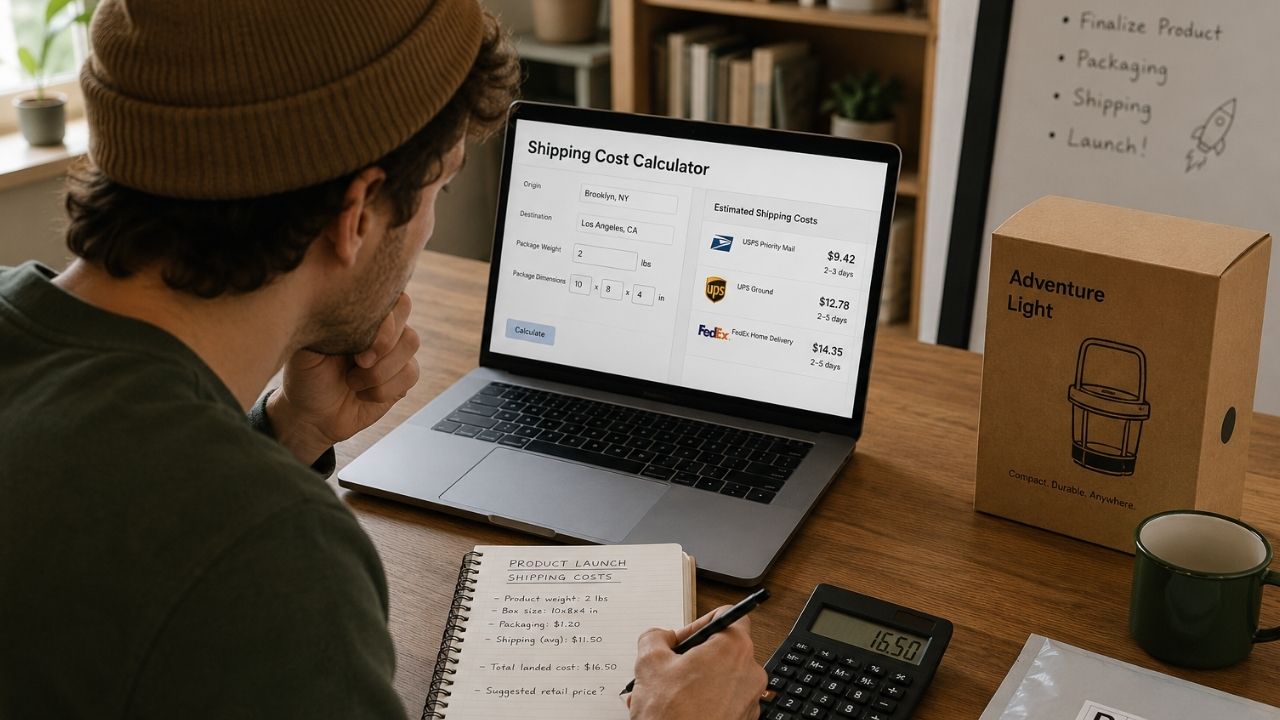
But two things do lock the moment you launch: your reward tier prices, and the expectation you set. A backer who pledged against a $12 shipping estimate and gets invoiced $34 four months later does not shrug. They drop out of the pledge manager, they ask for a refund, and they say so in the comments where the next few thousand backers can read it.
This issue is pretty is common, and it is expensive. One crowdfunding cost guide puts the typical shortfall at around $10,000 budgeted for shipping and fulfillment against a bill closer to $35,000. It rarely traces to one bad decision. It’s a stack of small assumptions made in the weeks before launch, when nobody has the finished box in hand yet.
The schedule slips for the same reason. Kickstarter board games run late by about 3.5 months on average, and while the data can’t cleanly separate fulfillment delays from manufacturing ones, board games are the worst case for kitting, so read that as a ceiling rather than a forecast.
None of it is hard to fix while you’re still drafting the page. All of it gets harder once the number is a public promise and your inventory is on a boat. That’s what makes Kickstarter and crowdfunding fulfillment a planning input rather than an emergency purchase.
Every item below is cheap to fix before you launch and expensive to fix after.
Don't want to run these numbers yourself?
eFulfillment Service works with Kickstarter, Indigogo, and Gamefound creators to build shipping costs into your reward tiers before you launch.
1. Weigh and measure the shipping-ready package
Not the product. Not the prototype. The box that leaves the warehouse: retail box, mailer or carton, void fill, insert card, tape.
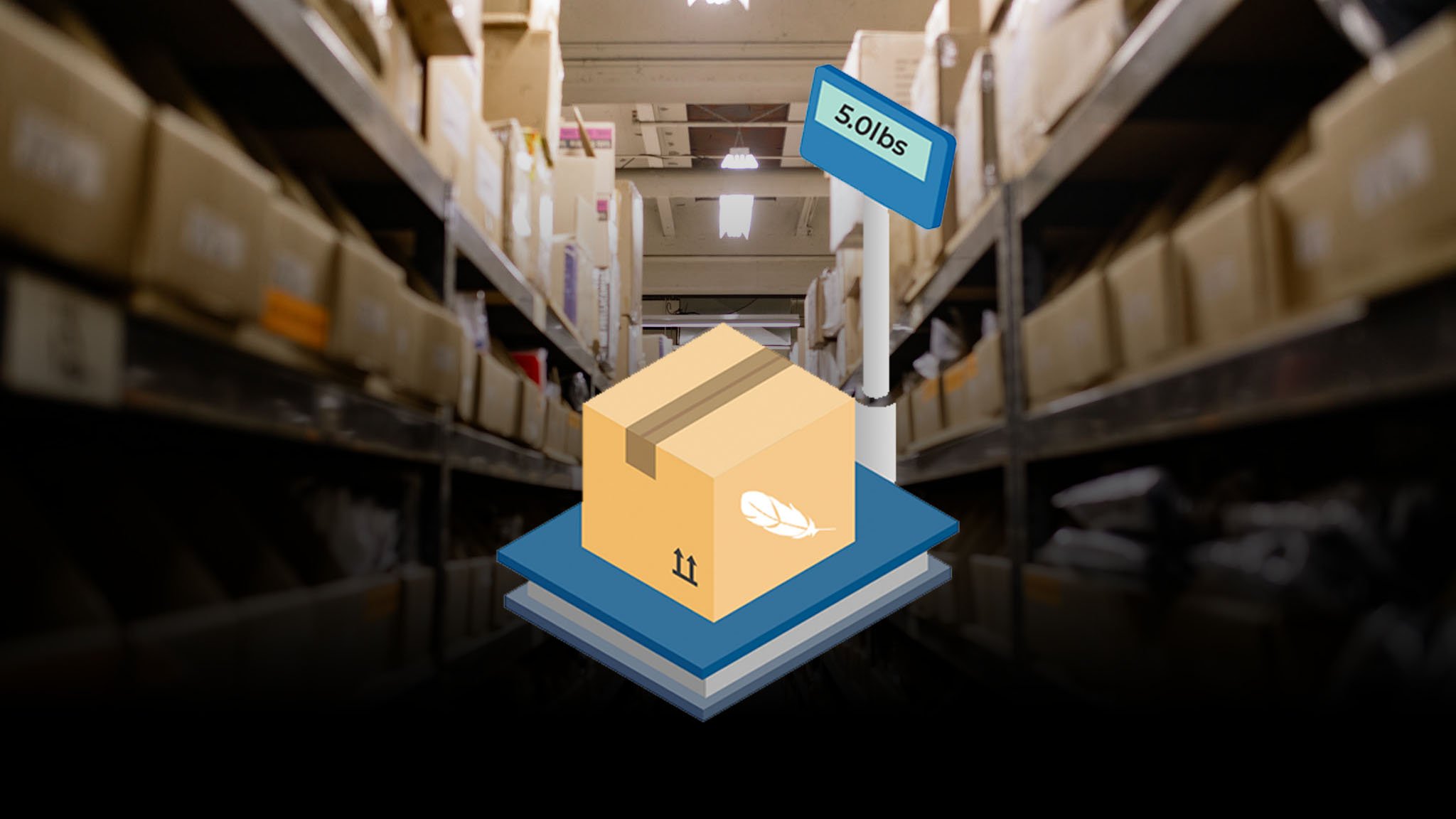
Carriers bill on billable weight, which is the greater of actual weight and dimensional weight. Each carrier divides by its own number. UPS and FedEx have used 139 for years; USPS filed to move from 166 to 139 for July 2026, which brings it in line with them.
If you were quoting USPS, that shift is worth two pounds on the box below. Dimensional weight was already costing you nine before it happened, which is the part that’s easy to skip past.
Run the math on your own package:
| Input | Example |
|---|---|
| Outer dimensions | 14 x 12 x 11 in |
| Cubic inches | 1,848 |
| ÷ divisor (139, USPS/UPS/FedEx) | 13.3 → 14 lb DIM weight |
| Actual weight | 3 lb |
| Billable weight | 14 lb |
A three-pound game billed at fourteen pounds is where most shipping budgets break. You cannot catch that mismatch without the finished package on a scale, or a dimensional weight calculator fed with the finished measurements.
Do this: have your manufacturer ship you one production-representative sample. Pack it exactly the way it will ship, then weigh and measure it before you write a shipping number anywhere.
One thing worth knowing: the carton a sample arrives in is often not the carton the production run uses, because samples ship as singles and the run ships six to a master. Ask which one you’re holding.
2. Price each reward tier separately
An average shipping cost across all tiers hides the tiers that lose money. Price them one at a time.
- Base tier: the smallest box, usually the safest number
- Deluxe tier: often a different box size entirely, and heavier on top of that
- Add-ons: each combination changes the outer carton, which changes DIM weight, a dynamic covered in depth in our Kickstarter board game fulfillment guide
- All-in pledge: the most expensive box you will ship, and the one most likely to be underpriced
Then price each tier to a named destination rather than a national average. Domestic rates move by shipping zone, and a package going coast to coast can cost meaningfully more than one staying regional.
3. Decide where you will ship before you promise “worldwide”
International backers show up on day one of a crowdfunding campaign. They don’t accumulate gradually the way they do for a normal store, which means customs paperwork and VAT arrive on day one too.

Two decisions matter here.
DDP or DAP. With DDP (Delivered Duty Paid), you collect duties and taxes up front and the backer receives the package with nothing owed. With DAP, the carrier bills the backer on delivery, which produces surprise fees and refused packages. BackerKit’s own guidance is that DDP is preferred for exactly that reason. It costs more, and it is almost always the right call for rewards.
Which countries you serve. Restricting shipping to a defined list is a legitimate, respectable choice. Jamey Stegmaier of Stonemaier Games documented shipping Viticulture to Europe at $47 per unit while charging backers $20, a loss of $27 on every European box. That campaign ran in 2012, before pledge managers were standard, so the specific numbers are dated. The failure mode is not.
Cutting a country from your list before launch costs you nothing. Doing it after funding means refunds and a public explanation.
Once the list is set, put rough numbers on it. Estimating the duty and VAT side is cruder than it sounds: take your declared unit value, look up each destination’s import tax rate and de minimis threshold, and run it for the three countries you expect the most backers in. The rules differ by country and change often enough that it’s worth confirming current thresholds rather than trusting a blog post, including this one. The number is still knowable before you publish anything, which is the point.
4. Count your SKUs after stretch goals, not before
This is the item most creators skip, and it’s the one that turns a clean fulfillment plan into a mispick problem.
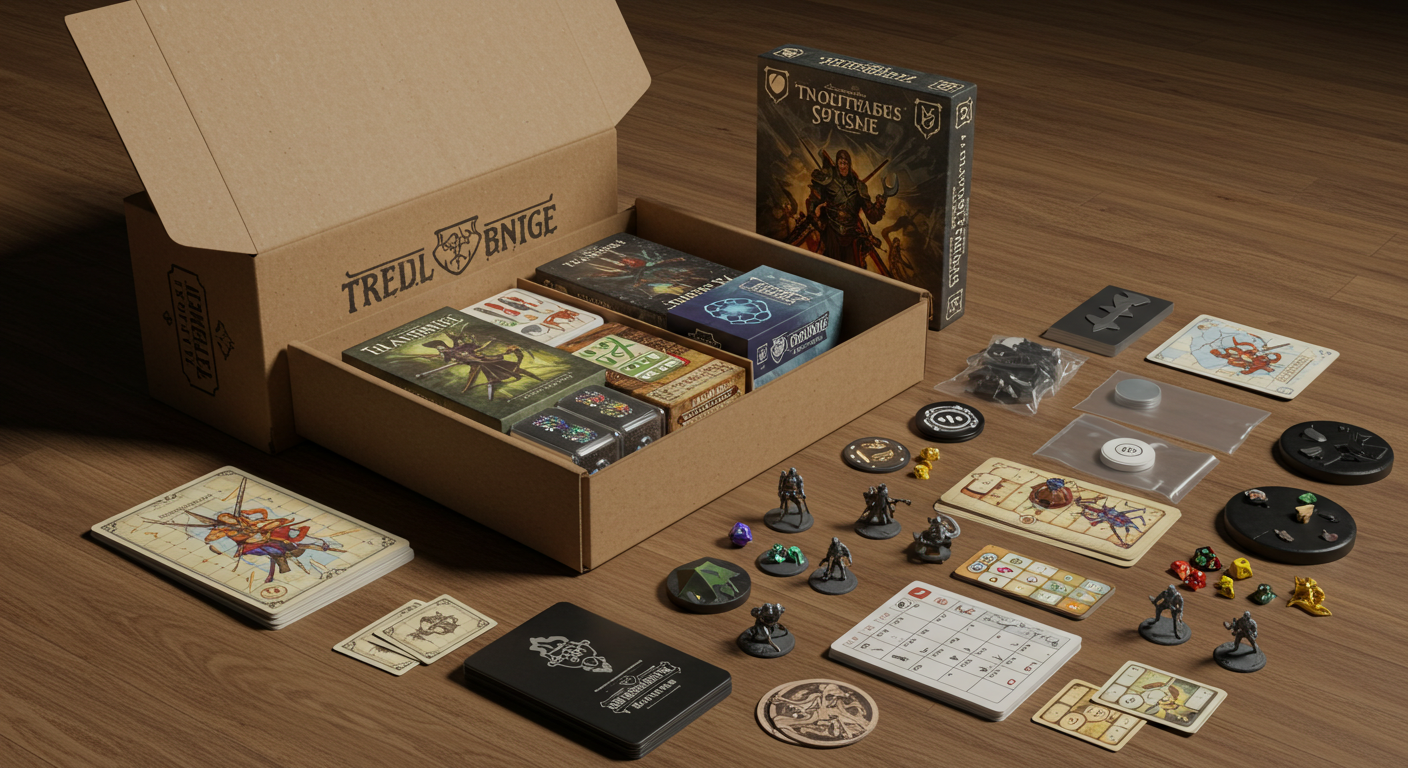
A pledge is rarely one item. Base reward, early-bird bonus, two stretch-goal components, and a premium add-on can share components across four different bills of materials. Every shared component is a chance to put the wrong thing in a box.
Write out the full matrix before you launch:
- List every physical component your campaign could produce, including unlocked stretch goals
- List every pledge combination a backer can buy
- Map which components go in which combination
- Count the distinct pack-outs. That count is what your fulfillment center quotes against, and it is rarely the same as your product count
If the matrix runs past a dozen or so distinct pack-outs, kitting stops being a detail and becomes the main line item in your fulfillment quote. Our packaging and kitting tips for board game fulfillment walk through how those pack-outs get built on the warehouse floor.
5. Pick your pledge manager and confirm the data handoff
Your pledge manager collects the addresses. Your fulfillment center ships to them. Confirm how one hands off to the other before you need it to work.

Confirm three things in writing:
- Format. Does your fulfillment partner accept a CSV export from your pledge manager, or do they need an API or store integration? Most 3PLs integrate natively with Shopify, BigCommerce, WooCommerce, Magento, and Squarespace. A pledge manager export is a different path, and worth confirming rather than assuming. There’s no good data on which handoff method produces fewer address errors at campaign volume, so ask your provider which one they’d rather receive.
- SKU mapping. Your pledge manager’s product names and your fulfillment center’s SKUs must match exactly. Reconcile them before your inventory arrives.
- Address lock date. Backer addresses go stale between funding and shipping. Set the date you close address changes and put it in front of backers early.
6. Vet your fulfillment partner while you still have leverage
Before you launch, you’re a prospect asking questions. After you fund, you’re a creator with a deadline taking whatever’s available. Those are very different negotiating positions.
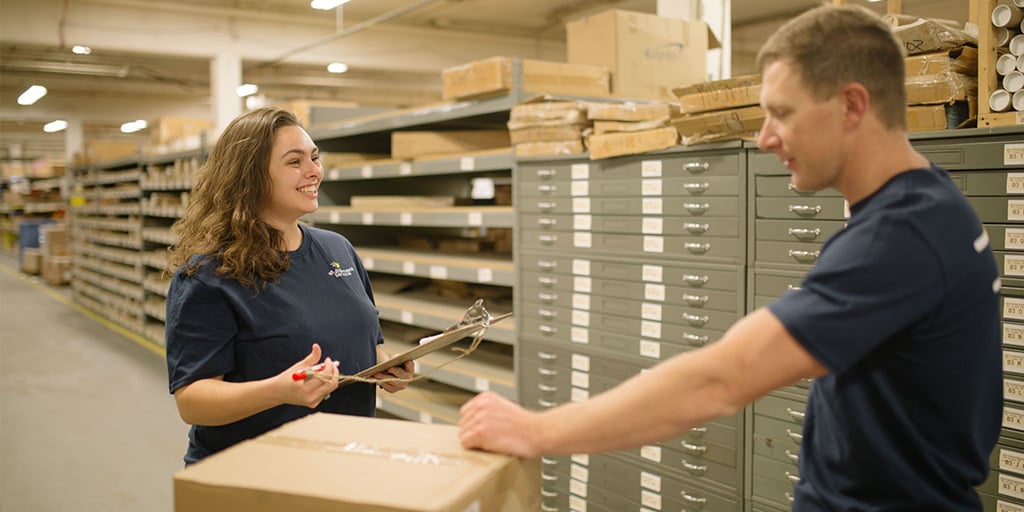
Our guide to choosing a fulfillment partner for a crowdfunding campaign covers the evaluation in full. The short version: ask every candidate the same list.
- Do you take project-based campaigns, and what’s your backer-count threshold? Many 3PLs won’t onboard a one-time surge at all. eFulfillment Service, for example, generally wants to see at least 200 backer orders for a crowdfunding batch. A stated number is more useful than a vague yes.
- What are your kitting fees, and how are they calculated? Per unit, per component, or per hour changes the total substantially at campaign volume.
- Are there setup fees, minimums, or long-term storage charges? Ask all three separately. A provider with no setup fee can still have a storage minimum that bites six months after your waves ship.
- How far ahead do you need my inventory? eFulfillment Service asks for account setup at least a week before inventory arrives; other providers vary. The account setup is the short part. Booking freight into that receiving window is the long pole, and it’s the one you need the date for.
- How do you handle customs documentation and DDP? Some providers do it in-house, some refer out. Either arrangement can work, as long as you know which one you’re buying.
Run that list past two or three providers and compare. The spread between quotes on an identical spec is usually the fastest education you’ll get in what your campaign costs to ship.
What goes wrong with the wrong partner is rarely dramatic. It’s a mispacked kit, or an email that sits unanswered while your backers wait on an update you can’t give them.

One EFS client, the three-person team behind the Worlds Within TTRPG, came to us after previous fulfillment partners produced delays, communication failures, and unexpected costs on complex kitting work. Their components ship as multi-piece kits, the pack-out profile most likely to go wrong, and their orders run at a 99% accuracy rate on our floor. That figure is theirs, not a company-wide average, and we don’t publish one.
What they told us afterward was about none of that: “We felt genuinely cared for. That alone allowed us to focus on our game and community instead of worrying about logistics.”
Sometimes the answer is that you shouldn’t hire anyone. Under roughly 200 units of a single SKU, no add-ons, mostly domestic backers, you will fulfill it more cheaply from a garage than any 3PL will quote you, ours included. Outsourcing earns its cost at complexity and volume, and a campaign like that has neither.
7. Build the timeline backward from the date you print
The estimated delivery month on your campaign page is the most-scrutinized promise you’ll make. Build it in reverse:
| Step | Typical duration |
|---|---|
| Campaign ends → pledge manager closes | 4–8 weeks |
| Manufacturing | 8–16 weeks |
| Freight to fulfillment center | 3–8 weeks (ocean) or 1–2 weeks (air) |
| Receiving and inventory check-in | 3–10 business days |
| Kitting and pack-out prep | 1–3 weeks, scales with SKU count |
| Wave shipping to backers | 1–2 weeks to release the full batch |
That totals roughly 15 to 38 weeks before any buffer, and which end you land on depends mostly on whether you freight by air or by sea. Treat four months as the floor rather than the plan.
Then add a buffer. Whether four weeks or twelve is right depends on how much of your supply chain crosses an ocean, and you won’t know your exposure until manufacturing is booked. Pick a number, write down the reasoning, and you’ll be able to defend it in an update later.
Whatever buffer you pick, keep your backers posted. Per Kickstarter’s own creator handbook, going silent after the campaign ends erodes backer trust even when fulfillment is running on schedule.
Fifteen spreadsheet tables sound like a lot?
eFulfillment Service can run your real per-tier, per-zone shipping costs before you lock reward pricing, so you’re not building this math alone.
8. The pre-launch checklist
Package and cost
- Production-representative sample weighed and measured, packed as it will ship
- Billable weight calculated (actual vs. dimensional) for every box size
- Shipping priced tier by tier, including all-in pledges
- Domestic pricing checked zone by zone
Destinations
- Country list decided and written into the campaign page draft
- DDP vs. DAP chosen, with the cost difference in your budget
- Duties and import VAT estimated for your top three international markets
SKUs and assembly
- Full component list written, including stretch goals you expect to unlock
- Pledge-combination matrix mapped to distinct pack-outs
- Kitting quoted against that pack-out count
Systems
- Pledge manager selected
- Data handoff format confirmed with your fulfillment partner in writing
- SKU naming reconciled between both systems
- Address-lock date set and communicated
Partner and timeline
- Two or three fulfillment partners quoted on the same spec
- Backer-count threshold and setup fees confirmed
- Kitting fees and long-term storage terms confirmed
- Inventory-arrival lead time confirmed
- Delivery date built backward with a stated buffer
Skip the manual math
Plug your package dimensions into eFulfillment Service’s free dimensional weight calculator to see your real billable weight before you finalize your box size.
FAQ
When should I contact a 3PL — before or after my campaign funds?
Before. A fulfillment quote is a planning input for your reward-tier pricing, and you need it while those prices are still editable. Providers will quote off a spec sheet and a sample package; you don’t need finished inventory to start the conversation.
What if I don’t hit a 3PL’s minimum backer count?
Ask anyway. Thresholds like 200 backer orders are guidelines tied to whether batch fulfillment makes economic sense for both sides, and a campaign that lands somewhat under can often still be worked out in conversation. If it genuinely can’t, self-fulfilling a batch that small is usually the cheaper answer regardless. If your campaign is likely to land near the line, a provider would generally rather talk before launch than turn you away after.
Should I charge backers for shipping during the campaign or in the pledge manager?
Collect in the pledge manager. That’s now standard practice, and it exists specifically because campaign-time estimates are unreliable. What the pledge manager does not do is excuse a bad estimate on the campaign page, because backers judge the final invoice against whatever number you showed them. State clearly that shipping is collected later, and make the published estimate close enough that the invoice isn’t a shock.
How much should I budget for fulfillment beyond postage?
Postage is one line. Receiving, storage, kitting, pick and pack, and packaging materials are separate, and kitting is the one that varies most with campaign complexity. Get all of them itemized in your quote rather than accepting a single blended per-order number — our guide to 3PL costs and fee structures breaks down what each line should cover.
Can I switch fulfillment partners mid-campaign if it goes badly?
Yes, and creators do it, but it costs weeks and a freight move you didn’t budget. It’s the most expensive version of this checklist, and one of the common fulfillment pitfalls worth designing around beforehand.
Do I need a separate plan for returns and damaged rewards?
Yes. Backers report damage and non-delivery for months after a wave ships, and replacements come out of inventory you have to deliberately hold back. Decide your spare-unit percentage before manufacturing closes, and read up on post-fulfillment support for Kickstarter returns while you’re at it.
Key Takeaways
- Billable weight sets your shipping cost. Weigh the finished, packed box on a scale before you publish a shipping number. Dimensional weight, not the scale reading, is what most budgets get wrong.
- Price every reward tier separately. An averaged shipping number hides the all-in pledge that loses money on every unit, the way Stonemaier’s $47-cost, $20-charged European shipping did.
- Count pack-outs, then quote kitting against that number. Stretch goals and add-ons multiply into combinations far faster than they multiply SKUs.
- Vet fulfillment partners before you launch, while you can still walk away. Quote two or three on an identical spec and compare the spread.
- DDP beats DAP for rewards. Paying duties up front costs you more, but it avoids refused packages and surprise bills at the backer’s door.
- Build your delivery date backward. Manufacturing, freight, receiving, kitting, and wave shipping each take weeks, and the buffer you add should have a written reason behind it.
Which Stage Are You In?
Still building the campaign page (pre-launch). Work the checklist top to bottom now. Get a fulfillment quote before you finalize tier pricing, because the shipping line on your page is the hardest number to change later.
Funded, manufacturing not started. You can’t move tier pricing anymore, but you can still control kitting complexity and your inventory-arrival date. Lock your pack-out matrix and get your fulfillment partner your SKU list this month.
Manufacturing complete, shipping soon. Focus on the handoff: SKU mapping, address lock, and a wave-shipping schedule your provider has confirmed in writing. Then get your backer updates on a fixed cadence, and start thinking about what happens to leftover inventory once the waves are out.
Serial creator planning your next campaign. You already know where the last one hurt. Bring those specific numbers to your fulfillment conversation: package weights, backer geography, kitting time. Then quote two or three crowdfunding fulfillment providers against them.


0 Comments