

Multi-channel inventory management means tracking, sharing, securing, and replenishing the same pool of products across every place you sell. Your own store, marketplaces like Amazon and eBay, social shops, as well as your warehouse and retail locations.

On paper, it looks straightforward. In reality, it’s like trying to keep one set of car keys in five different pockets at once. Someone’s going to grab them at the wrong time unless you’ve got a plan.
Customers expect items to be available and ship fast, no matter where they buy. When inventory data lags behind reality, backorders and cancellations chew up margins and goodwill.
Overselling hurts trust. Understocking stalls growth. Both quietly drain cash.
The consequences show up fast:
- Listings go out of sync – so you sell what you don’t have
- Ads keep running on out-of-stock SKUs – wasting money
- Staff spends hours reconciling counts – rather than serving customers
- Reviews reflect the missed expectations – not your actual product quality
Accuracy isn’t a nice-to-have. It’s the foundation of multi-channel selling. Keep on reading to learn how to keep your stock accurate across multiple channels.
Multi-Channel Selling and Common Pitfalls in Inventory
The complexity of multi-channel selling
Most modern sellers don’t live in one channel. They’ll be:
- Running their own e-commerce site for brand control and better margins
- Listing on Amazon for reach
- Testing eBay for certain categories
- Opening social shops for discovery
- Maintaining a physical store or showroom for hands-on experience
That’s a lot of doors into the same stockroom. Each platform has its own operational rules, listing structures, marketing tactics, and fulfillment timelines.
For instance, Amazon might reserve units for pending orders, while your website shows everything that hasn’t shipped yet. Your POS system sells a unit that your WMS hasn’t removed yet.
More channels means more shoppers. However, it also means more operational headaches. Industry watchers report the widespread marketplaces as well as blended online/offline shopping journeys. As the norm, not the edge case.
- Shopify research: This highlights the growing importance of omnichannel strategies for reaching shoppers where they are. Not just where you’re comfortable selling. It outlines best practices for inventory handling across channels.
- BigCommerce report: It also lays out how multi-channel retailing expands reach while increasing operational complexity.
Common pitfalls in multi-channel inventory
Inventory is cash sitting on the shelf. To improve cash flow, you have to ensure you don’t run out of stock. However, a few missteps cause most of the pain:
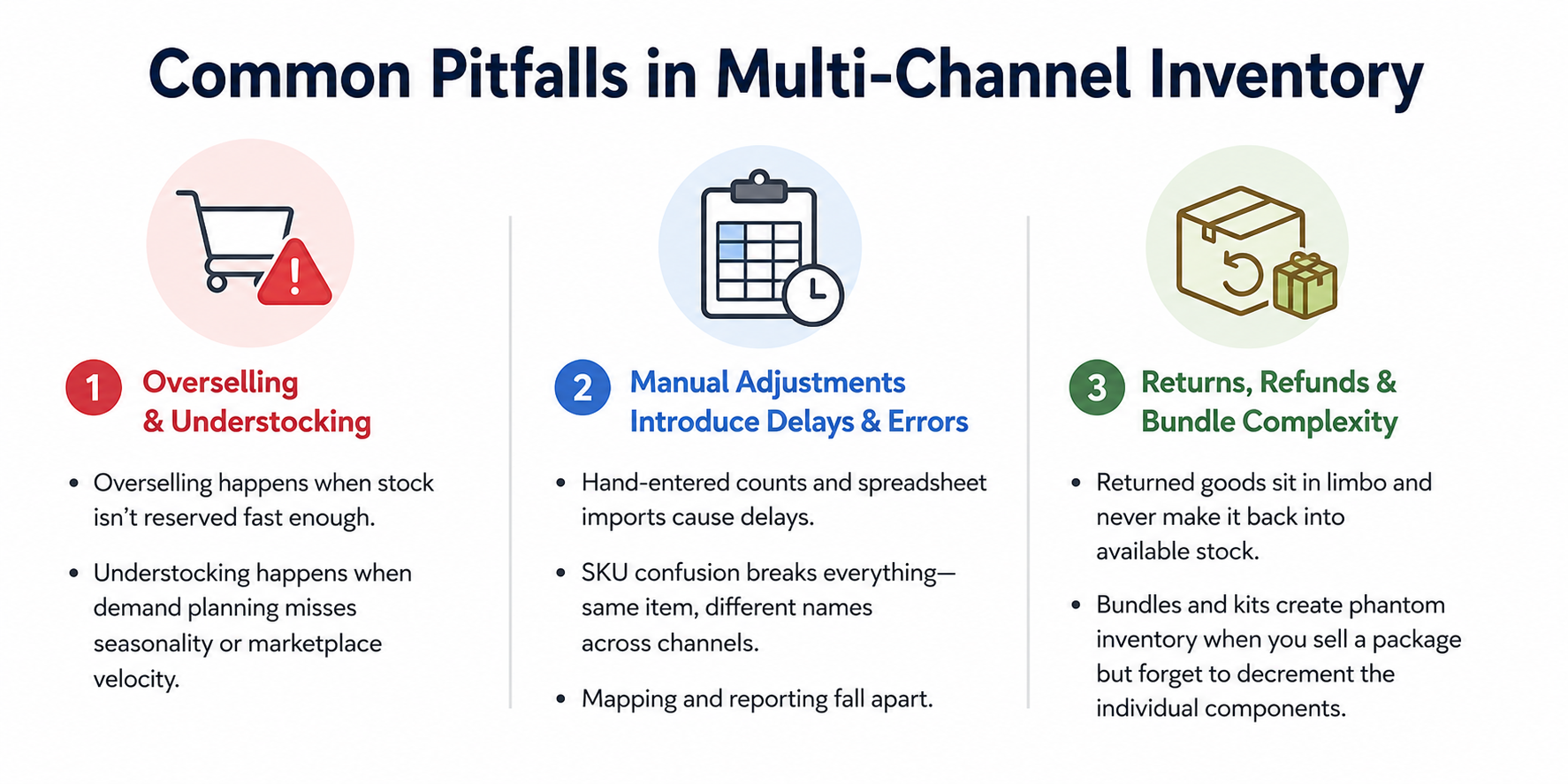
Photo credit: generated by the author via ChatGPT
- Overselling happens when you don’t reserve stock fast enough. Orders hit different channels at the same time, and you promise what you can’t deliver. Understocking is the flip side. Demand planning misses seasonality or marketplace velocity, and you run out just as momentum builds.
- Manual adjustments introduce delays and errors. Hand-entered counts and spreadsheet imports for calculating ending inventory mean updates happen in batches or at day’s end, so listings stay stale for hours.
- Product returns and refunds are another black hole. Returned goods sit in limbo and never make it back into available stock. Bundles and kits create phantom inventory when you sell a package but forget to decrement the individual components.
The fallout is predictable:
- Canceled orders
- Poor reviews
- Customer churn
- Support team apologizing for problems they didn’t create
How To Keep Stock Accurate Across Multi-Channels
Getting inventory right across channels is part discipline, part tooling. A few proven moves make a big difference. That said, here’s how to keep your stock inventory accurate and complete amid multiple channels:
- Start with a single source of truth. Whether it’s an ERP or your inventory app, pick one system to own on-hand quantities, including allocations and reservations. Pull everything else into it, and push updates out from there. Fragmented truth creates fragmented results.
- Sync inventory in near real time. When an order lands on any channel, units should decrement immediately. Most major platforms support instant or frequent updates with the right connectors.
- Standardize stock keeping units (SKUs). Stick to a single SKU for the same physical item everywhere. Map marketplace listings to that one SKU and keep attributes in sync. Your business reporting and customer service will thank you.
- Use buffers and channel allocations. When planning inventory around product launches, small safety stock helps absorb timing gaps or unexpected spikes. Channel-specific allocations keep marketplaces from draining your DTC store (or vice versa) when you need balance.
- Do cycle counts (not just annual counts). Frequent counts catch drift early. They are far less disruptive than one giant audit. If you’re new to cycle counting, this practical walkthrough is a good start.
- Treat bundles and kits as first-class citizens. Use virtual bundles that break down into components at pick/pack time so each sale deducts the right parts.
Fulfillment with a Personal Touch.
See How Using a 3PL like eFulfillment Service sellers saves time. Get a Free Quote from eFulfillment Service Today!
How To Balance Tech and Human for Inventory Management
Multi-channel commerce has become the new standard for business growth. But when managing stock across multiple channels, you have to balance leveraging technology with human expertise. Here’s how:
Leveraging technology for inventory accuracy
Technology can be the difference between playing catch-up and staying ahead. Here’s a tech stack to invest in:
- Real-time integrations – connect your storefronts, marketplaces, POS, and fulfillment partners to a centralized inventory system. Popular options include:
- Cin7 Core (formerly DEAR)
- Extensiv (Skubana), Linnworks
- Brightpearl by Sage
- NetSuite
- Odoo
- ChannelAdvisor/Rithum
- Sellbrite
- Ordoro
- Demand forecasting – with AI spots patterns humans miss (think promo lift, halo effects from new launches, or regional variations, turning them into smarter purchase orders)
- Intelligent order routing – automatically ships from the location closest to the buyer with available stock (you can hold a small reserved pool for top channels or VIP customers when you need to protect SLAs)
- Barcode-driven workflows – reduce errors from receiving to picking to returns (scanning records stock movements as they happen…simple, boring, incredibly effective!)
With the right technology, businesses can keep inventory accurate. Without adding more manual work!
Tools built with reliable embedded software can help connected devices and systems track stock movements. They can assist in keeping inventory data consistent across channels.
Ultimately, this gives teams more time to focus on fulfillment and customer satisfaction.
Employing human factors in training and processes
Tools won’t save a broken process. People do. To tap into human expertise, here’s what you can do:
- Train teams on the why (not just the what). When staff understand that scanning every movement prevents oversells and angry emails, the habit sticks. Keep standard operating procedures (SOPs) short and specific: how to receive and label, how to reconcile discrepancies, how to process returns the day they arrive.
- Implement consistent rituals to prevent fires. Daily exception reviews catch stuck orders or mismatched SKUs. Weekly cycle counts focus on fast movers and high-value items. Pre-promo checks confirm allocations and buffers for listing accuracy before you hit “launch.”
- Keep comm tight between marketing and operations. If marketing is planning a flash sale or a marketplace feature, ops needs a heads-up so stock and staffing are ready. Surprises are great for birthday parties. Not for inventory!
The same principle applies beyond retail. For instance, a real estate data company using a land insights alternative needs clear processes to keep property listings and land records accurate.
Teams should regularly verify data updates and flag discrepancies. They should communicate changes before publishing them.
With proper training and consistent checks, staff can reduce errors and ensure customers and investors have reliable information when making property decisions.
Summary
Multi-channel selling isn’t going away. The mix keeps expanding as social commerce, including marketplaces and retail partnerships, evolves.
The trap? Thinking you can manage it all with manual updates and wishful thinking. That said, centralize your truth. Sync in real time. Train your team. And let technology handle the heavy lifting.
Tech stack helps:
- AI-driven forecasting will get more accessible.
- Dynamic pricing will better align demand with available stock.
- Tighter APIs between multiple channels and systems will make real-time updates the default.
- Sellers that build these muscles now will move faster with less friction.
Start by:
- Picking a system to be your inventory source of truth and standardizing SKUs
- Fixing obvious mapping issues and turning on real-time stock sync for your top channels
- Adding safety stock and channel allocations for your highest-velocity SKUs
With these in place, you can optimize your inventory and keep stock accurate across multiple channels.
Need to stay on top of your stock inventory across multiple channels? eCommerce Fulfillment Service can help with warehousing, storage, fulfillment, returns, and other online retail functions. To get a free quote, sign up today!

About the Author
Brooke Webber is a passionate advocate for a people-first strategy in HR. Her major focus areas are workplace psychology and employee listening, where she has built strong experience as a writer and industry voice.



0 Comments