
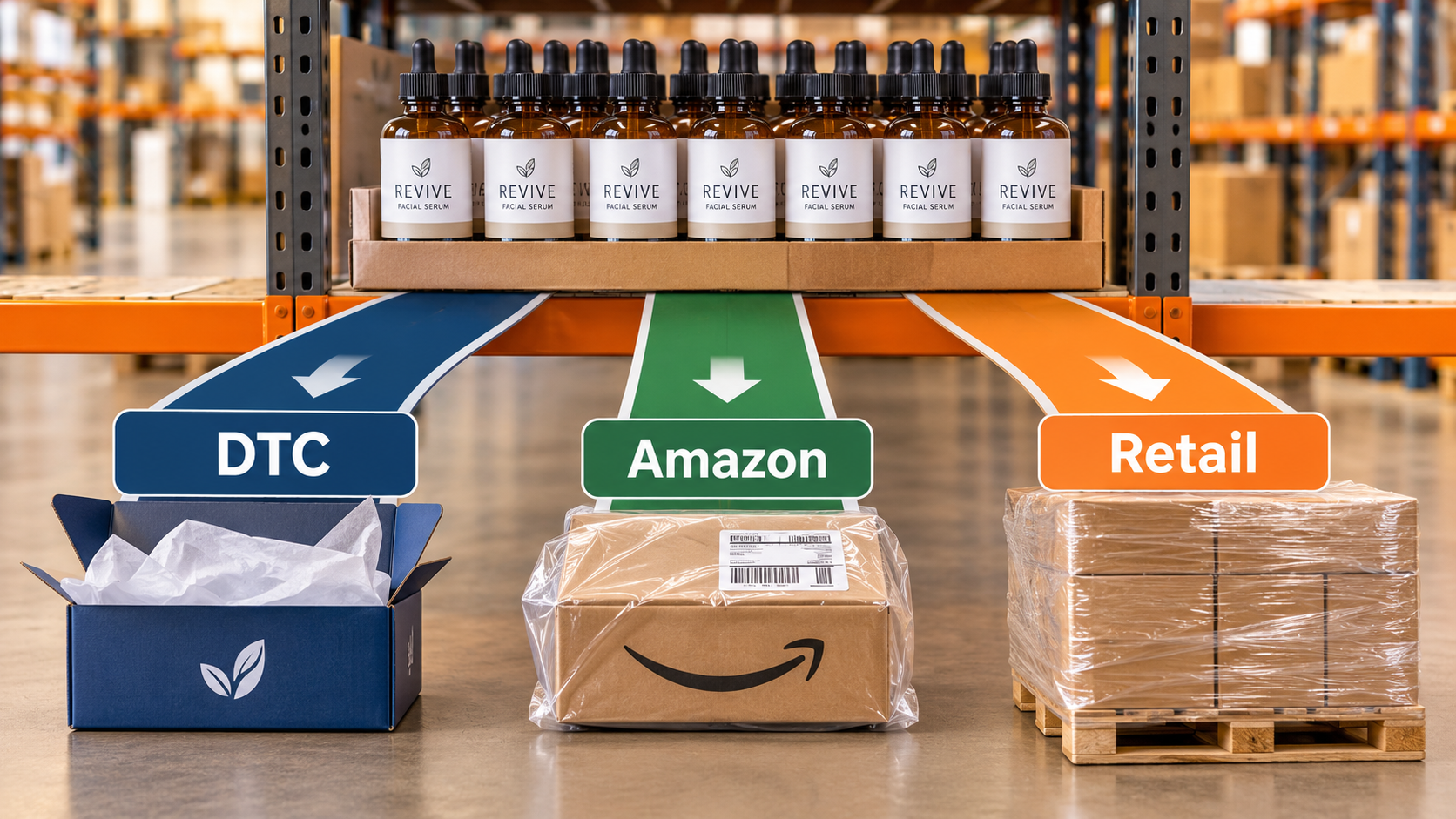
Selling a beauty product on three channels is not three times the work of selling it on one. The selling is the easy part. The hard part is that a single lot of moisturizer has to satisfy three rulebooks that contradict each other: Amazon’s prep and expiration requirements, a retailer’s routing guide, and a direct customer who expects fast, branded delivery. All three draw on the same underlying inventory, which is where things start to get a bit complicated.
A unit prepped for Amazon is not in a state to ship to a Sephora distribution center, and neither version is the branded unboxing a DTC buyer paid full price to receive. This guide walks through what each channel of beauty fulfillment actually demands, the inventory problem sitting underneath all three, and how to evaluate a 3PL that can run the whole thing without you having to reconcile spreadsheets at midnight.
One product, three rulebooks
The instinct when you add a channel is to think about demand: more places to sell means more orders.
Each channel imposes its own requirements on the same physical unit, and those requirements collide at the inventory level.
Here is the same jar of moisturizer, seen by three channels:
| Requirement | DTC | Amazon (FBA) | Retail / Wholesale |
|---|---|---|---|
| Packaging | Branded box, tissue, insert | Polybag or carton, FNSKU label | Case pack, often shrink-wrapped, UCC-128 label |
| Labeling | None beyond the product | Expiration + lot label, FNSKU | Retailer item barcode, pallet/case labels |
| Timing | Same/next-day dispatch | Inbound appointment windows | Strict delivery window (OTIF) |
| Penalty for error | Bad review, refund | Listing suppression, removal fees | Chargebacks, deductions |
| Who controls the rules | You | Amazon Seller Central | The retailer’s vendor manual |
None of these is harder than the others in isolation. The difficulty is that one unit of inventory can only be in one state at a time, and the three channels want it in three different states. Decide wrong about how much to prep for Amazon, and you’ve stranded inventory you can’t ship DTC during a viral spike. Under-allocate to a retailer’s purchase order, and you’re taking a chargeback.
The failure shows up as “we were out of stock” when the stock existed
The most common multichannel failure is not a true stockout. It’s inventory that exists but is committed to the wrong channel, or sitting in an Amazon fulfillment center when the demand came through Shopify. The brand sees “sold out,” the customer sees a delay, and the founder sees numbers that don’t reconcile.
This is why multichannel comes down to inventory allocation. When inventory is allocated properly, fulfilling orders across all three channels becomes much easier. Without a clear plan, each channel can end up competing for the same inventory.
The DTC channel: speed and the box set the baseline
Direct-to-consumer is where a beauty brand earns its margin and its reputation at the same time. It’s also the channel with the loosest external rules and the highest emotional stakes, which makes it the first thing a stretched team under-resources once Amazon and retail start making louder demands.

Two things define DTC fulfillment for beauty:
- Dispatch speed. Amazon set the customer expectation, and it doesn’t reset just because they bought from your Shopify store. Orders that ship same-day or next-day hold the line; orders that sit for three days generate “where is my order” tickets that eat your support time.
- The unboxing. For beauty specifically, the box is the product’s first physical impression and a real driver of repeat purchase and user-generated content. Tissue, inserts, branded tape, a gift-with-purchase: these are the touchpoints founders obsess over, and for good reason.
The mistake brands make is treating DTC as the “default” channel that a generic 3PL handles while the hard work goes to Amazon and retail. In practice, DTC is where custom kitting, inserts, and PR mailers live, and a provider that slaps product in a brown box is eroding the one channel where you keep the full margin.
Where DTC breaks under multichannel pressure
When a provider is optimizing for Amazon prep and retail pallets, DTC orders get deprioritized: picked last, packed plainest. You feel it as a slow decline in review sentiment and repeat rate rather than a single failure. Protecting DTC means the 3PL has to treat a two-unit branded order with the same care as a retail pallet, even though the pallet looks more important on a volume report.
Your DTC unboxing shouldn't get packed last.
eFulfillment Service handles custom kitting, inserts, and PR mailers, so your highest-margin channel keeps the branded experience buyers paid full price to receive.
The Amazon channel: prep, expiration windows, and a rulebook that suppresses listings
Amazon is where beauty brands hit the most rigid, least forgiving requirements. The rules are written by someone else and enforced automatically.

If you’re using Fulfillment by Amazon (FBA), the core constraints for beauty and personal-care products are:
- 1. Expiration dating. Consumable and topical products generally need a visible expiration date, and Amazon applies minimum-remaining-shelf-life rules at inbound. Product that’s too close to expiry gets refused or removed.
- 2. Lot and expiration labeling. Units need the right labels applied before they reach the fulfillment center. That is a prep step, and skipping it is how shipments get held.
- 3. FNSKU labeling and prep. Poly-bagging and FNSKU application have to be done to spec, or the shipment gets flagged.
- 4. Inbound appointment windows. You can’t just ship when ready; FBA inbound runs on scheduled receiving.
Amazon’s expiration and prep requirements change often enough that “we did it right last quarter” isn’t a guarantee. A provider who handles FBA prep regularly is tracking those changes as part of the job; a brand doing it occasionally usually finds out a rule changed when a shipment gets refused.
There’s no good public number on how often beauty FBA shipments get refused over expiration or labeling, but it comes up often enough that treating prep as a casual task is a mistake.
There’s also the TikTok Shop wrinkle. TikTok Shop ended self-fulfilled shipping for most sellers, pushing brands toward Fulfilled by TikTok or a certified 3PL partner. If TikTok is part of your channel mix, that’s another prep-and-routing standard the same inventory has to meet.
The retail channel: EDI, routing guides, and chargebacks
Retail and wholesale are a different kind of hard. The volume is attractive, since a single purchase order can dwarf a month of DTC, but the compliance regime is unforgiving and expensive to get wrong.
Selling into retail typically means:
- EDI (electronic data interchange). Purchase orders, advance ship notices, and invoices flow through a standardized electronic format. No EDI capability, no retail account.
- Routing guides. Each retailer publishes a vendor manual specifying exactly how product must be labeled, cartoned, palletized, and delivered, down to label placement and pallet height.
- OTIF (on-time, in-full) requirements. Deliver late or short, or deliver the wrong thing, and the retailer issues a chargeback against your invoice.
For a beauty brand, retail also layers its own compliance expectations on top: lot traceability and expiration management, plus sometimes the climate or hazmat handling a general-merchandise 3PL may not support.
The inventory layer underneath all three
Everything above comes back to one question: can you see and control a single pool of inventory across every channel, in real time?
Beauty makes this harder than most categories for three reasons:
- Lot and expiration tracking. Shipping in the order units were received (FIFO, first-in-first-out) isn’t safe here. Active-ingredient products need FEFO (first-expired, first-out), so the units closest to their expiry date ship first, within what each channel’s dating rules allow.
- SKU complexity. A single line might carry 20 shades across three sizes and two finishes. Multiply that by three channels and the allocation math gets unmanageable by spreadsheet fast.
- Demand volatility. A creator video can take a SKU from 30 orders a day to 500 overnight. If that spike hits DTC while your inventory is committed to an Amazon replenishment, you lose the viral window with product sitting in the wrong building.
The practical requirement is a system where one inventory count is visible across DTC, Amazon, and retail, and where allocation decisions get made on purpose. That synced count is what real-time inventory visibility buys you: selling the jar you have instead of overselling a jar that’s already promised to a retailer.
Returns make the pool messier
Returns re-enter this same pool, and beauty returns carry a wrinkle: a returned unit may not be resaleable, and even when it is, its remaining shelf life matters. Returns processing that inspects a returned unit, grades it by remaining shelf life, and either restocks or removes it keeps the inventory count honest across channels, which is why it belongs in the core workflow rather than bolted on at the end.
One inventory count, visible across every channel.
With eFulfillment Service, your stock lives in one pool with real-time visibility across DTC, Amazon, and retail — so you sell what you actually have instead of overselling what’s already promised.
Compliance travels with the product, not the channel

One thing that does not change by channel is regulatory obligation. It follows the product everywhere it ships.
- FDA / MoCRA. The Modernization of Cosmetics Regulation Act created obligations around facility registration, product listing, and adverse-event reporting, with a serious-adverse-event reporting window of 15 business days. Meeting it depends on lot-level traceability, knowing which lot shipped where, which is exactly the data your multichannel inventory system should already hold.
- Hazmat. Many beauty products are regulated for transport: fragrances and many alcohol-based products fall under flammable classifications, and aerosols under compressed-gas rules. A 3PL that can’t legally store and ship hazmat can’t serve a brand with those SKUs, and brands often discover this only after signing.
- Storage conditions. Formulas degrade in heat. Climate-sensitive products need storage that holds a stable temperature, which many warehouses optimized for general merchandise simply don’t maintain.
The point is that compliance is a property of the product, so it has to be solved once, at the inventory layer, and then honored across all three channels. Solving it per-channel is how brands end up compliant on Amazon and exposed on retail.
Fulfillment with a Personal Touch.
See How Using a 3PL like eFulfillment Service sellers saves time. Get a Free Quote from eFulfillment Service Today!
How to choose a 3PL for multichannel beauty
The evaluation is different from choosing a single-channel fulfillment partner. The real question is whether a provider can run one inventory pool across three contradictory rulebooks without you having to keep an eye on it.

The evaluation is different from choosing a single-channel fulfillment partner. The real question is whether a provider can run one inventory pool across three contradictory rulebooks without you babysitting it.
Questions worth asking any provider:
- 1. Do you integrate natively with Shopify, Amazon, and the retail EDI my accounts require? A CSV export by itself doesn’t count; the test is whether orders and inventory sync automatically across all three.
- 2. Do you do FBA prep in-house (expiration labeling, FNSKU, poly-bagging), or do I still own that?
- 3. How do you handle allocation across channels? Is there a deliberate way to reserve or prioritize inventory, or does it ship first-come-first-served regardless of channel?
- 4. Is inventory tracked by lot and expiration, with FEFO picking? For beauty this is non-negotiable.
- 5. Can you handle my hazmat classifications and storage conditions? Name the specific SKUs: fragrances, aerosols, anything alcohol-based.
- 6. What does the DTC unboxing look like? Custom inserts, branded materials, and kitting, or a brown box?
- 7. How do you handle a demand spike? The honest answer involves receiving speed and labor flexibility rather than a slogan.
- 8. What’s the retail compliance track record? Routing-guide adherence and chargeback rates are measurable; ask for specifics.
A provider that answers the first four well is set up for multichannel. A provider that treats each channel as a separate workflow with separate inventory will recreate the exact problem you’re trying to solve.
Key Takeaways
- Multichannel is an inventory problem, not a sales problem. One lot of product has to satisfy Amazon’s prep rules, a retailer’s routing guide, and a DTC buyer’s expectations from a single pool, and those rulebooks contradict each other.
- Most “stockouts” aren’t. The product usually exists but sits in the wrong channel, or in an Amazon fulfillment center while demand came through Shopify. The failure is allocation.
- Each channel’s penalty is different. DTC punishes you with reviews and refunds, Amazon with suppressed listings and removal fees, retail with automatic chargebacks. All three bite the same inventory.
- Compliance follows the product, not the channel. MoCRA traceability, hazmat classifications, and climate-sensitive storage apply everywhere the SKU ships, so they have to be solved once at the inventory layer.
- Judge a 3PL on allocation, beyond ship speed. Any provider can move boxes. What separates a multichannel partner is running one inventory count across three channels, with native integration and in-house FBA prep, so you stay off the reconciliation treadmill.
Note: Regulatory requirements under MoCRA continue to evolve. Consult with a qualified regulatory affairs professional for advice specific to your product line and business structure.
Get your multichannel fulfillment running from one inventory pool
If DTC, Amazon, and retail are each pulling your inventory in a different direction, the fix is a fulfillment partner that runs all three from one pool, with in-house Amazon FBA prep, Shopify and marketplace integrations, and the kind of careful packing that protects your highest-margin channel.


0 Comments