
Most supplement brands think their FDA labeling only lives on the bottle. Increasingly, it lives on the product page, in a disclaimer rule that just changed for the first time in years, and in a heavy-metal threshold most sellers have never heard of.
The bottle still matters. 21 CFR 101.36 spells out exactly what has to be on it, in what order, at what type size, and getting that wrong is still the most common way a supplement listing gets flagged. But three developments from the past year change what “labeling compliance” actually covers for an ecommerce brand in 2026, and none of them are about the ingredients inside the bottle.
Not sure your fulfillment partner can actually produce this paperwork?
Ask directly: can your 3PL pull every order that shipped from a specific lot, going back two years or more? eFulfillment Service tracks lot and expiration dates as standard practice, with FEFO rotation applied automatically rather than as a special request, following handling protocols aligned with FDA and GMP expectations.
What has to be on a supplement label
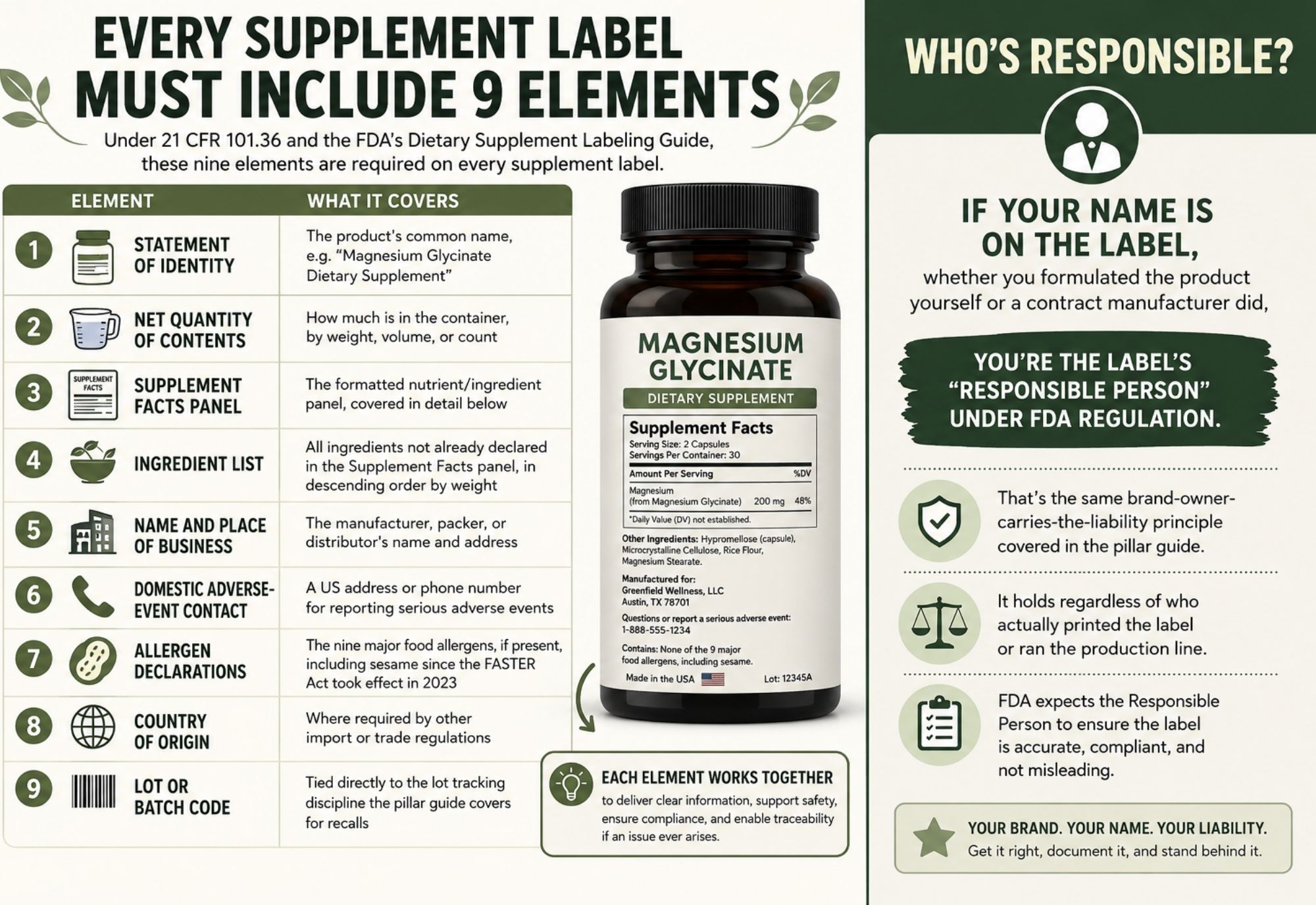
Under 21 CFR 101.36 and the FDA’s Dietary Supplement Labeling Guide, nine elements are required on every supplement label:
|
Element |
What it covers |
|---|---|
|
Statement of identity |
The product’s common name, e.g. “Magnesium Glycinate Dietary Supplement” |
|
Net quantity of contents |
How much is in the container, by weight, volume, or count |
|
Supplement Facts panel |
The formatted nutrient/ingredient panel, covered in detail below |
|
Ingredient list |
All ingredients not already declared in the Supplement Facts panel, in descending order by weight |
|
Name and place of business |
The manufacturer, packer, or distributor’s name and address |
|
Domestic adverse-event contact |
A US address or phone number for reporting serious adverse events |
|
Allergen declarations |
The nine major food allergens, if present, including sesame since the FASTER Act took effect in 2023 |
|
Country of origin |
Where required by other import or trade regulations |
|
Lot or batch code |
Tied directly to the lot tracking discipline the pillar guide covers for recalls |
Who’s actually responsible for getting this right
If your name is on the label, whether you formulated the product yourself or a contract manufacturer did, you’re the label’s “Responsible Person” under FDA regulation. That’s the same brand-owner-carries-the-liability principle covered in the pillar guide, and it holds regardless of who actually printed the label or ran the production line.
The Supplement Facts panel: format rules that trip people up
The panel has to be titled “Supplement Facts,” not “Nutrition Facts.” That single word matters: it signals the product is regulated under DSHEA rather than as a conventional food, and using the wrong heading is a real, recurring mistake among first-time brand owners repackaging a formula.
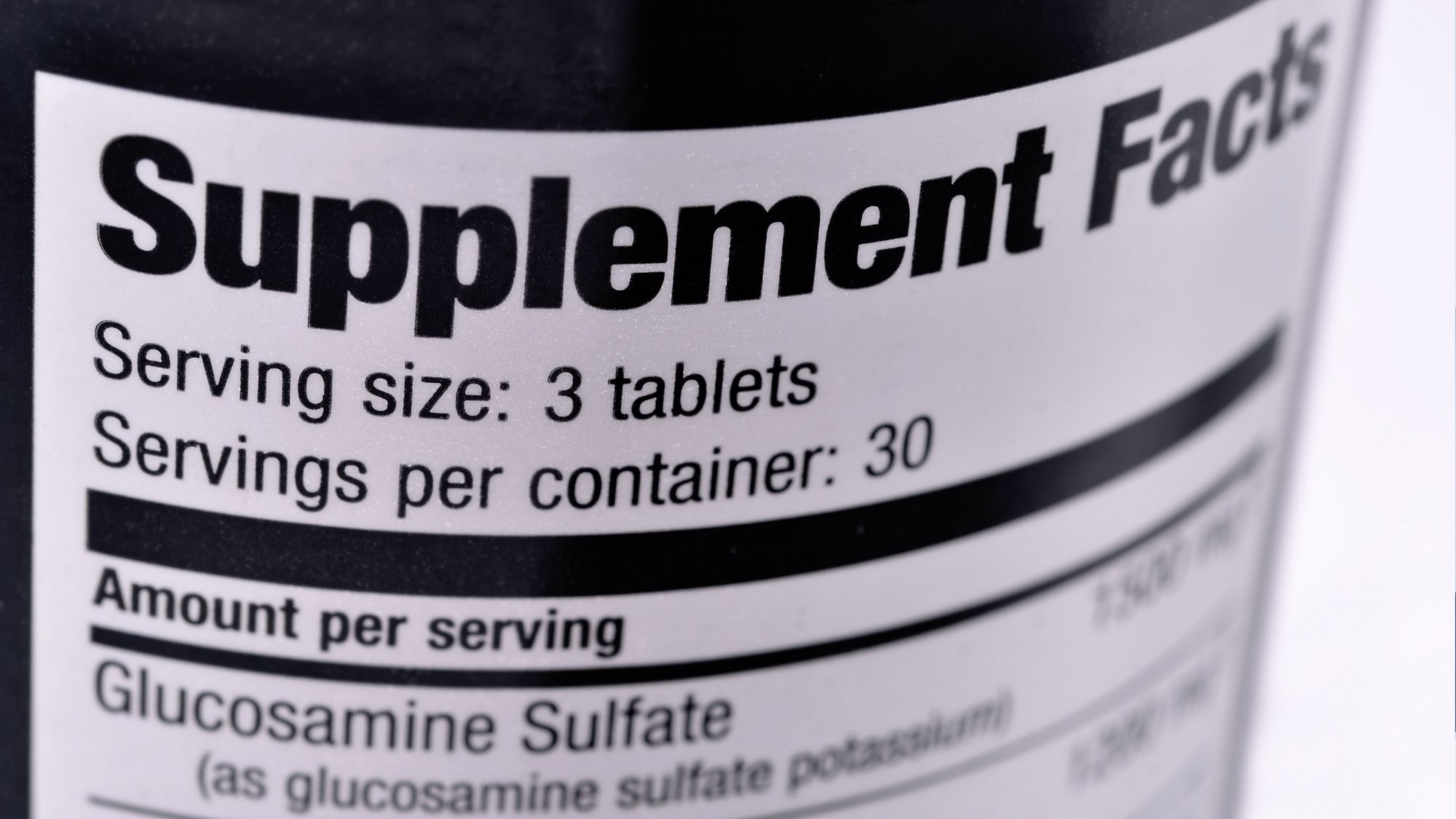
A few formatting specifics that catch people off guard:
- The “Supplement Facts” title must appear in bold type, larger than any other text in the panel
- Body text must be at least 6-point type, with 8-point required for the serving size line
- Dietary ingredients are listed in a prescribed order: vitamins first (in the order set by 21 CFR 101.36(b)(2)), then minerals, then other dietary ingredients by descending weight
- Any ingredient without an established Daily Value needs a footnote symbol reading “Daily Value Not Established”
None of this is about what’s in the product. It’s entirely about how it’s presented, and it’s exactly the kind of detail a graphic designer without regulatory background will get wrong on a first label draft.
The DSHEA disclaimer just changed
Every structure/function claim (“supports immune health,” “promotes healthy joints”) requires this exact disclaimer somewhere on the label, in boldface: “This statement has not been evaluated by the Food and Drug Administration. This product is not intended to diagnose, treat, cure, or prevent any disease.” It’s required under Section 403(r)(6)(C) of the FD&C Act, and it’s informally nicknamed the “quack Miranda warning” within the industry.
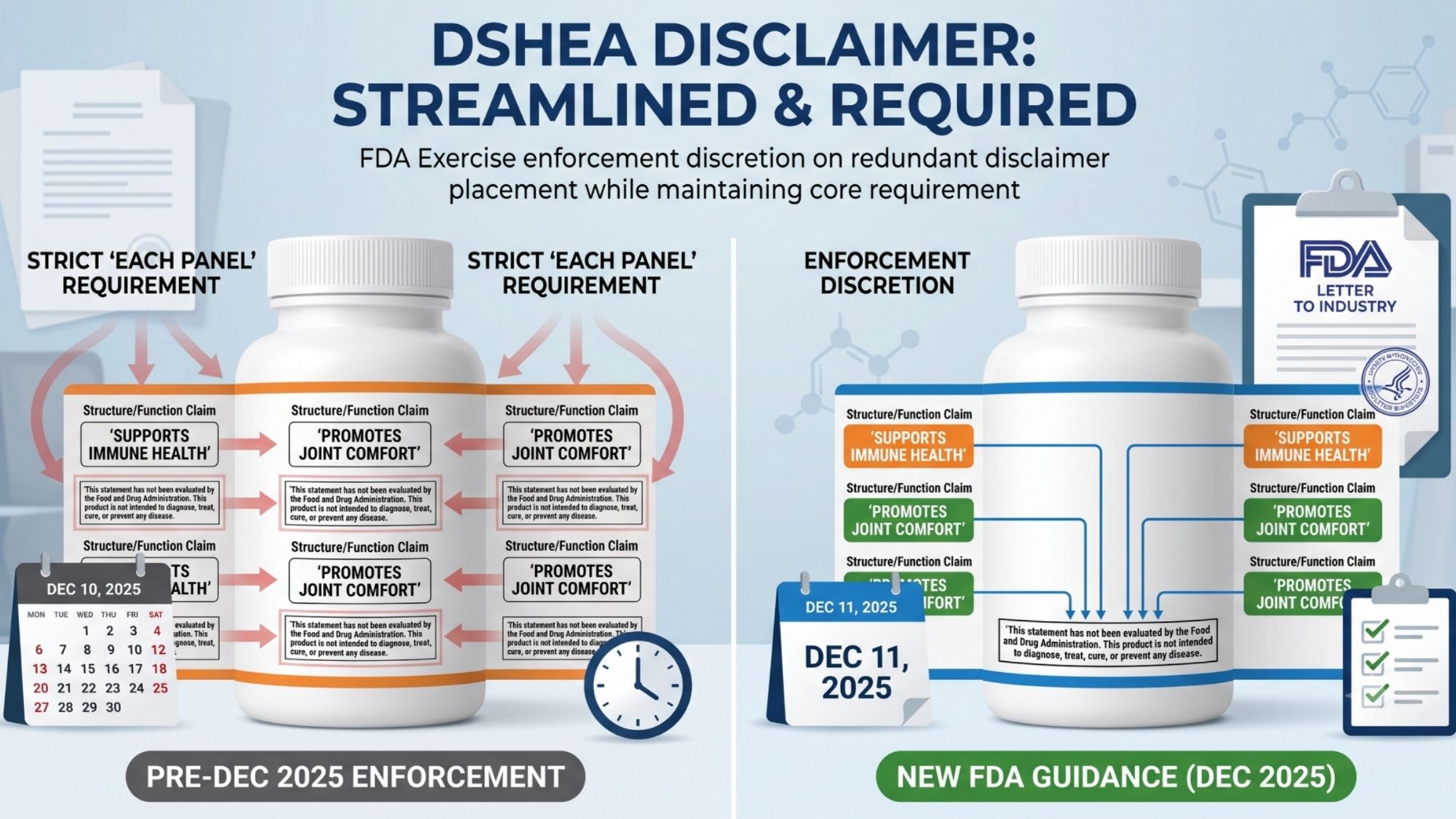
Until December 2025, FDA’s stated position was that this disclaimer had to appear on every single panel of the label where a structure/function claim appeared, which meant a lot of repeated boilerplate text on smaller packages.
On December 11, 2025, FDA sent a letter to the industry announcing it will exercise enforcement discretion on that specific “each panel” requirement (Source: FDA letter to industry, December 11, 2025; corroborated by NutraIngredients and multiple law firm summaries including Hogan Lovells and Kleinfeld Kaplan & Becker). What that means in practice:
- Still required: the disclaimer must appear on the label, and it must be linked to each structure/function claim it covers.
- No longer strictly enforced: repeating the disclaimer on every panel where a claim appears.
- Not yet final: FDA said it’s likely to propose a formal rule change if this review doesn’t turn up concerns, but this is enforcement discretion today, not a rewritten regulation.
If your label design has been cramming a repeated disclaimer onto every panel to stay safe, this is worth revisiting with whoever handles your labeling, though “worth revisiting” is different from “you can remove it entirely.” The disclaimer itself isn’t going away.
Selling supplements on Amazon and your own site?
eFulfillment Service handles FBA prep and direct-to-consumer fulfillment out of the same facility, with lot-level tracking that follows the product across both channels.
Your product listing counts as labeling too
FDA’s legal definition of “labeling” is broader than the sticker on the bottle. It covers written, printed, or graphic material that accompanies the product, and FDA has long treated a product’s marketing claims, including on a website or a marketplace listing, as part of that picture when evaluating a product’s intended use. A structure/function claim made only on your Shopify product description, never printed on the physical label, is still a claim FDA can evaluate under the same rules.
This is a genuinely different exposure than what most first-time supplement founders expect. They proof the physical label carefully and then let a copywriter loose on the Amazon listing with none of the same discipline.
Your FNSKU sticker is a different thing entirely, and it’s easy to confuse the two. The FNSKU barcode Amazon requires for FBA inventory is a warehouse tracking label, not an FDA label. It identifies the unit for Amazon’s fulfillment system. Getting your FBA labeling right solves a logistics problem. It does nothing for FDA compliance, and neither does the reverse.
Running FBA and DTC out of the same warehouse?
eFulfillment Service handles Amazon FBA prep and direct-to-consumer fulfillment under one roof, without treating them as the same workflow. Keep your marketplace and owned-channel orders both moving without picking a single lane.
The Prop 65 problem: heavy metals and the warning label
California’s Proposition 65 sets a maximum allowable dose for lead exposure at 0.5 micrograms per day. For comparison, USP’s own permitted exposure limit for lead in dietary supplements is 10 micrograms per day, twenty times higher (Source: OEHHA). A product can be fully USP-compliant on heavy metals and still trigger a mandatory Prop 65 warning label for any customer shipped to California.

Independent testing shows this happens often:
- Consumer Reports’ October 2025 testing of protein powders flagged one product at 143% of its lead level of concern
- Clean Label Project testing of 160 protein powder products found 47% exceeded California’s Prop 65 limits for heavy metals in a single serving
- Plant-based proteins (pea, rice, hemp) averaged 10 to 15 times more lead contamination than whey, because plants absorb heavy metals from soil regardless of organic certification
- A class action was filed July 7, 2026 alleging undisclosed lead, cadmium, and arsenic in a protein powder sold at Costco, and Texas’s attorney general opened a separate protein powder heavy-metal investigation in June 2026
The Prop 65 warning requirement isn’t a product ban. A supplement can legally be sold with heavy metal levels above the threshold, but only with the warning label attached. Selling into California without one, when your product’s actual metal content would require it, is the exposure.
If you sell any plant-based protein, greens powder, or botanical-heavy formula, this is worth independent lab testing before a customer, a competitor, or a plaintiff’s firm does it for you.
Not sure what's actually in your greens powder or plant protein?
Heavy metal testing is outside what a 3PL does, but clean lot tracking is what lets you act fast if a specific batch needs a warning label added or gets pulled. See how lot-level tracking works for exactly this kind of situation.
What’s not your problem yet: front-of-package labeling
FDA proposed a front-of-package “Nutrition Info box” rule in January 2025, requiring an at-a-glance box on the front of packaged food showing whether saturated fat, sodium, and added sugars are low, medium, or high. Current drafts of the rule specifically exclude dietary supplements, since supplements are governed by Supplement Facts regulations rather than Nutrition Facts (Source: FDA proposed rule).
The rule was originally expected to be finalized around May 2026. As of this writing, FDA is still working through a large volume of public comments, and it hasn’t been finalized. Worth watching if your brand also sells functional foods or beverages that would fall under Nutrition Facts rules, but not something requiring action for a straightforward dietary supplement line today.
Ready to see how a supplement-specific 3PL actually operates?
eFulfillment Service has supported dietary supplement, nutraceutical, and natural product brands for more than 20 years, with lot tracking, FEFO rotation, kitting, and returns management as standard parts of the service, not upsells.
Adding a new ingredient: the NDI notification
If you’re formulating with an ingredient that wasn’t part of the food supply before October 15, 1994, and hasn’t been previously notified to FDA, you likely need a New Dietary Ingredient (NDI) notification. Under Section 413(a)(2) of the FD&C Act, that notification has to reach FDA at least 75 days before the product ships in interstate commerce.
FDA released new educational materials on this process in June 2025, including two videos and a fact sheet, specifically because so many NDI submissions arrive incomplete (Source: FDA, June 11, 2025). Common issues FDA flagged include missing safety data and unclear identification of the ingredient itself.
This mostly affects brands introducing genuinely novel ingredients, not brands reformulating with established ones. If your next product uses an ingredient no other supplement on the market currently contains, loop in a regulatory consultant before your first production run, not after.
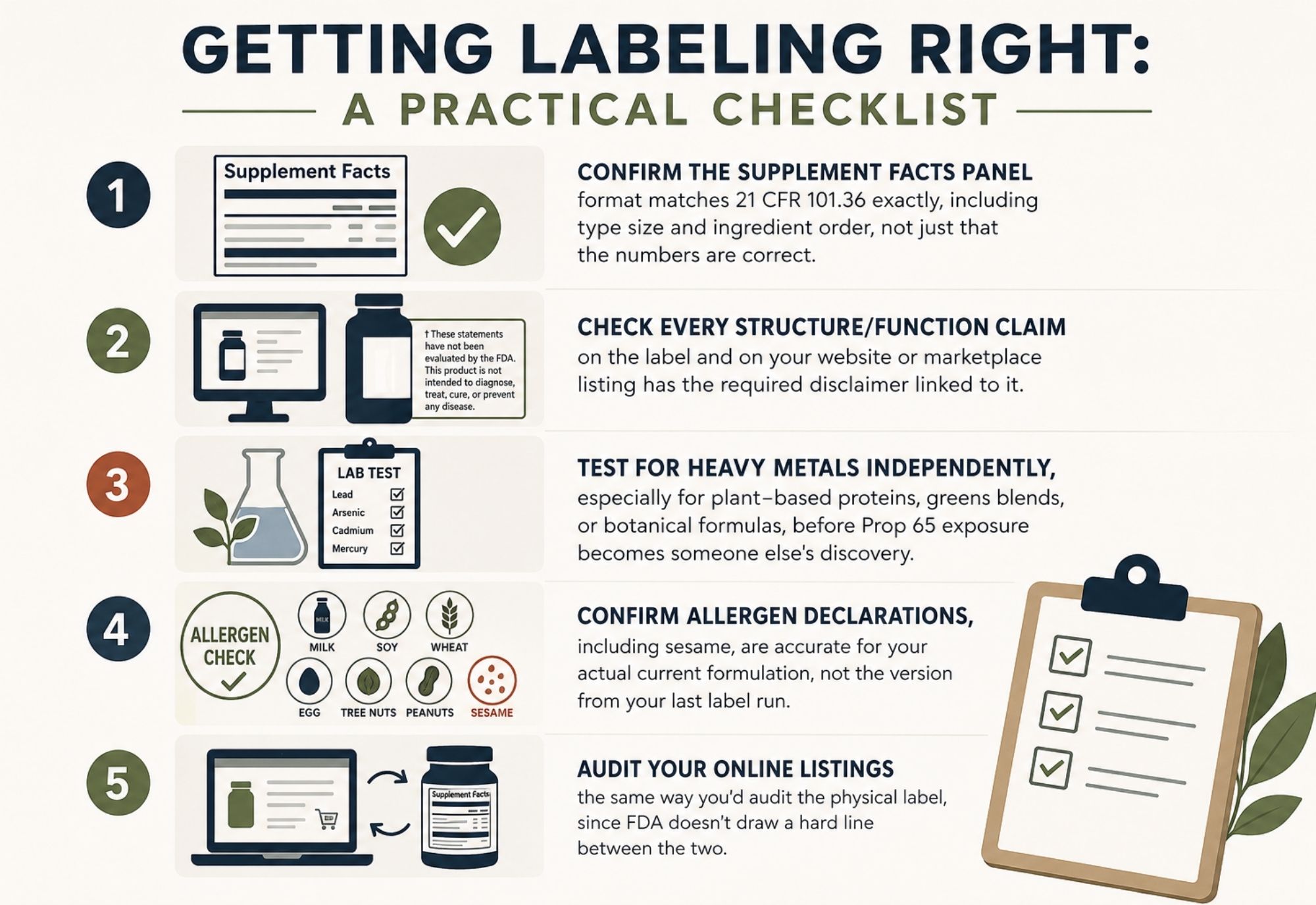
Getting labeling right: a practical checklist
Before your next label goes to print, or your next listing goes live:
- Confirm the Supplement Facts panel format matches 21 CFR 101.36 exactly, including type size and ingredient order, not just that the numbers are correct.
- Check every structure/function claim on the label and on your website or marketplace listing has the required disclaimer linked to it.
- Test for heavy metals independently, especially for plant-based proteins, greens blends, or botanical formulas, before Prop 65 exposure becomes someone else’s discovery.
- Confirm allergen declarations, including sesame, are accurate for your actual current formulation, not the version from your last label run.
- Audit your online listings the same way you’d audit the physical label, since FDA doesn’t draw a hard line between the two.
FAQs: FDA Supplement Labeling
What are the required elements on a dietary supplement label?
Nine elements: statement of identity, net quantity, the Supplement Facts panel, ingredient list, name and place of business, a domestic adverse-event contact, allergen declarations, country of origin where applicable, and a lot or batch code.
Did the DSHEA disclaimer requirement change?
Partially. As of December 11, 2025, FDA exercises enforcement discretion on requiring the disclaimer to appear on every panel where a structure/function claim appears. The disclaimer itself, and the requirement to link it to each claim, is still required.
Does my website product description count as FDA labeling?
Yes, functionally. FDA's definition of labeling extends to marketing material that accompanies a product, including website and marketplace listings, and structure/function claims made there are evaluated the same way as claims printed on the bottle.
Do I need a Prop 65 warning on my supplement?
If your product exposes a California customer to 0.5 micrograms or more of lead per day, or exceeds thresholds for other listed chemicals, yes. This is common enough in plant-based proteins and greens powders that independent testing is worth doing proactively rather than finding out from a lawsuit.
Is the new FDA front-of-package labeling rule going to affect my supplement?
Not under current drafts. Dietary supplements are excluded from the proposed front-of-package "Nutrition Info box" rule, which is designed for conventional foods labeled under Nutrition Facts rules. The rule also hasn't been finalized yet.
When do I need to submit a New Dietary Ingredient notification?
When your product contains an ingredient that wasn't part of the food supply before October 15, 1994, and hasn't already been notified to FDA. The notification is due at least 75 days before you ship the product.
Key Takeaways
- Nine elements are legally required on every supplement label, and the Supplement Facts panel has its own strict formatting rules separate from what ingredients you list.
- The DSHEA disclaimer requirement partially changed on December 11, 2025. The disclaimer itself is still required; repeating it on every panel is no longer strictly enforced.
- Your website and marketplace listings are FDA labeling too, not a separate, lower-risk space from the physical bottle.
- FNSKU barcodes are an Amazon logistics requirement, not an FDA one. Getting one right does nothing for the other.
- Prop 65’s lead threshold (0.5 mcg/day) is twenty times stricter than USP’s own limit (10 mcg/day). Independent testing, especially for plant-based proteins and greens powders, is worth doing before a lawsuit does it for you.
- Front-of-package labeling is not currently a supplement problem. The proposed rule excludes dietary supplements and hasn’t been finalized.
Whatever stage you’re in, the fastest way to find out if a provider will actually deliver what they promise is to ask the questions in this guide before you sign, not after your first invoice arrives. eFulfillment Service will walk through exact, itemized pricing and a real point of contact from the first conversation. Get a free quote and see how DTC fulfillment works when nothing is hidden until month two.

0 Comments