
Most e-commerce budgets are spent chasing the sale. Ads, offers, landing page tests, the whole acquisition machine.
Then an order comes in, and the brand goes quiet, as if the work is done. But whether the customer decides to buy again is where retention is actually won, and most brands sleepwalk through it.
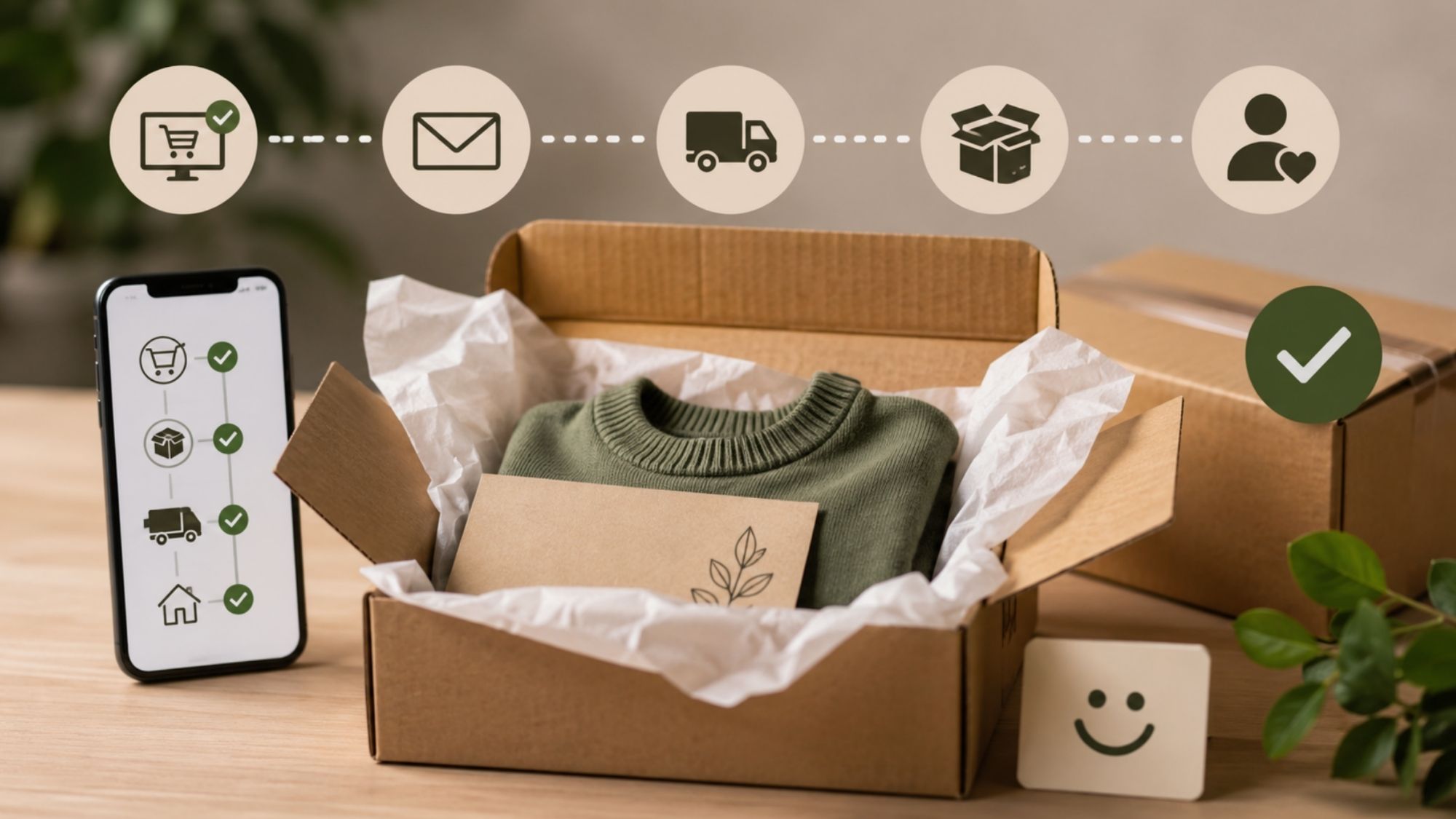
Call it a Repeat Customer Engine: a system that treats every fulfillment touchpoint from confirmation, tracking, delivery, unboxing, to following up as a small promise you either keep or break.
Keep enough of them in a row and the second purchase stops being a marketing problem.
The math justifies the effort.
Bain & Company found that a 5% improvement in retention can lift profits by 25% to 95%.
McKinsey puts the revenue upside of getting personalization right at 10–15%, with better marketing efficiency on top. That upside lives almost entirely in the window nobody staffs properly.
The Four Touchpoints That Carry the Weight
Each stage below earns different treatment. Confirmation and follow-up are where most of the revenue leverage sits. Packaging and delivery are mostly about not breaking trust you already have. Here’s how they break down.
Order confirmation and shipping updates
Send the confirmation instantly. Not in five minutes. The gap between placing an order and seeing an email is a gap the customer fills with doubt, and doubt is expensive.

What the confirmation and update flow should do:
- Confirm the order with details, expected ship date, and a way to modify or cancel
- Route all tracking through one branded link instead of dumping people onto a carrier page
- Flag delays before the customer notices them
WISMO (“where is my order?”) tickets are consistently among the highest-volume inquiries an e-commerce support team handles, and Zendesk has documented playbooks for cutting them through proactive updates and a self-serve tracking link.
Fulfillment with a Personal Touch.
See How Using a 3PL like eFulfillment Service sellers saves time. Get a Free Quote from eFulfillment Service Today!

Every WISMO ticket you prevent is an agent hour you get back and a customer who never had to feel ignored.
Packaging and unboxing
Unboxing is the first physical contact anyone has with your brand. That doesn’t mean tissue paper and confetti. Thoughtful is cheaper than most brands assume:
- Right-sized, clean materials with a deliberate reveal
- A short note that helps the customer get more from what they bought
- A QR code to set up guides or care instructions
- A sample that actually relates to the purchase
If sustainability is part of your positioning, the box is where you prove it or expose it.
The unboxing bar rises with the emotional weight of the product. Shops that sell vinyl record frames or race-day keepsakes are shipping something the customer plans to look at for years, and the packaging has to open like it knows that. But even a commodity product benefits from a reveal that feels considered rather than fulfilled.

Allbirds publishes openly about recycled, right-sized packaging and why it matters.
When the message on the website and the material in the customer’s hands agree, that consistency registers. When they don’t, recycled-everything marketing wrapped in three layers of virgin plastic, customers notice that too.
Delivery
Speed matters less than people think. Certainty matters more.
A package that arrives in five days as promised builds more trust than one that arrives in three days after being promised two. Customers will tolerate reasonable timelines; what they won’t tolerate is being kept in the dark while their money sits in someone else’s account.
Alex Byder, Founder of BD Homebuyer, works in real estate transactions where the stakes of a missed timeline are measured in tens of thousands of dollars, and he sees the same trust mechanics at any price point.
He said, “People do not remember the fast transactions, they remember the ones where nobody surprised them. Tell someone exactly what is happening and when, and you can survive almost any delay. Go quiet for two days, and you have lost them, even if everything arrives on schedule.”
Give options where you can, like standard and expedited tiers, pickup points, lockers, clear same-day cutoffs. If your carriers offer delivery photos or drop-off instructions, surface them. Control is the product here.
A customer who chose their delivery window feels different about a hiccup than one who had it inflicted on them.
Post-delivery follow-up
The package landing is not the end of the sequence. It’s the moment the customer is most engaged with your brand all year, and most brands spend it silent.
A light sequence works:
- Delivery confirmation with quick tips or setup guidance
- A check-in two or three days later, timed to catch problems before they become returns
- A review or UGC request once they’ve actually used the thing
- A replenishment or cross-sell nudge timed to how often people typically rebuy that product
The check-in deserves more weight than it usually gets. A beauty brand that emails application tips 48 hours after delivery is intercepting before it becomes a return label.
Returns prevented this way never show up in a dashboard, which is exactly why nobody budgets for them.
Replenishment timing is where recurring-need products quietly print money. Health brands understand this better than most. A patient who orders TRT online gets refill nudges timed to the prescription cycle, not to a marketing calendar. Retail can borrow that logic wholesale.
This window is also the natural moment to invite people into loyalty or referral programs. They just experienced the brand at its most tangible. The pitch writes itself.
The Tooling Underneath It
None of this holds up manually past a few dozen orders a day. But the answer is a small number of tools that pass data cleanly.
Order management feeding shipping. Shipping feeding the tracking page and the ESP.
Everything feeding the help desk, so an agent opening a ticket sees the order, the carrier scans, and the customer’s history in one screen instead of three tabs.
The practical building blocks:
- Automated confirmations and shipping notifications via email and SMS
- A branded tracking page treated as owned media, customers check it four, five, six times per order, which makes it prime real estate for helpful content and well-timed offers
- Exception workflows that flag address errors, missed scans, and split shipments so support moves before the customer does
- Segments built from behavior: first-time vs. repeat, high-value, replenishment cycles, at-risk

Personalization here doesn’t need predictive models on day one.
If phone calls are part of how orders or issues come in, route them so those conversations land in the same customer record as the emails and carrier scans. An agent who can see that the customer already called twice handles the third contact very differently.
Brands That Treat This as the Main Event
Chewy built a retention story almost entirely out of post-purchase gestures, handwritten notes, surprise pet portraits, flowers sent when a customer’s pet dies. None of it scales in a spreadsheet sense, and that’s the point. The gestures signal that the relationship outranks the transaction, and customers repay that in tenure.
Glossier made the pink pouch a shareable object. Packaging as marketing, not protection.
Allbirds runs its values through the logistics layer, so the materials in the customer’s hands reinforce the reason they bought.
Smaller operators do versions of this constantly without press coverage. An outdoor gear shop that drops trail recommendations into the confirmation email.
A supplement company that times refill reminders to when the bottle actually runs low. Unglamorous, cheap, effective. Helpful scales in a way that flashy doesn’t.
Measuring Whether Any of It Works
Post-purchase is usually the least instrumented part of the funnel, which means most brands are guessing about the part of the journey with the highest profit leverage.
Gregor Emmian, Deputy Chief Digital Growth Officer at Rise, watches retention economics daily because in fintech, a user who stays is worth multiples of one who churns.
He said, “Most teams obsess over the acquisition dashboard and check retention once a quarter. Flip that. Repeat rate and lifetime value tell you whether the business compounds or leaks, and post-purchase behavior is the earliest signal you get. Read it weekly and act on it, because by the time churn shows up in revenue you are six months late.”
Worth tracking:
- Repeat purchase rate and time between orders
- CLV by cohort
- NPS collected after delivery, not at random
- WISMO ticket rate, and what share gets deflected by proactive updates
- On-time delivery rate and order-to-ship time
- Fulfillment accuracy like mis-picks, damages
- Return rate with reason codes, plus time to refund
- Open, click, and conversion rates on post-purchase emails and the tracking page
- Review volume and rating distribution by product
Don’t try to move all of it at once. Pick one or two lagging metrics a month, trace them back to a moment you can actually touch, change the moment, watch the number. Twelve months of that and you have a playbook grounded in your customers instead of someone else’s case study.
Where to Start
Place a test order on your own store. Read every email that arrives. Track the package the way a customer would. Open the box at your kitchen table.
Somewhere in that walk-through, something will feel off. Fix that one thing this week. Then do it again next week. The engine gets built one kept promise at a time, and the compounding does the rest.
Of course, none of these touchpoints work if the underlying fulfillment is shaky.
If picking, packing, and shipping are eating the hours you should be spending on customer experience, eFulfillment Service handles order fulfillment for growing e-commerce brands, with no minimums and the kind of accuracy that makes every promise upstream easier to keep.

About the Author
Jesse Galanis is a professional writer whose aim is to make complex concepts easy to understand. He strives to provide quality content that assists people in everyday life.


0 Comments