
You’re between chapters, phone open during a lunch break, when a new comment lands on the campaign page: “Any update on shipping? It’s been three weeks since you said ‘soon.'” Three more comments below it echo the same question in different words.
The campaign funded four months ago. Books arrived from the printer three weeks ago. Somewhere between “funded” and “arrived,” 1,400 backer addresses turned from a spreadsheet into a shipping problem nobody scheduled time to solve.
This is the moment most crowdfunded book creators hit, and it’s rarely because the book itself went wrong. It’s because reward fulfillment for a few thousand backers is a different operation than shipping a few orders a week from a self-published storefront, and the gap between those two only shows up once the packages need to move. This article is a companion piece to our complete guide to book fulfillment for publishers and authors, which covers the fulfillment landscape end to end; this guide narrows in on the specific mechanics of a crowdfunding reward spike.
Already know you need a book-specialist 3PL?
eFulfillment Service has shipped millions of books for indie authors, small presses, and subscription boxes with ISBN-level inventory tracking, Media Mail routing, and street date enforcement built in.
Why book campaigns fulfill differently than a normal book launch
A self-published author selling from their own site ships a handful of orders a day, on their own schedule. A funded crowdfunding campaign compresses hundreds or thousands of orders into a single delivery window, all promised around the same date, to backers who have already paid and are watching a public comment thread.

That combination changes the job in three ways:
- Volume arrives all at once. Take a different campaign as an example: one that raised $40,000 from 900 backers doesn’t ease into fulfillment; it needs 900 packages moving in roughly the same stretch of weeks.
- The audience is watching in public. Backers compare notes in the comments section and in Kickstarter’s own update threads. A delay for one backer becomes a delay every other backer can read about.
- Reward tiers multiply the SKU count. A single title easily becomes a dozen fulfillable combinations once you stack signed copies, bundles and shipping-tier splits on top of the base edition.
Treat reward fulfillment as its own project, with its own timeline, rather than an extension of however you’ve been shipping books so far.
The Timeline You Actually Have
Kickstarter’s own guidance is blunt about the realistic window: it typically takes about a year from the day a campaign ends to the day the last backer receives their reward. Kickstarter presents this as the typical, expected timeline for a funded campaign.
Kickstarter breaks the post-campaign period into rough phases, and they’re worth mapping against your own calendar the day your campaign closes:
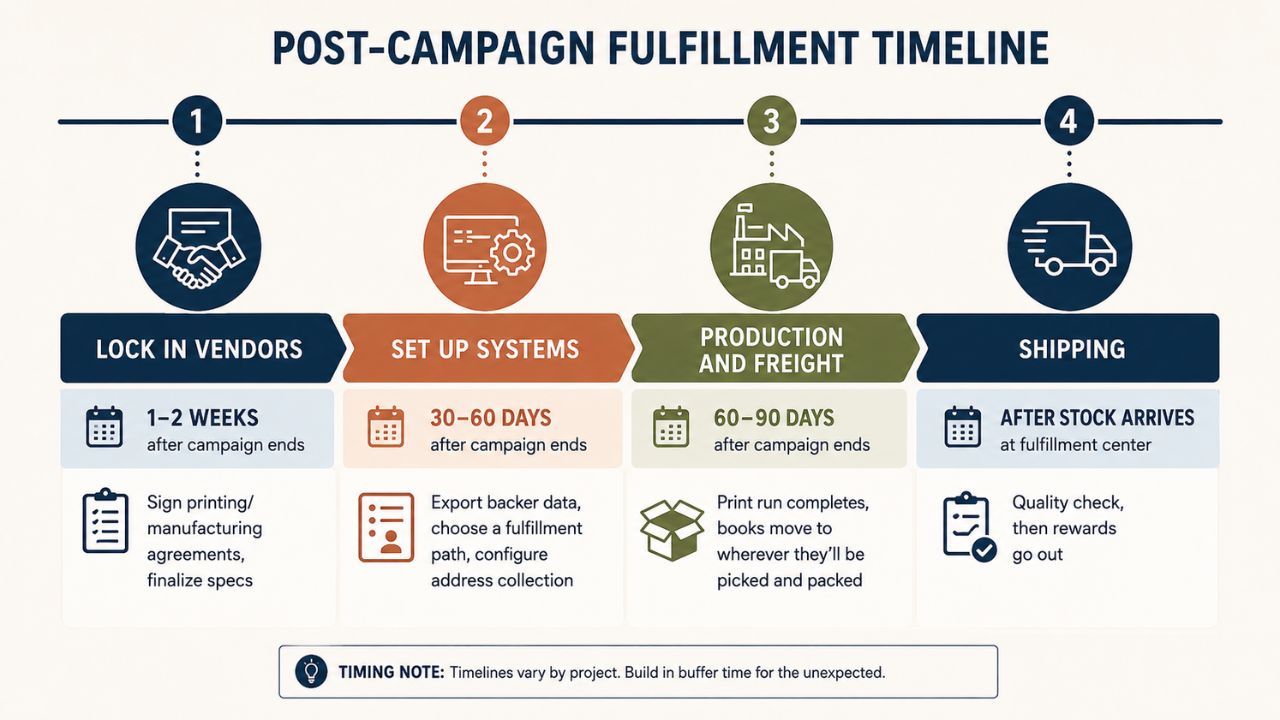
That “shipping” row is doing more work than it looks like on a table. For a campaign with a few thousand backers, actually getting packages out the door, including address corrections, batch printing, customs paperwork, and the inevitable reshipped or damaged item, routinely stretches across several months on its own. That’s the real reason the timeline runs closer to a year than a few weeks, even once the book itself exists.
Books are usually faster to produce than hardware or apparel: no tooling, no factory queue behind a dozen other clients. That speed is exactly why creators underestimate the shipping phase. The printing goes fine. Then several hundred packages need addresses verified, postage bought, and boxes packed, and that part takes real operational hours no matter how smoothly the book itself came together.
One widely cited (if dated) data point gives a sense of how common lateness has been on large campaigns: a 2012 CNNMoney analysis of Kickstarter’s 50 most-funded projects at the time found that 84% shipped later than promised, with only 8 hitting their original delivery date. That sample skewed toward large hardware campaigns, not books, and the platform has matured since. Book campaigns also rarely carry the manufacturing risk that a hardware campaign does. Kickstarter hasn’t published an updated version of that figure broken out by category, so there’s no good data on what share of book-only campaigns hit their promised date today. What holds up anecdotally is the underlying pattern: creators plan the campaign and the printing, then treat “shipping” as a footnote instead of the phase that eats the most unplanned time.
Save Time and Let us Handle Your Book Fulfillment!
See How Using a 3PL for saves Amazon sellers time. Get a Free Quote from eFulfillment Service Today!
Pricing shipping before you launch, not after
The single most common mistake, according to BackerKit’s own shipping guidance for creators, is not working out fulfillment logistics until after the campaign has already funded. By then, reward tiers are locked in, and any shipping cost you underquoted comes straight out of your margin.

Get shipping priced correctly before you launch:
- Weigh the full package as it ships. Include the box and packing material, plus every add-on bundled into that tier. A 6″x9″ hardcover with a signed bookplate and a sticker sheet weighs and prices differently than the book alone.
- Separate domestic from international pricing. International shipping on a book-weight package can cost as much as the book itself. Charging a flat rate that only works domestically is the fastest way to lose money on every overseas backer. Our dedicated guide to international shipping for Kickstarter rewardscovers the specifics.
- Check Media Mail eligibility early. USPS Media Mail is the cheapest domestic option for pure book shipments, but a reward that bundles a book with unrelated merchandise, like an enamel pin or a t-shirt, can disqualify the whole package from that rate. Know which tiers qualify before you price them.
- Build padding into the shipping budget itself. Postage rates change and dimensional weight surprises happen. A tier priced for a paperback shouldn’t be the one straining your budget once a stretch goal turns it into a two-book bundle.
Self-fulfillment vs. a pledge manager vs. a 3PL
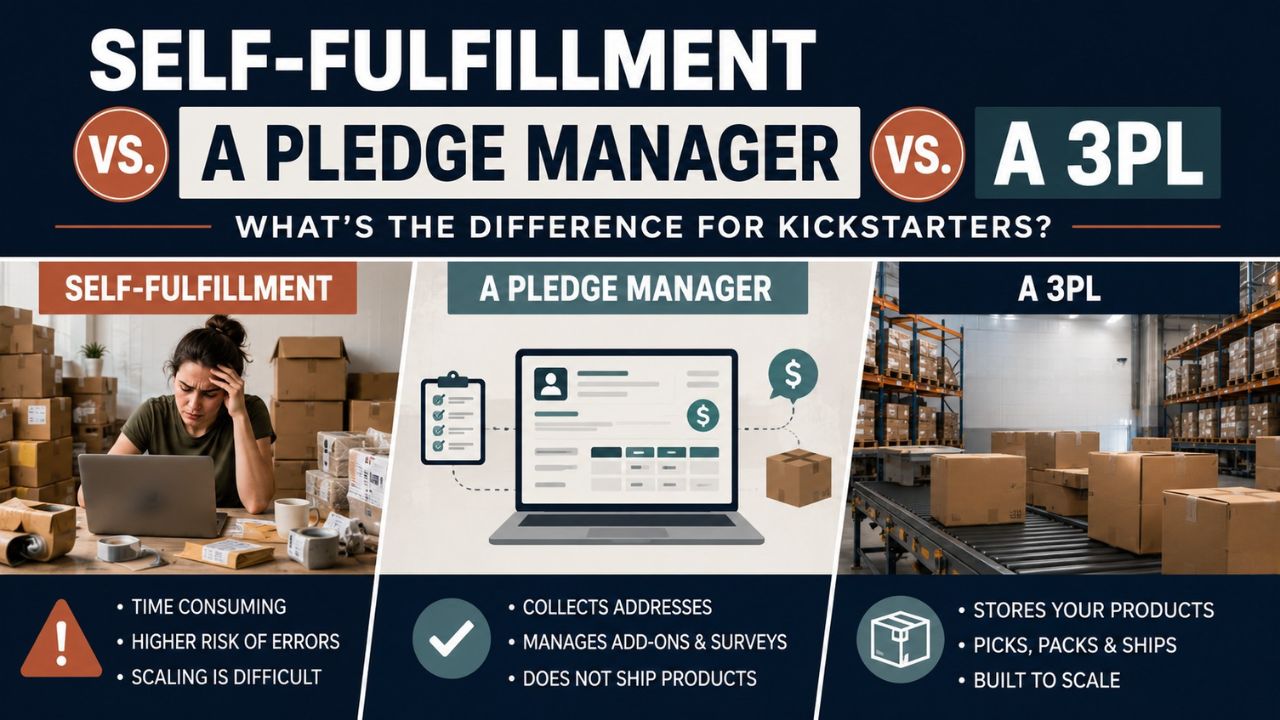
Once the print run is confirmed, three paths are realistic. The right one depends mostly on backer count.
Self-fulfillment
Packing and shipping every reward yourself works for small campaigns only: low hundreds of backers, a single reward tier, no international shipping. Below that scale, the labor is manageable, if tedious. Above it, hours disappear fast: printing labels, weighing packages, driving to the post office, then doing it all again the next day.
A pledge manager’s built-in shipping tools
Platforms like BackerKit offer bulk postage tools for creators handling the shipping themselves. For campaigns under roughly 2,500 orders, these tools let you buy discounted USPS postage and print labels in bulk, with backers automatically sorted into package groups by reward tier. It’s a middle ground: still DIY, but with software doing the sorting and rate-shopping instead of a spreadsheet.
A 3PL that handles Kickstarter and crowdfunding orders
Past a certain backer count, or once international shipping and multiple SKUs complicate things, handing the physical work to a fulfillment center becomes the more realistic option. eFulfillment Service is one example of a Kickstarter 3PL (third-party logistics provider) built for this specific spike. It generally looks for a minimum of around 200 backer orders and charges no storage or receiving fees on crowdfunding inventory. eFulfillment Service has filled thousands of Kickstarter orders total.
A 3PL isn’t the right call for every campaign. Plenty of a few-hundred-backer campaigns are genuinely better off staying DIY or leaning on a pledge manager’s postage tools instead of paying for a 3PL they don’t yet need. If your numbers are past that point, though, it’s worth knowing the real cost before deciding either way.
Shipping special editions without the Media Mail guesswork
If your book releases regularly include bonus items, kitting them correctly and mailing them compliantly is exactly the kind of detail eFulfillment Service handles for author and publisher clients every day.
What actually causes the delays
Delays rarely trace back to one dramatic failure. They accumulate from small decisions made or skipped during the “set up systems” phase of the timeline above. The pattern that shows up most often:
- Address collection starts too late. Waiting until books arrive to start collecting or verifying backer addresses adds weeks that didn’t need to exist. Open address collection as soon as the campaign closes.
- No plan for undeliverable or changed addresses. Some backers move or mistype an address without noticing. Build in a follow-up window before the ship date to catch it before packages go out.
- Reward tiers weren’t finalized before pricing shipping. A stretch goal that adds a bonus item after the campaign has already funded means re-pricing shipping on tiers you already promised at a lower cost.
- No contingency for the print run running long. Even book printing, generally faster than hardware manufacturing, can slip. A shipping plan with zero slack turns any printer delay directly into a missed delivery date.
- The creator assumes shipping will take about as long as receiving packages did when buying supplies. It doesn’t. Packing and shipping hundreds of individually addressed, tier-specific packages takes meaningfully longer per unit than receiving a single bulk shipment.
Board game Kickstarters get the reputation for shipping horror stories, but book backers notice a delay just as fast. Someone waiting on a signed first edition checks the tracking page constantly.
None of this requires a bigger book or a better printer to fix. It requires treating the shipping phase as a project with its own deadlines, starting the day the campaign funds.
After the campaign: what changes once rewards ship

Fulfillment doesn’t end when the last package leaves the building. Crowdfunded audiences generate a specific kind of post-shipping workload:
- Replacement requests for damaged books. A book shipped in a padded mailer can still arrive with a bent corner or a crushed spine, and backers who already waited months for delivery are unusually quick to flag it.
- Address corrections after the fact. A package that bounces back as undeliverable needs a resolution path, and backers expect a faster answer than a typical retail customer would tolerate.
- A public comment thread that stays open. Unlike a normal ecommerce order, backers can see how you respond to other backers’ issues in real time, which raises the bar on how fast and how visibly problems get resolved.
This is also where the difference between a fulfillment partner and a one-time shipping favor shows up. A 3PL that’s handled crowdfunding orders before already has a process for exactly this kind of post-ship support; a friend with a garage does not.
If you’re planning more than one campaign
Some book creators run a single campaign and go back to steady direct sales afterward. Others use crowdfunding as a recurring launch mechanism, returning with a new title or special edition every year or two. If that’s the plan, the fulfillment relationship becomes even more important.
Some book creators run a single campaign and go back to steady direct sales afterward. Others use crowdfunding as a recurring launch mechanism, returning with a new title or special edition every year or two. If that’s the plan, the fulfillment relationship becomes even more important.
A one-time DIY shipping push is survivable once. Rebuilding that shipping process from scratch for every campaign has an ongoing cost: relearning postage rates and retraining whoever packs the boxes, every single time. Creators who’ve moved to selling books direct year-round between campaigns often find that keeping inventory with the same fulfillment partner between launches means the next campaign’s reward shipment starts from an existing setup instead of a blank slate.
Efficiency Tip: Partnering with an 3PL can free up your time to focus on what you do best, sell great products!
Get a Free Quote from eFulfillment Service and see how we can simplify your selling!
FAQs: Kickstarter Book Fulfillment
How many backers before self-fulfillment stops making sense?
There's no hard cutoff, but the practical strain point tends to show up somewhere in the low hundreds, especially with more than one reward tier or any international backers. Below that, most creators can manage it. Above it, the hours add up fast.
Does Media Mail work for Kickstarter book rewards?
Yes, for tiers that are books alone. A reward that bundles a book with unrelated merchandise may not qualify, so check eligibility tier by tier before you price shipping.
What's the minimum campaign size a 3PL will take on?
It varies by provider. eFulfillment Service, for example, generally looks for at least 200 backer orders for a crowdfunding shipment; smaller campaigns are usually a better fit for self-fulfillment or a pledge manager's built-in postage tools.
Should we wait until the print run arrives to start planning fulfillment?
No. Address collection and fulfillment-path decisions should happen in the first 30-60 days after the campaign closes. Shipping costs need to be finalized well before the books physically exist.
What happens to backer support after the last package ships?
It doesn't stop at delivery. Expect replacement requests for damaged items and address corrections for bounced packages in the weeks after shipping, and plan for who handles that before it starts.
Can international shipping be included at the same flat rate as domestic?
No. International shipping on a book-weight package can cost as much as the book itself. Pricing it into a flat domestic rate usually means losing money on every international backer.
Key Takeaways
- Plan for a year, not a month. Roughly twelve months from campaign close to last reward delivered is Kickstarter’s own platform-wide median; treat it as the planning baseline until your own experience gives you reason to expect faster.
- Shipping delays outnumber production delays. Books print faster than most reward categories; the phase that eats unplanned time is packing and shipping hundreds of individually addressed packages.
- Price shipping before the campaign launches, using the full packed weight of each tier including add-ons. Separate international costs from domestic rather than pricing both at one flat rate.
- Reward tier count is really SKU count. Special editions and stretch-goal bundles multiply what needs to be picked and packed correctly. Printed unit count alone leaves out the picking-and-packing work each add-on creates.
- The self-fulfillment ceiling is real but fuzzy. The low hundreds of backers is where most creators start feeling the strain, especially with multiple tiers or international backers involved.
- Support doesn’t end at delivery. Damaged-item replacements and address corrections are a predictable part of the post-ship workload for a publicly watched campaign.

0 Comments