
What are 3PL services?

3PL services are the logistics functions an ecommerce or wholesale business outsources to a third-party provider instead of handling in-house. “3PL” stands for third-party logistics: the company that stores your inventory, packs your orders, and ships them to your customers on your behalf.
A 3PL sits between your supplier and your buyer. Product arrives from your manufacturer at the 3PL’s warehouse, gets stored and counted, and then, every time an order comes in through your store, the 3PL picks the items, packs the box, and hands it to a carrier. You keep selling, and someone else runs the warehouse.
The term covers a wide range of providers, from single-facility fulfillment specialists to global freight networks. What they share is the core promise: you stop touching the physical product, and you get your time back to grow the brand.
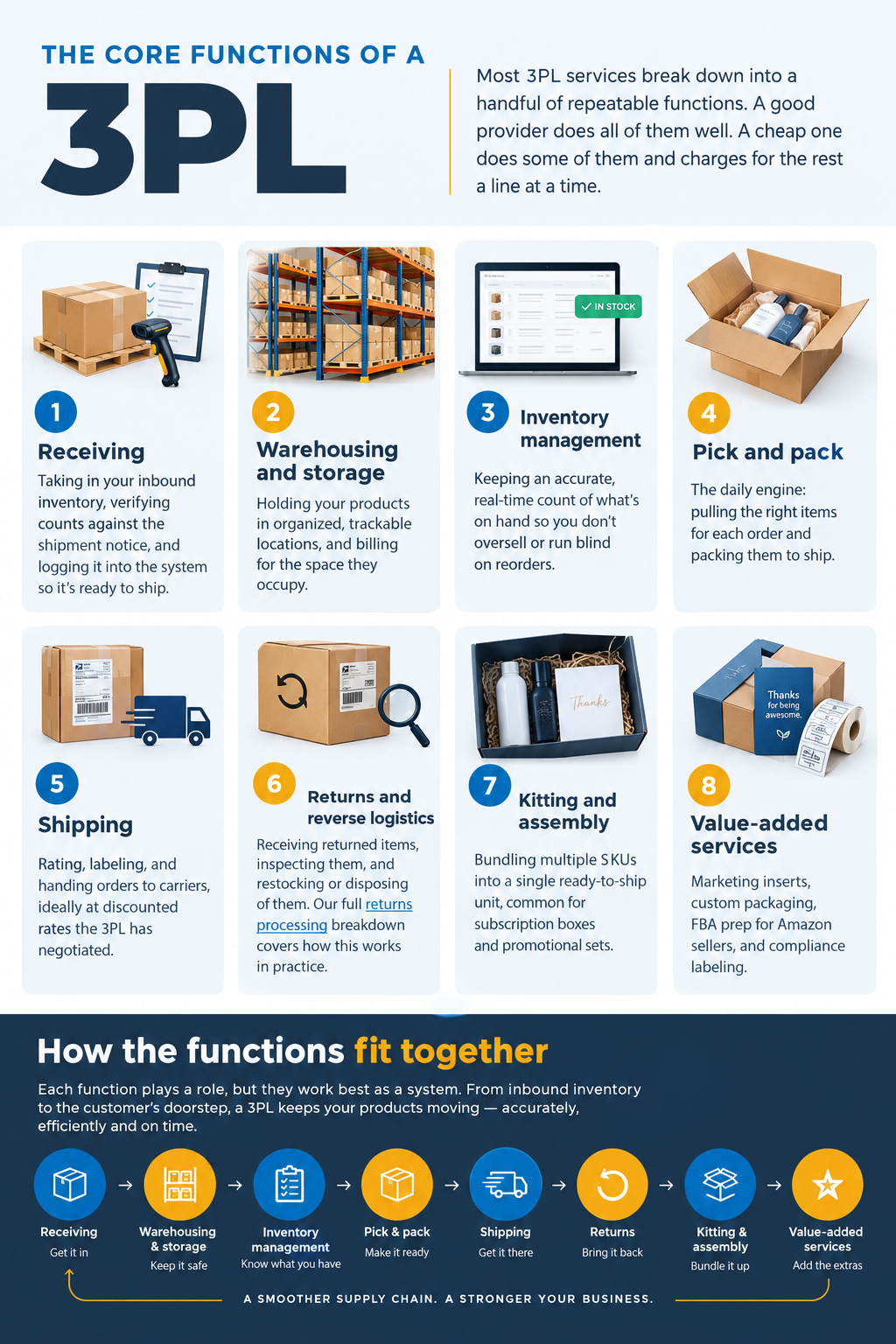
The core functions of a 3PL
The three types of 3PLs
Not every 3PL does the same job, and the label gets stretched to cover very different companies. Most fall into one of three categories.
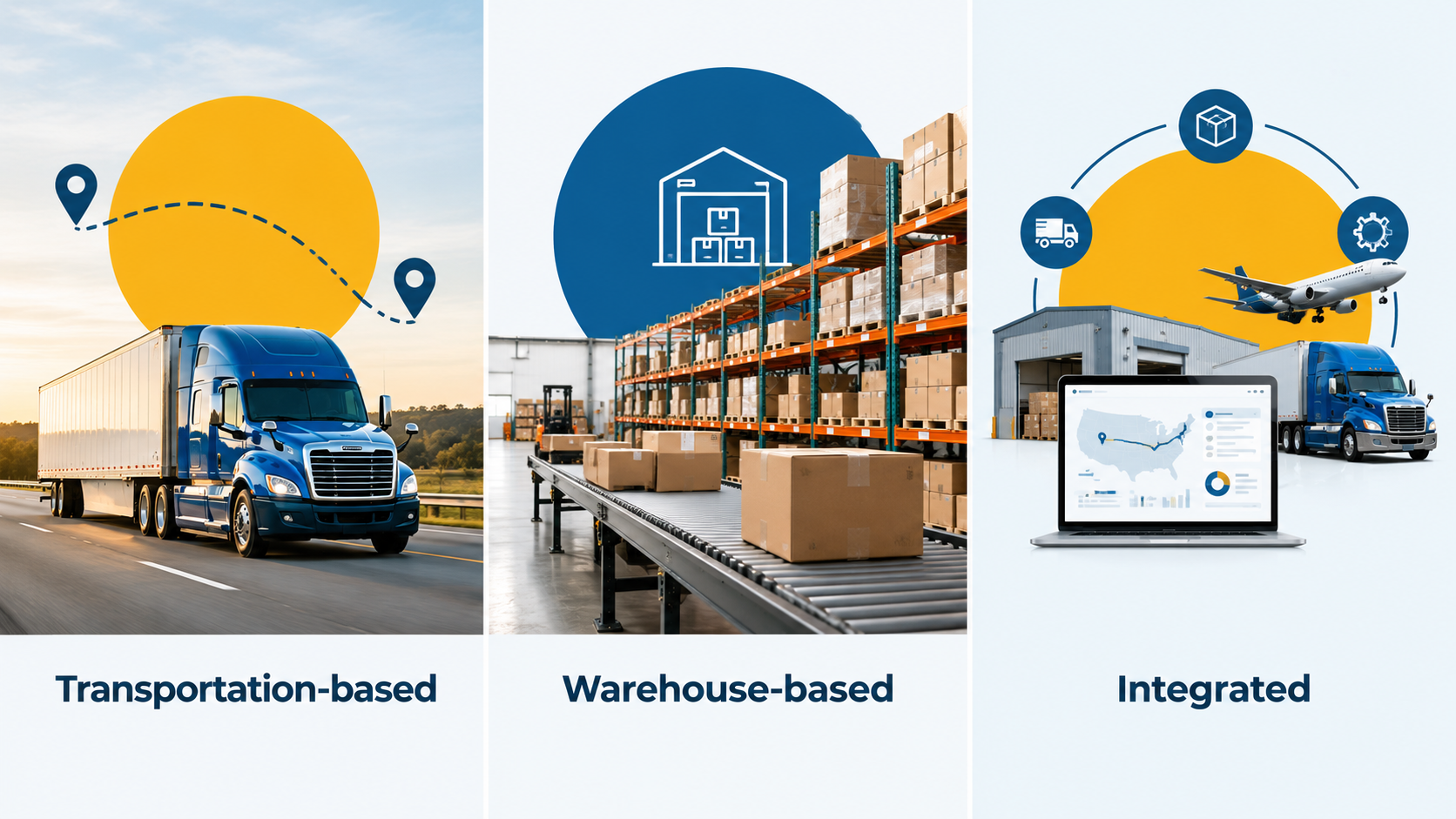
Not every 3PL does the same job, and the label gets stretched to cover very different companies. Most fall into one of three categories.
|
Type |
What they focus on |
Best fit for |
|---|---|---|
|
Transportation-based |
Freight and carrier management, moving goods between points |
Brands whose main need is shipping and freight, not storage |
|
Warehouse-based |
Storage, inventory, and order fulfillment (pick/pack/ship) |
Ecommerce and DTC brands fulfilling direct-to-customer orders |
|
Integrated |
A blend of warehousing, fulfillment, transportation, and tech |
Larger operations wanting one provider across the chain |
For most growing ecommerce brands, the relevant category is warehouse-based fulfillment: a provider that stores your product and ships individual orders to your customers. That’s the model this guide focuses on, and the one that matters when you’re comparing providers for a Shopify, Amazon, or multichannel store.
The honest caveat is that these categories blur at the edges. Plenty of warehouse-based 3PLs also manage freight, and “integrated” is a word any provider can put on a homepage. Judge a 3PL on the specific functions you need done well, not on the category it claims.
The benefits of using a 3PL
The reason to outsource fulfillment is rarely a single dramatic event. It’s the slow realization that packing orders is capping how fast the business can grow.
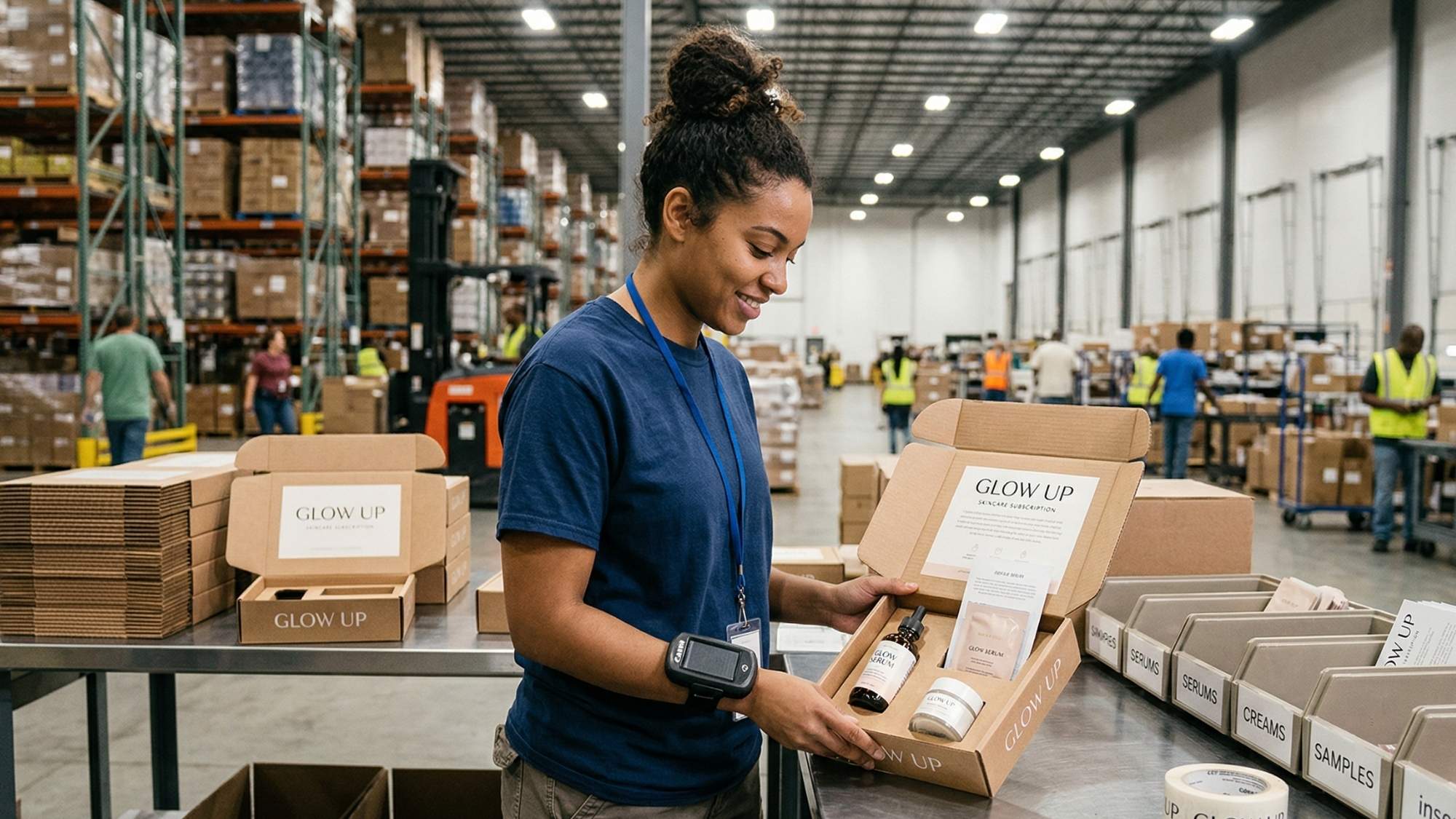
- Time back to grow the brand. Every hour spent on receiving, picking, and shipping is an hour not spent on product, marketing, or customers. For most founders, that trade stops making sense somewhere between 10 and 20 orders a day.
- Lower and more predictable shipping costs. Established 3PLs negotiate carrier discounts a single brand can’t match, which can meaningfully cut per-order shipping.
- Expertise you don’t have to hire. Peak-season staffing, carrier rate shopping, Amazon compliance, international paperwork: a good 3PL has already built the muscle.
- Room to scale without signing a warehouse lease. You add orders without adding square footage, forklifts, or payroll.
- Fewer errors at volume. A purpose-built fulfillment operation generally ships more accurately than a founder packing boxes at midnight during a sale.
Where it genuinely depends: if you’re shipping only a handful of orders a week, or your product needs hands-on custom assembly no warehouse can replicate, in-house may still be the right call for now. Outsourcing pays off when volume, not ambition, says it’s time.
Plan storage for the surplus you do order
eFulfillment Service can quote your order volume, kit complexity, and climate-control needs as separate, itemized lines instead of one blended “premium storage” number.
What do 3PL services cost?
3PL pricing is built from several separate fees, not one flat rate, which is exactly why comparing providers on a single headline number is so misleading. Published pricing guides show wide ranges because every brand’s product, order profile, and volume are different, so treat any figure as a ballpark rather than a quote.

Here are the fee categories almost every 3PL charges in some form:
|
Fee category |
How it’s usually billed |
What it covers |
|---|---|---|
|
Receiving |
Per hour or per unit/carton |
Checking in and logging your inbound inventory |
|
Storage |
Per bin, cubic foot, or pallet per month |
The space your product occupies |
|
Pick and pack |
Per order, often plus per-item |
Pulling and packing each order |
|
Shipping |
Per order (carrier cost + any markup) |
Getting the parcel to the customer |
|
Kitting / assembly |
Per unit or per hour |
Bundling SKUs into ready-to-ship units |
|
Returns |
Per package + per unit |
Receiving, inspecting, and restocking returns |
|
FBA / B2B prep |
Per item or per unit |
Prepping inventory for Amazon or retail |
|
Account / support |
Flat weekly or monthly |
Ongoing account management and support |
|
Special requests & billing |
Per instance |
One-off tasks, rush jobs, payment processing |
Directionally, published industry breakdowns tend to put pick-and-pack in the low single dollars per order, and storage anywhere from under a dollar per cubic foot to a few dollars per pallet per month. The spread is enormous, and those other categories are where a “cheap” quote quietly makes its money back.
The number that actually matters isn’t any single line. It’s your total cost per order shipped, across every category, at your real volume. That’s the only figure worth comparing between providers, and the only one a real quote can give you. Our guide to order fulfillment pricing models walks through how the pieces add up.
How to choose a 3PL: why “cheap” doesn’t always mean cheap
The cheapest 3PL quote and the cheapest 3PL are rarely the same company. A low headline rate often signals fees waiting in the other categories, or a service level that costs you later in missed shipments, inventory errors, and customer complaints that land on your brand instead of the warehouse’s.
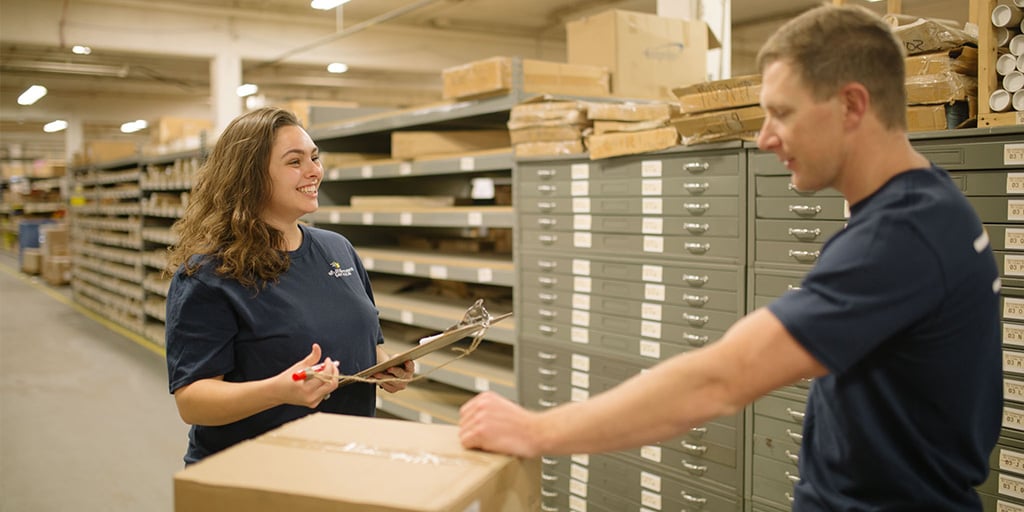
What to evaluate beyond the sticker rate
- Accuracy and error rates. Ask how they measure pick accuracy, and who pays when they get an order wrong.
- A transparent, itemized fee schedule. If a provider won’t show you the full fee list up front, assume the gaps are where the surprises live.
- No forced minimums or long contracts. Order minimums and multi-year lock-ins protect the 3PL, not you. eFulfillment Service has run on no order minimums and no long-term contracts since 2001, so brands can scale, or leave, on their own terms.
- Real integrations with your stack. The 3PL should connect cleanly to your store and marketplaces so inventory and orders sync without manual exports.
- Support you can actually reach. A dedicated contact who knows your account beats a ticket queue when something breaks mid-sale.
- A peak-season track record. Anyone can ship in February. Ask what November and December look like, and how long they’ve been doing it.
Price still matters, and you shouldn’t overpay. But the better question isn’t “who’s cheapest?” It’s “who ships my orders accurately, prices honestly, and will still be standing next peak season?”
Tired of 3PL quotes with fine print?
eFulfillment Service has helped ecommerce brands fulfill orders since 2001, with no order minimums, no long-term contracts, and a fee schedule we’ll walk you through line by line before you commit.
3PL vs 4PL: what’s the difference?
A 3PL executes logistics, and a 4PL manages the logistics providers. A third-party logistics company physically stores and ships your product. A fourth-party logistics provider (4PL) sits one level up, coordinating multiple 3PLs and supply-chain partners on your behalf and acting as a single point of oversight.
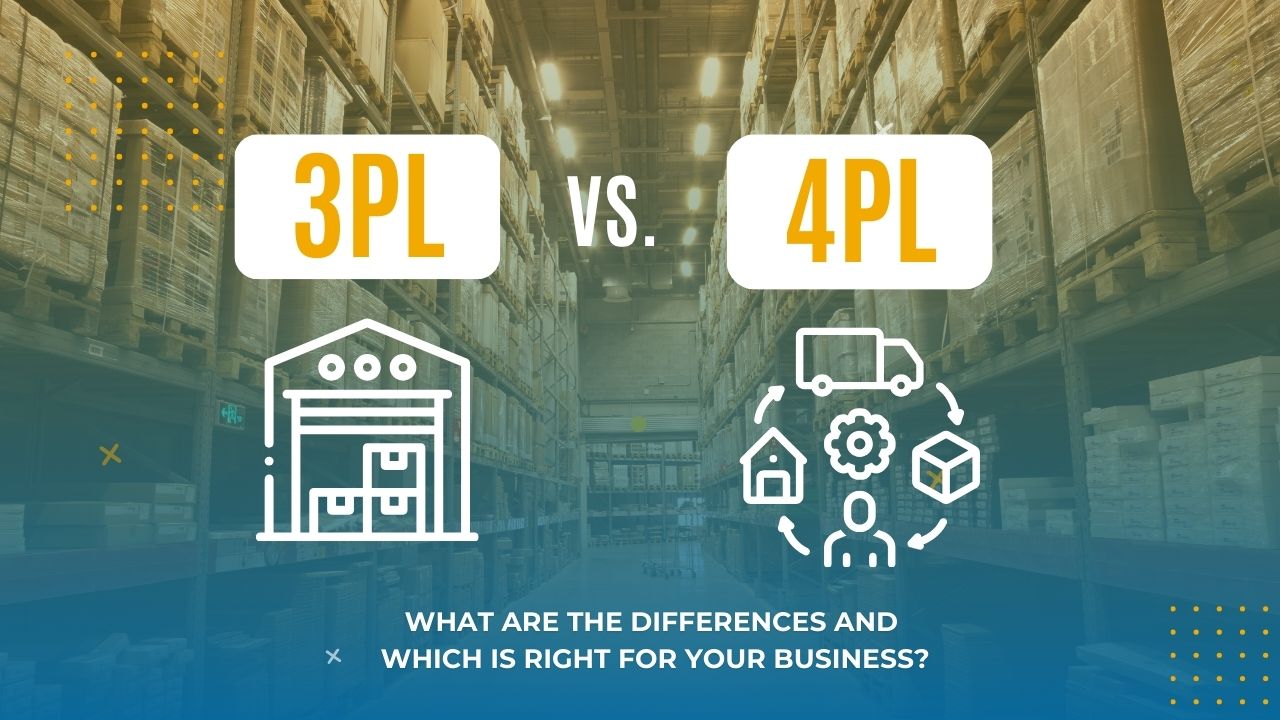
For most ecommerce brands, especially startups and growth-stage sellers, a single capable 3PL is the right answer. A 4PL makes sense for large, complex operations spanning many warehouses, carriers, and regions, where managing the managers becomes a role in itself. If you’re shipping from one or two locations, you almost certainly need a strong 3PL, not a 4PL.
Get back to growing your brand. Let EFS handle the boxes.
No minimums, free setup, no long-term contract, and a quote built around your own titles and volume. Tell EFS what you are shipping and get solid numbers back.
What are 3PL services in simple terms?
3PL services are the storage, packing, and shipping of your orders, handled by an outside provider. You send your inventory to the 3PL, and every time a customer buys, the 3PL picks, packs, and ships that order for you, so you never touch the product.
When should an ecommerce business start using a 3PL?
There's no fixed number, but most brands outgrow in-house fulfillment somewhere between 10 and 20 orders a day, when packing starts stealing the time needed to grow. If fulfillment has become a daily bottleneck, you're at the stage where a 3PL usually pays for itself.
How much do 3PL services cost?
3PL pricing is made up of separate fees for receiving, storage, pick and pack, shipping, returns, and more, so there's no single flat rate. What matters is your total cost per order shipped at your real volume, which only an itemized quote can tell you.
What's the difference between a 3PL and a fulfillment center?
A fulfillment center is the warehouse where orders are picked, packed, and shipped. A 3PL is the company that operates it and manages the broader logistics. In everyday ecommerce use, the terms are often used interchangeably.
Do 3PLs require order minimums or long contracts?
Some do and some don't. Many larger 3PLs require monthly order minimums or multi-year contracts, but not all. eFulfillment Service, for example, has operated with no order minimums and no long-term contracts since 2001. Always confirm before signing.
Can a 3PL handle Amazon FBA prep and multichannel orders?
Yes. Many 3PLs offer FBA prep, which is the inspection, labeling, and packaging to Amazon's requirements, alongside direct-to-consumer and marketplace fulfillment, so you can run Amazon, your own store, and other channels through one provider. If you're weighing specific providers, our roundup of the top 3PLs for Amazon sellers compares the field.
Key Takeaways
- 3PL services = outsourced storage, packing, and shipping. A third-party logistics provider holds your inventory and fulfills your orders so you can focus on growing the brand.
- The work is a connected line, not a menu. Receiving, storage, inventory, pick and pack, shipping, and returns all depend on each other, so a weak link anywhere shows up as a late or wrong order.
- Pricing is built from many fees, not one rate. Compare providers on total cost per order shipped at your real volume, never on the headline pick-and-pack number.
- Good isn’t cheap. A low quote often hides fees or a service level that costs you later in errors, oversells, and peak-season failures.
- Minimums and long contracts are optional. Some 3PLs require them, and others (like eFulfillment Service) don’t, which matters most when you’re still growing.
- Most ecommerce brands need a strong 3PL, not a 4PL. A 4PL manages other logistics providers and only makes sense for large, multi-warehouse operations.
Whatever stage you’re in, the fastest way to find out if a provider will actually deliver what they promise is to ask the questions in this guide before you sign, not after your first invoice arrives. eFulfillment Service will walk through exact, itemized pricing and a real point of contact from the first conversation. Get a free quote and see how DTC fulfillment works when nothing is hidden until month two.
0 Comments