You publish an $18 paperback on Amazon and walk away with roughly $6.20 after printing costs (~$4.60) and Amazon’s cut. Sell that same book from your own website and you keep $13 or more.
According to a December 2025 survey by Written Word Media, 30% of indie authors already sell direct to readers, and another 30% plan to start within the next 12 months. (Written Word Media, 2025) The authors moving first are building something Amazon can’t take from them: a direct relationship with their readers.
Selling direct comes down to three paths: ship orders yourself from home (DIY), use a print-on-demand platform, or hand fulfillment off to a third-party warehouse (3PL). Each has a different cost, time commitment, and ceiling. This guide covers all three — plus how to build your store, price your book, and drive traffic to it.
Already know you need a book-specialist 3PL?
eFulfillment Service has shipped millions of books for indie authors, small presses, and subscription boxes with ISBN-level inventory tracking, Media Mail routing, and street date enforcement built in.
Why selling direct changes the math

The margin gap
Here’s the unit economics on an $18 trade paperback.
On Amazon:
- Printing cost: ~$4.60 (KDP pricing)
- Amazon’s cut (40%): $7.20
- Your royalty: $6.20
On your own store:
- Printing cost: ~$4.60
- USPS Media Mail shipping: $4.13 (USPS current rates)
- Your net (before platform fees): ~$9.25
At 100 books a month, that gap is roughly $305 in additional margin. At 500 books, it’s over $1,500. And that’s before you account for the fact that Amazon sales often require ad spend to generate — direct sales usually don’t.
What you actually own
When you sell on Amazon, you have no idea who bought your book. No email address, no demographic data, no ability to follow up. Amazon owns the customer relationship and will recommend a competing title the moment your reader finishes yours.
When you sell direct, you collect the buyer’s email at checkout. You can follow up, announce your next book, offer exclusive deals. You can sell bundles, hardcover editions, or anything else Amazon structurally can’t accommodate. You control pricing, timing, and presentation — no approval needed.
The platform risk no one talks about until it happens
Amazon’s algorithm changes without warning. A keyword policy update, a category reassignment, a shift in how also-boughts are weighted — any of these can cut your visibility overnight. It’s happened to authors who built their entire income on a single listing.
The Alliance of Independent Authors flagged exactly this in late 2025, reporting increased volatility in Amazon visibility following changes to how the platform weights sales history. (The Bookseller, 2025)
Selling direct doesn’t mean abandoning Amazon. The smartest indie authors use Amazon for discovery and their own store for reader relationships. (Books.by, 2025) Use both. Just don’t bet everything on one.
Three fulfillment options: which one fits you
Option 1: DIY shipping from home
This is where almost every author starts, and it works fine at low volume.
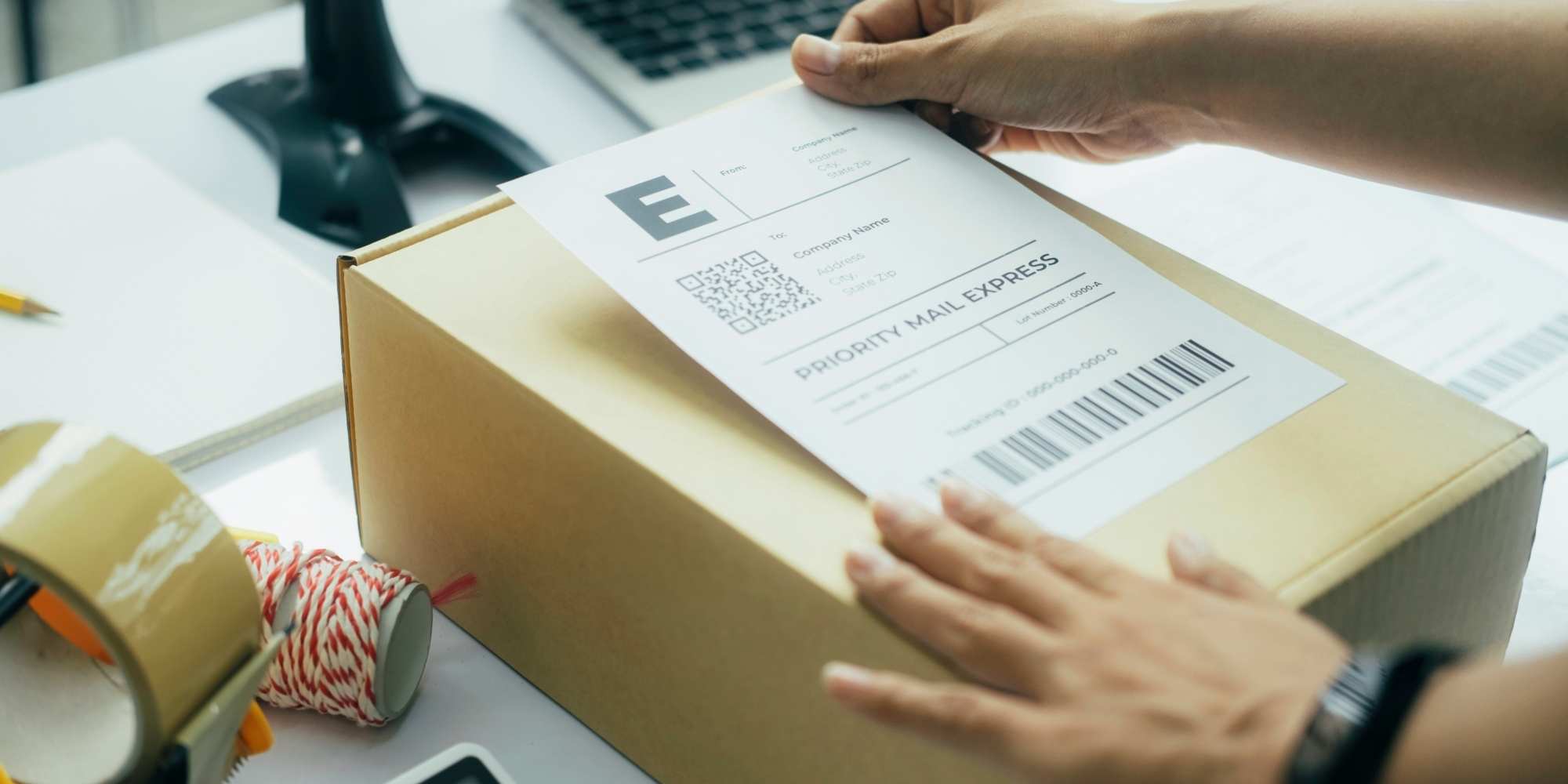
You buy a box of books from your printer, store them at home, and ship orders yourself. When a sale comes in, you pack the book, print a label, and drop it at the post office.
What it costs per order:
- Book: ~$4.60 (or less if buying in bulk)
- Mailer: $0.50–$1.00
- USPS Media Mail postage: $4.13
What you need to get started:
- Postal scale: $20–$30
- Poly or rigid mailers
- Label printer (optional but speeds things up)
The ceiling hits around 20–30 orders per month. A single order takes 5–10 minutes end to end. Thirty orders is 2.5–5 hours a month. At 100 orders, it’s a part-time job. Storage is also a factor — a pallet of 200 books is bigger than it sounds.
Save Time and Let us Handle Your Book Fulfillment!
See How Using a 3PL for saves Amazon sellers time. Get a Free Quote from eFulfillment Service Today!

Option 2: Print-on-demand (POD)
POD eliminates inventory and storage entirely. A customer orders, the platform prints and ships directly, and you collect the margin.
Platforms built for direct author sales — Lulu Direct, IngramSpark, and BookVault — integrate natively with Shopify and WooCommerce. The order routes automatically. No manual work on your end.
Cost per book: $4–$6 for a standard trade paperback, depending on page count and trim size. Slightly more than bulk printing, but you’re paying for zero inventory risk.
The tradeoff: POD books typically ship 3–5 business days after printing, not counting transit. You also have less control over packaging — custom inserts and swag bundles usually aren’t an option.
POD is the right call if you’re early-stage, don’t want inventory risk, and are okay with slightly longer fulfillment windows.

Option 3: Third-party fulfillment (3PL)
A 3PL is the option that turns a side hustle into an actual business.
You send inventory in bulk to a warehouse. They receive it, store it, and when a customer orders from your store, they pick, pack, and ship — usually within 1–2 business days. You never touch a box. You never make a post office run. Orders go out faster than most authors can manage from home, and the experience your reader gets is professional and consistent.
Pricing varies by provider and volume, so it’s worth getting a quote for your specific situation rather than going off industry averages. What you’re paying for is speed, professionalism, and most importantly, your time back.
The practical tipping point for most authors is around 50 orders a month — once DIY fulfillment is genuinely eating into writing or marketing time. But some authors move earlier just because they’d rather spend zero time on logistics from day one.
If you’re past that threshold, eFulfillment Service is worth a look. They work with indie authors specifically: no order minimums, no long-term contracts, USPS Media Mail rates built in, and free account setup. You send them your books, they handle the rest.
Quick comparison
|
Model |
Upfront cost |
Cost per order |
Your time |
Best for |
|---|---|---|---|---|
|
DIY Shipping |
$20–$50 |
$4.65–$5.25 |
5–10 min/order |
Under 30 orders/month |
|
Print-on-Demand |
$0 |
$8–$12 |
0 min |
Early stage, no inventory risk |
|
3PL |
$0 (free setup) |
Varies — get a quote |
0 min |
50+ orders/month |
Shipping more than 50 orders a month from your garage?
That’s the point where most publishers find a 3PL pays for itself. eFulfillment Service offers simple, transparent per-order pricing with no long-term contracts, so you can make the switch without the risk.
How to set up your online book store
You don’t need a complicated site. Just a functional one that loads fast, takes payment, and doesn’t confuse people.

Shopify or WooCommerce?
This is the question every author spends too long on. Start with Shopify.
Shopify is a hosted platform. You pay ~$39/month and Shopify handles hosting, security, and updates. Pick a theme, add your products, connect payments, and you’re selling. The learning curve is hours, not weeks.
WooCommerce is a WordPress plugin. It’s free to install, but you’re responsible for hosting, security certificates, and plugin updates. When something breaks — and it does — you troubleshoot it or pay someone. The total cost often ends up similar to Shopify, with more operational overhead.
If you’re already running WordPress and comfortable with it, WooCommerce is fine. Otherwise, Shopify is faster and simpler for most authors. Either way, both integrate directly with major POD platforms and most 3PLs, so fulfillment setup isn’t a reason to choose one over the other.
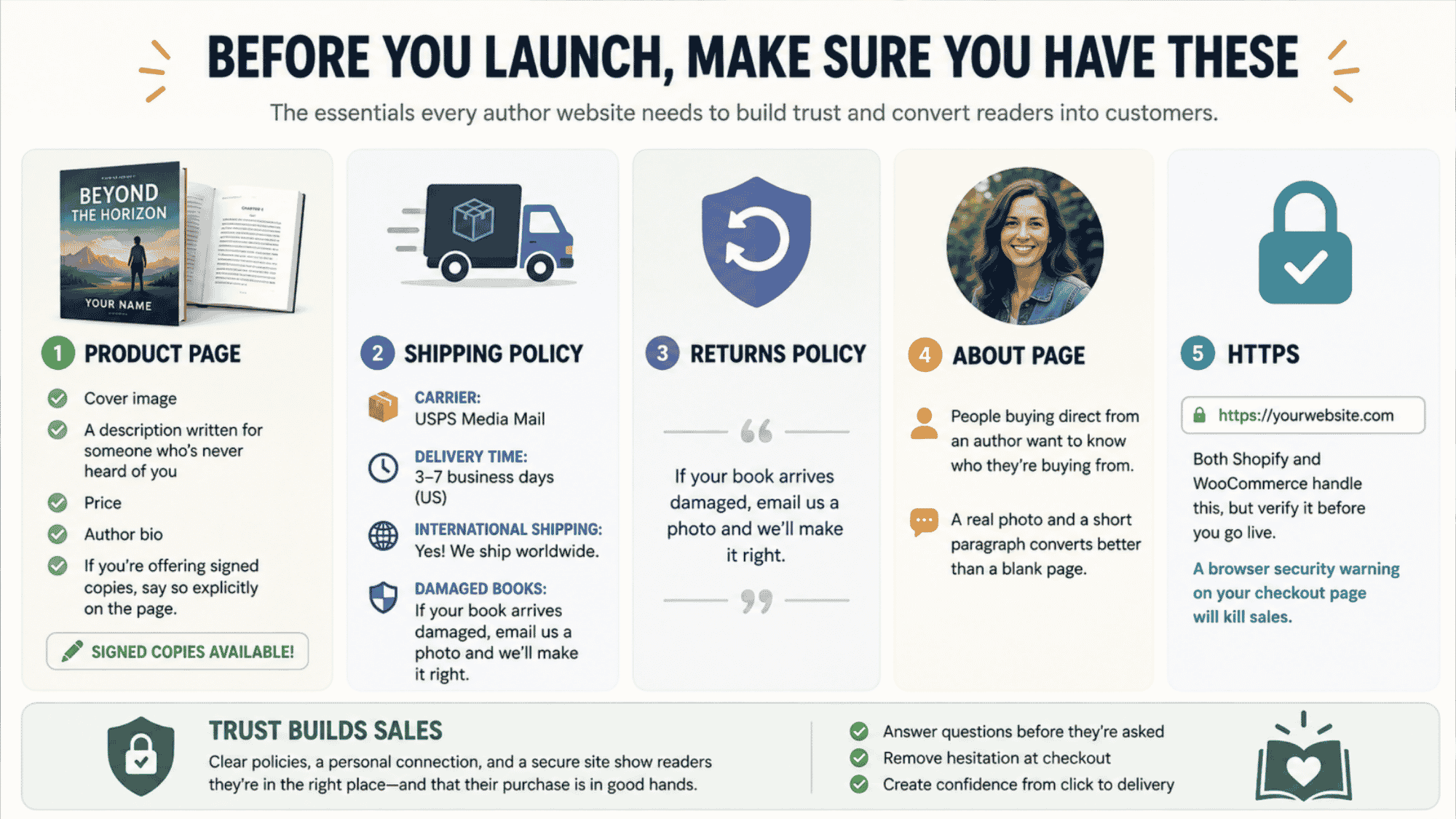
Before you launch, make sure you have these
Product page: cover image, a description written for someone who’s never heard of you (more on this below), price, and your author bio. If you’re offering signed copies, say so explicitly on the page.
Shipping policy: which carrier you use, how long delivery takes, whether you ship internationally, and what happens if a book arrives damaged.
Returns policy: one line is enough — “If your book arrives damaged, email us a photo and we’ll make it right.”
About page: people buying direct from an author want to know who they’re buying from. A real photo and a short paragraph converts better than a blank page.
HTTPS: both Shopify and WooCommerce handle this, but verify it before you go live. A browser security warning on your checkout page will kill sales.
Efficiency Tip: Partnering with an 3PL can free up your time to focus on what you do best, sell great products!
Get a Free Quote from eFulfillment Service and see how we can simplify your selling!
Connecting your store to a fulfillment provider
For POD (Lulu Direct, BookVault): install their native Shopify or WooCommerce app, connect your account, and map your products. When a customer orders, it fires automatically.
For a 3PL: integration is typically via API or order export. Most modern 3PLs connect directly to Shopify through a native integration or middleware like ShipStation. Your 3PL’s onboarding team should handle this — if they can’t, that tells you something about their technical capability.
Test the integration before you launch. Place a real order, pay for it yourself, and track it through to delivery.
Payments and taxes
Shopify Payments is the simplest setup for US authors — built in, accepts cards and Apple Pay/Google Pay, fee is 2.9% + $0.30 per transaction on the basic plan (Shopify pricing). Add PayPal as a secondary option — some customers won’t enter a card on a site they don’t recognize yet.
Sales tax: if you have nexus in a state (at minimum, your home state), you’re required to collect and remit sales tax on orders shipped there. Shopify has built-in tax calculation for US states — turn it on. If nexus obligations aren’t clear to you, a one-hour conversation with an ecommerce accountant is worth it.
International shipping: customs forms, VAT for UK/EU customers, potential import duties. If you’re just starting out, limit shipping to the US and add international once your domestic operation is running.
How to price and list your book
Getting your store built is the mechanical part. Before you publish anything, you need to get two things right: what to charge, and how to describe the book to someone who’s never heard of you.
Pricing
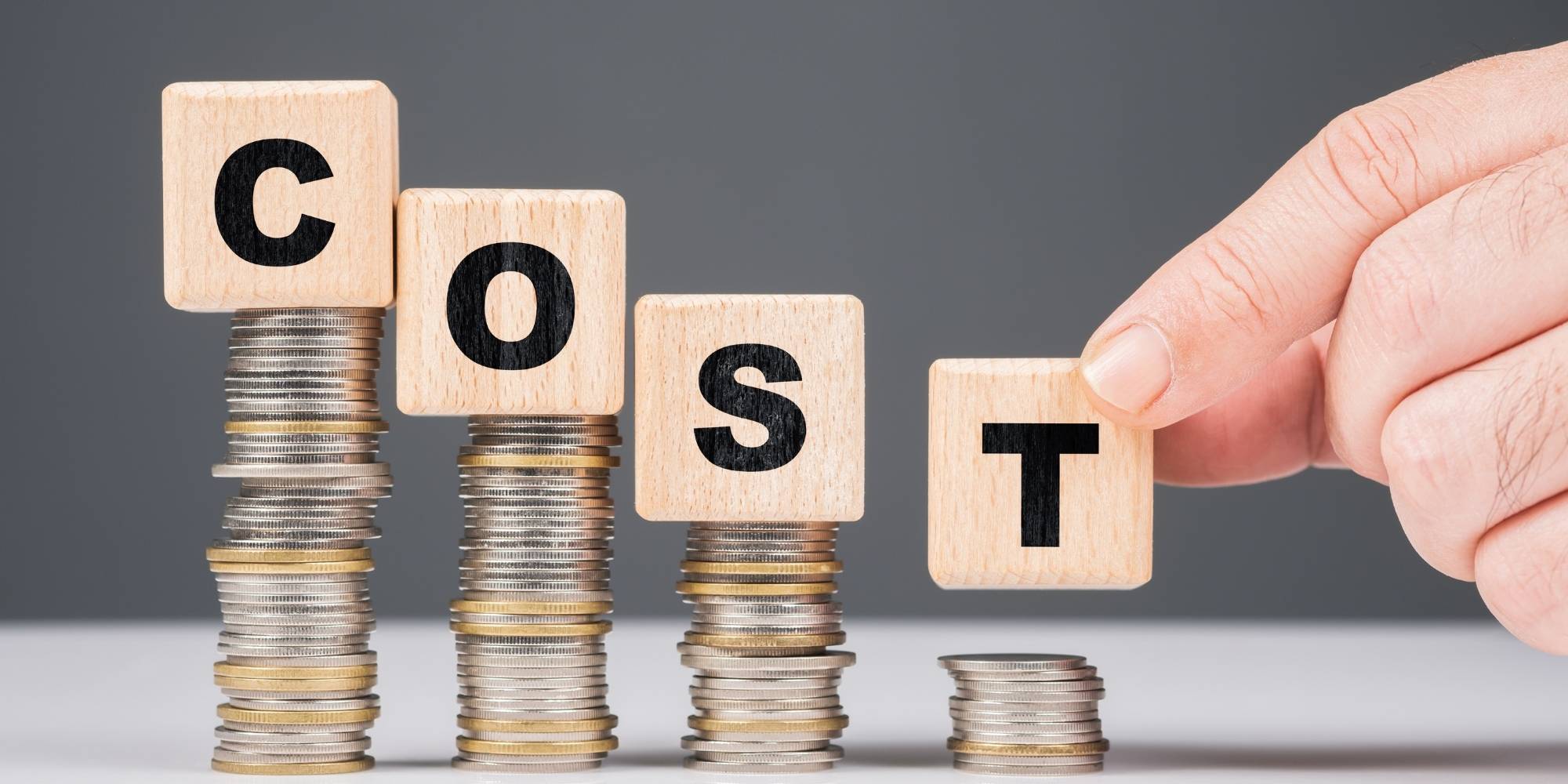
The instinct is to match your Amazon price. That’s usually the wrong call.
On Amazon, you’re competing against dozens of covers on a search page. Price is a signal readers use to decide whether to click. On your own store, the reader has already found you — they’re on your page, reading about your book. You’re not competing with anyone.
Most direct-selling authors price $1–$3 above their Amazon price. Your buyer is paying to have a book shipped from a human, not a warehouse — there’s a perceived value premium in that. You also need the margin: match Amazon while absorbing shipping costs and your direct channel earns very little over Amazon after fees.
Signed copies are a different product entirely. Price them $3–$5 above the unsigned price. Buyers expect the premium and will pay it.
For shipping, you have three options:
- Charge actual cost — transparent, but a $4.13 shipping line item on a $16 book kills conversions.
- Flat rate ($3.99–$4.99) — close to real cost, better psychologically.
- Free shipping above a threshold ($35) — turns single-book buyers into two-book buyers on many orders.
Whatever you choose, show it on the product page. Shipping surprises at checkout are the biggest source of abandoned carts in ecommerce.
Writing a product page that converts
Your back cover copy was written for someone already holding the book in a bookstore. Your product page has to get a stranger to pick it up in the first place. These are different jobs.
The structure that works:
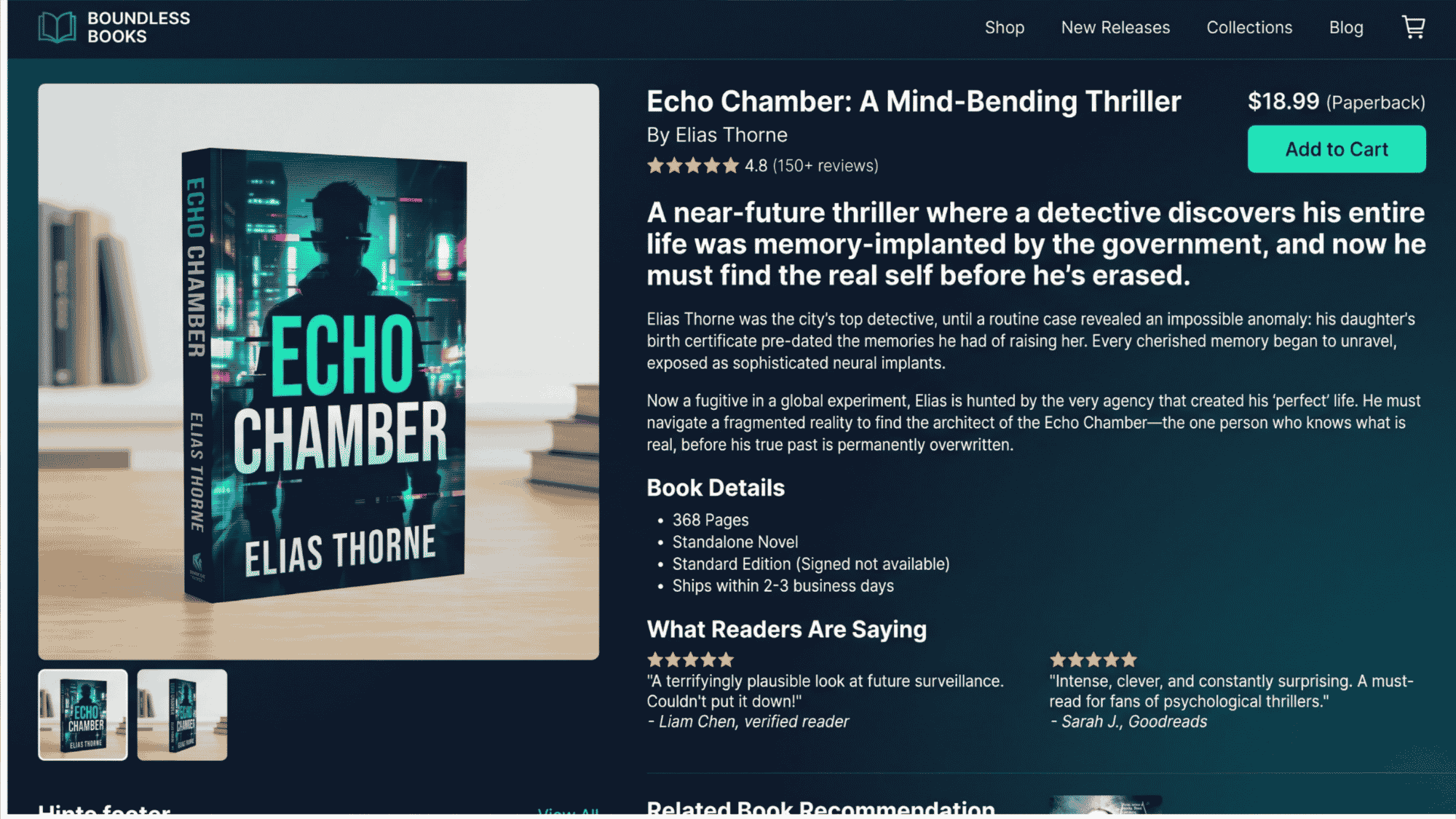
- A one-sentence hook — concrete, not vague. Not “a sweeping tale of love and loss” but the genre, the emotional payoff, the central conflict. A skimmer needs to know within five seconds if this book is for them.
- Two or three short paragraphs — setup, stakes, and a tease. Keep the total under 200 words. Longer descriptions don’t convert better; they just give skimmers more places to lose interest.
- Answers to the obvious questions — How long is it? Is it a series? Signed or standard? How long does shipping take? Every unanswered question is a reason not to buy.
- Social proof — two or three review quotes if you have them, even from Goodreads or Amazon. “I couldn’t put it down” from a named reviewer does more than most authors expect.
- A photo of the physical book — well-lit, showing the cover and spine. Readers buying direct want to see the object.
The post-purchase experience
What happens after the sale is where most first-time direct sellers get caught off guard — and where reader relationships are actually built.
Order confirmation: Shopify sends one automatically, but check what it says. The default is bare (order number, address, total). Add a short thank-you that sounds like a person wrote it, and a sentence about what happens next.
Ship on time. If you said 3–5 business days, ship in 3–5 business days. Late shipments from a small store erode trust faster than a slow platform does, because the buyer expected a more personal experience.
Shipping confirmation: send one with a tracking number. Shopify generates this automatically if you’re printing labels through the platform.
Post-delivery follow-up: a few days after the estimated delivery date, send a short email asking if the book arrived and if they’re enjoying it. It catches delivery problems before they become chargebacks, and opens the door to a review request.
Handle problems simply. A book arrives damaged — replace it, no questions asked. A replacement copy costs about $8.73 ($4.60 to print, $4.13 to ship). That’s less than a chargeback and far less than a public complaint.
eFulfillment Service is built specifically for books.
We handle ISBN-level pick accuracy, USPS Media Mail optimization, damage-protective packaging, and street date embargoes all from one warehouse. Trusted by independent publishers and authors nationwide.
How to ship books cheaply
Shipping cost is one of the biggest variables in your margin. If you’re able to find the best and cheapest way to ship books, you keep more money per order.

USPS Media Mail: the rate most authors don’t know about
Media Mail is a USPS shipping class for educational materials, including printed books. Current rate: $4.13 for packages up to one pound (USPS current rates). A standard 300-page trade paperback weighs 14–16 ounces — comfortably within that tier.
Compare that to First Class or Priority Mail for the same weight: $5–$9 depending on zone. The savings add up fast at volume.
The rules you need to know:
- Domestic US shipments only — no international
- Package can only contain the book and a basic packing slip
- No promotional materials: no business cards, stickers, or handwritten notes
- USPS inspects Media Mail packages — non-qualifying items can get the package returned or charged extra postage
Note: If you want to include extras (signed bookplate, thank-you card, swag), use First Class or Priority Mail for that order.
When to use Priority Mail, UPS, or FedEx
Media Mail transit is typically 2–8 business days, which is fine for most orders. When speed matters, upgrade to Priority Mail (2–3 days, roughly $9–$12 for a book-weight package).
Use Priority Mail when:
- A customer requests faster shipping
- You’re shipping around a holiday with a hard delivery deadline
- The package includes non-book items that disqualify it from Media Mail
UPS and FedEx are rarely the right call for single-book orders — dimensional weight pricing and residential surcharges make them expensive. They become competitive on large, heavy bulk shipments (10+ books), but for direct orders, USPS wins on cost almost every time.

Packaging
Your packaging has two jobs: protect the book and not push you into a higher postage tier.
For most paperbacks: a rigid mailer (stay-flat or cardboard book mailer) is the standard. It prevents bending and adds only 1–2 ounces. Buy in bulk on Amazon or Uline — cost drops to $0.40–$0.60 per unit at 50-packs.
For hardcovers or dust jacket editions: rigid mailer with tissue or bubble wrap inside.
Poly Bubble Mailers: work for lighter paperbacks but offer less corner protection.
Don’t over-package. A book at 15 oz that fits in the one-pound tier shouldn’t be packed in materials that push it to 18 oz.
How to buy discounted shipping labels
Never pay retail postage at the post office counter.
Pirate Ship is free to use, no monthly fee, and offers below-commercial USPS rates on qualifying services. One important note: Media Mail has no commercial discount tier — the rate is the same everywhere you buy it. For Priority Mail and Ground Advantage, Pirate Ship saves you real money.
Shippo and Stamps.com offer similar discounts and integrate directly with Shopify and WooCommerce, so labels generate automatically from your orders dashboard.
For a solo author shipping 20–50 books a month, Pirate Ship plus a basic label printer (Rollo or DYMO 4XL, $80–$130 one-time) is a complete setup that costs almost nothing to run.
Selling after a Kickstarter campaign
Kickstarter fulfillment is its own category of challenge. An ongoing store spreads orders over weeks. A campaign concentrates them — hundreds of packages in a compressed window, with a hard deadline and backers watching.

Why it’s harder than running a store
When your campaign closes with 300 backers, you’re not processing orders one at a time. You’re managing backer updates, late pledges, address confirmations, reward tier variations, and packing 300 boxes.
The time math: 300 backers × 5 minutes per package = 25 hours.
That’s a full work week of packing before you’ve written a word or done any marketing. And that assumes no damaged books, wrong addresses, or returns.
DIY vs. 3PL for Kickstarter
For most campaigns, especially if backers paid a shipping fee, 3PL fulfillment fits comfortably within the budget. Pricing varies by provider and order volume, so get a quote once you know your backer count. What you’re trading money for is 25 hours back during a period when you should be engaging with new readers, not packing boxes.
DIY still makes sense if your campaign is under 50 backers, you have help, or you want the personal touch of hand-packing every order. Just be realistic about the time cost before you commit.
Setting shipping timelines
Backers are more patient than you think, but they need honest timelines up front.
Build fulfillment time into your Kickstarter schedule. If the book finishes printing in week six and you need three weeks for a 3PL to receive and ship, tell backers books go out in week nine — not week six.
Over-promise on quality, not on speed. A signed copy with a handwritten note, shipped three weeks after campaign close, delights people. The same book shipped in a rush that arrives bent does not.
Most 3PLs can receive a pallet directly from your printer, so you never touch the inventory. Confirm this workflow with your fulfillment partner before the campaign launches, not after it closes.
How to drive traffic to your online book store
A well-built store at a URL nobody visits sells zero books.

Use Amazon as a discovery engine, not a sales floor
Amazon is where readers find new authors. Millions of people search it specifically looking for their next book. Keep your book there. Optimize your listing — keyword-rich subtitle, A+ content if you qualify, strong categories — and let Amazon do the work of getting your book in front of strangers.
Then give those strangers a reason to come to your store:
- Your author bio on Amazon can include your website URL
- Your book’s back matter (the last pages of the physical book) can include a direct URL with an offer — a bonus chapter, a companion resource, a discount code for your next book
Email lists: the one asset Amazon can’t touch
The last page of every book you sell is prime real estate. Use it to invite readers to your email list with a simple call to action: “If you want to hear about what’s coming next, join my list at [yoursite.com/list].”
A reader who gives you their email has told you they want to hear from you. When you launch your next book or a signed edition, they’re your first buyers.
Email platforms like ConvertKit, MailerLite, or Beehiiv all offer free tiers suitable for authors starting out. Connect your signup form directly to your Shopify store so new subscribers get a welcome sequence automatically.

Offers only your store can make
Your direct store can do things Amazon structurally cannot:
Signed copies — many readers will pay $3–$5 more, especially gift buyers. List them as a separate SKU. The additional cost to you is a Sharpie and 30 seconds.
Bundles — sell your series as a set, or pair a book with a journal, character art print, or companion guide. Amazon can’t bundle across listings with any elegance. Your store does it natively.
Limited editions and exclusives — “Order direct by Friday and get the signed edition before it’s available anywhere else” is a pitch you simply can’t make on Amazon.
Social media
Not all social media drives direct sales. Be selective.
The content that converts shows your work and process: unboxing author copies, packing an order, talking about what you’re writing next, sharing reader messages. It’s specific, personal, and something a corporate publisher can’t replicate.
Instagram and TikTok/BookTok are the leaders for book discovery right now — BookTok surpassed 370 billion total views in 2025 and influenced an estimated 59 million print book sales. (WriteStats, 2026) Pinterest has outsized longevity: pins from two years ago still drive traffic.
One thing that matters more than platform: your call to action. “Link in bio” is weak. “Order signed copies at [yourstore.com], link in bio” tells people exactly what to do.
How to scale your setup as you grow

Under 20 orders/month: minimum viable setup
Start simple. Set up a Shopify store ($39/month). Use Lulu Direct or BookVault for POD fulfillment if you don’t want to hold inventory, or buy a small print run (50–100 books) and ship from home using Pirate Ship for USPS Media Mail labels.
Your goal at this stage is learning, not efficiency. Understand how orders flow, what customers ask, what your actual cost per order is, and how long shipping takes. Total monthly cost: $39 (Shopify) + packaging + postage. Under $100/month to run a real direct sales operation.
20–50 orders/month: tighten the DIY process
At this volume, packing and shipping takes 3–8 hours a month. Not catastrophic, but noticeable.
This is the stage to optimize:
- Get a label printer if you don’t have one
- Switch to bulk-ordered mailers to cut packaging cost
- Batch your packing runs to two days a week instead of shipping every order the same day
- Create a simple packing checklist to get each order down to 3 minutes instead of 8
Also at this stage: build your email list hard. Every direct buyer should get a post-purchase email asking for a review and introducing your next project.
50+ orders/month: time to look at a 3PL
Above 50 orders a month, DIY fulfillment starts eating into writing and marketing time in a real way. A 3PL ships faster, integrates with your store automatically, and handles all the physical labor. Your job becomes sending inventory replenishments and doing the marketing and writing that only you can do.
The margin math still works in your favor. You’re netting $13+ per order selling direct versus $6.20 on Amazon — and you’ve built a direct sales channel that belongs entirely to you.
Frequently asked questions
Do I need a fulfillment service to sell books on my own website?
No. Start by shipping from home using USPS Media Mail and Pirate Ship for labels. A fulfillment service makes sense once you’re past 50 orders a month and the time cost of packing is cutting into writing or marketing.
What is the cheapest way to ship a book?
USPS Media Mail, currently $4.13 for packages up to one pound (USPS current rates). A standard trade paperback fits within that tier. Use Pirate Ship or Shippo for labels — both are free and give you the best available rates without a monthly fee.
Can I sell on Amazon and my own website at the same time?
Yes, and you should. Amazon is for discovery. Your store is for building direct relationships, collecting email addresses, offering signed copies, and keeping more of each sale. They serve different purposes — use both.
How much does it cost to set up a store?
A Shopify store starts at $39/month with no setup fee. Add a custom domain (~$15/year) and optionally a premium theme ($0–$200 one-time). Total first-year cost for a basic store: under $600. Add a postal scale ($25) and label printer ($80–$130) if you’re shipping from home — complete setup under $800.
What’s the difference between print-on-demand and a 3PL?
POD platforms (Lulu Direct, IngramSpark, BookVault) print each book when an order is placed — no inventory, no fulfillment labor, but higher per-unit cost and slower shipping.
A 3PL stores pre-printed inventory you send them and ships from stock — faster delivery, lower per-unit cost, ability to include custom packaging, but you manage inventory replenishment.
How do I handle Kickstarter fulfillment?
Export your backer list as a CSV with names, addresses, and reward tiers. Import it into your shipping platform or 3PL to generate bulk labels. For campaigns over 100 backers, a 3PL is worth getting a quote on — you’re trading fulfillment cost for roughly 25 hours of packing time, and for most campaigns that trade makes sense, especially if backers paid a shipping fee. Set shipping timelines with backers before the campaign closes — not after.
Frequently asked questions
Do I need a fulfillment service to sell books on my own website?
No. Start by shipping from home using USPS Media Mail and Pirate Ship for labels. A fulfillment service makes sense once you’re past 50 orders a month and the time cost of packing is cutting into writing or marketing.
What is the cheapest way to ship a book?
USPS Media Mail, currently $4.13 for packages up to one pound (USPS current rates). A standard trade paperback fits within that tier. Use Pirate Ship or Shippo for labels — both are free and give you the best available rates without a monthly fee.
Can I sell on Amazon and my own website at the same time?
Yes, and you should. Amazon is for discovery. Your store is for building direct relationships, collecting email addresses, offering signed copies, and keeping more of each sale. They serve different purposes — use both.
How much does it cost to set up a store?
A Shopify store starts at $39/month with no setup fee. Add a custom domain (~$15/year) and optionally a premium theme ($0–$200 one-time). Total first-year cost for a basic store: under $600. Add a postal scale ($25) and label printer ($80–$130) if you’re shipping from home — complete setup under $800.
What’s the difference between print-on-demand and a 3PL?
POD platforms (Lulu Direct, IngramSpark, BookVault) print each book when an order is placed — no inventory, no fulfillment labor, but higher per-unit cost and slower shipping.
A 3PL stores pre-printed inventory you send them and ships from stock — faster delivery, lower per-unit cost, ability to include custom packaging, but you manage inventory replenishment.
How do I handle Kickstarter fulfillment?
Export your backer list as a CSV with names, addresses, and reward tiers. Import it into your shipping platform or 3PL to generate bulk labels. For campaigns over 100 backers, a 3PL is worth getting a quote on — you’re trading fulfillment cost for roughly 25 hours of packing time, and for most campaigns that trade makes sense, especially if backers paid a shipping fee. Set shipping timelines with backers before the campaign closes — not after.
Where to start
Selling direct is not complicated.
Under 20 orders a month, a basic Shopify store and a Pirate Ship account is all you need. Between 20 and 50 orders, tighten your DIY process and start building your email list. Above 50 orders, the case for outsourcing fulfillment gets strong fast.
The best version of your author business is the one where you’re writing and connecting with readers, not taping mailers at midnight.
0 Comments