
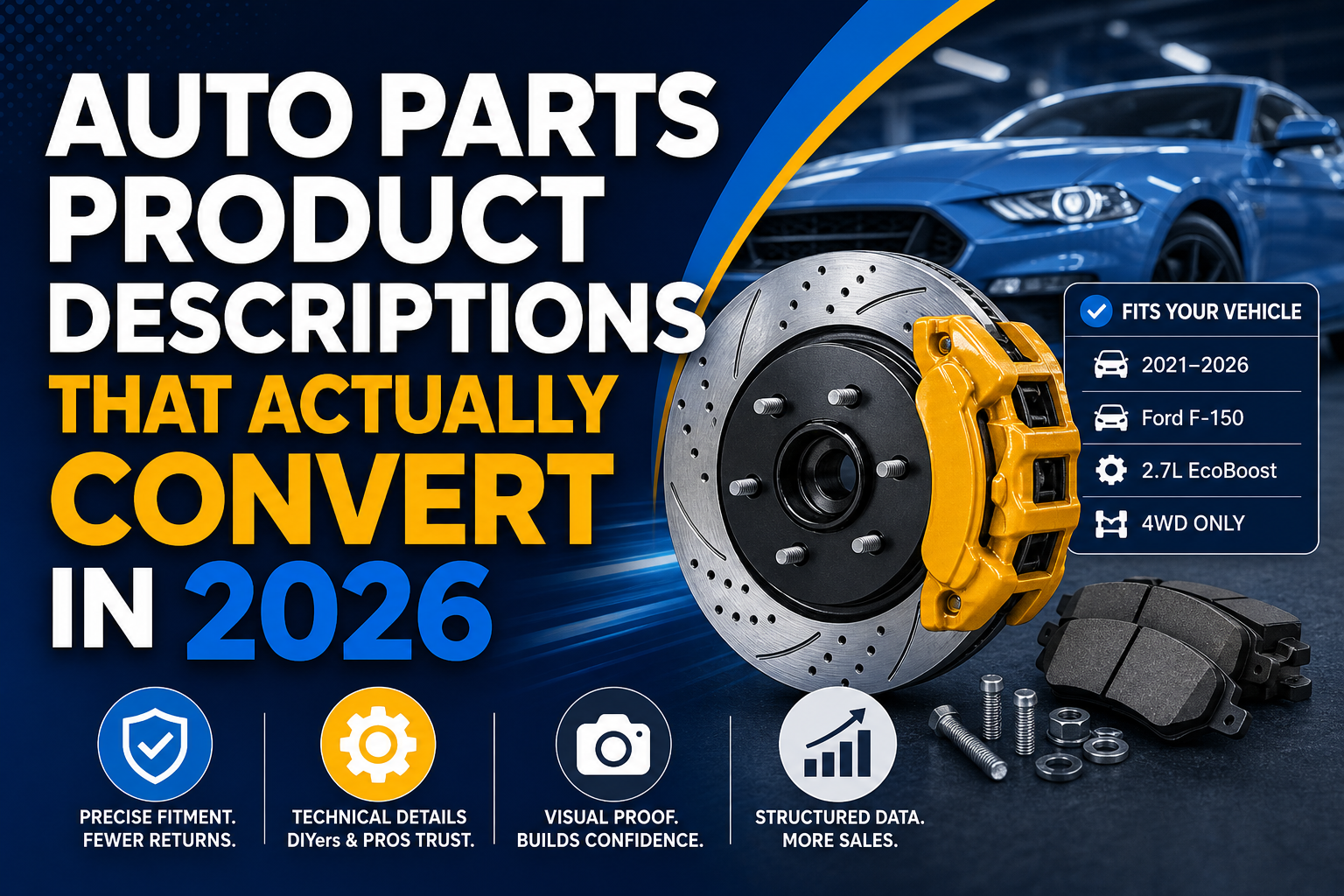
Quick Answer: A high-converting auto parts listing in 2026 needs four things above everything else: precise fitment data (year, make, model, trim, engine), technical specs written for both DIYers and pros, visual proof that the part fits the exact vehicle, and clean structured data so search engines and AI tools can actually read the page. Get those four right, and most other problems take care of themselves.
The Four-Part Framework for a Listing That Converts
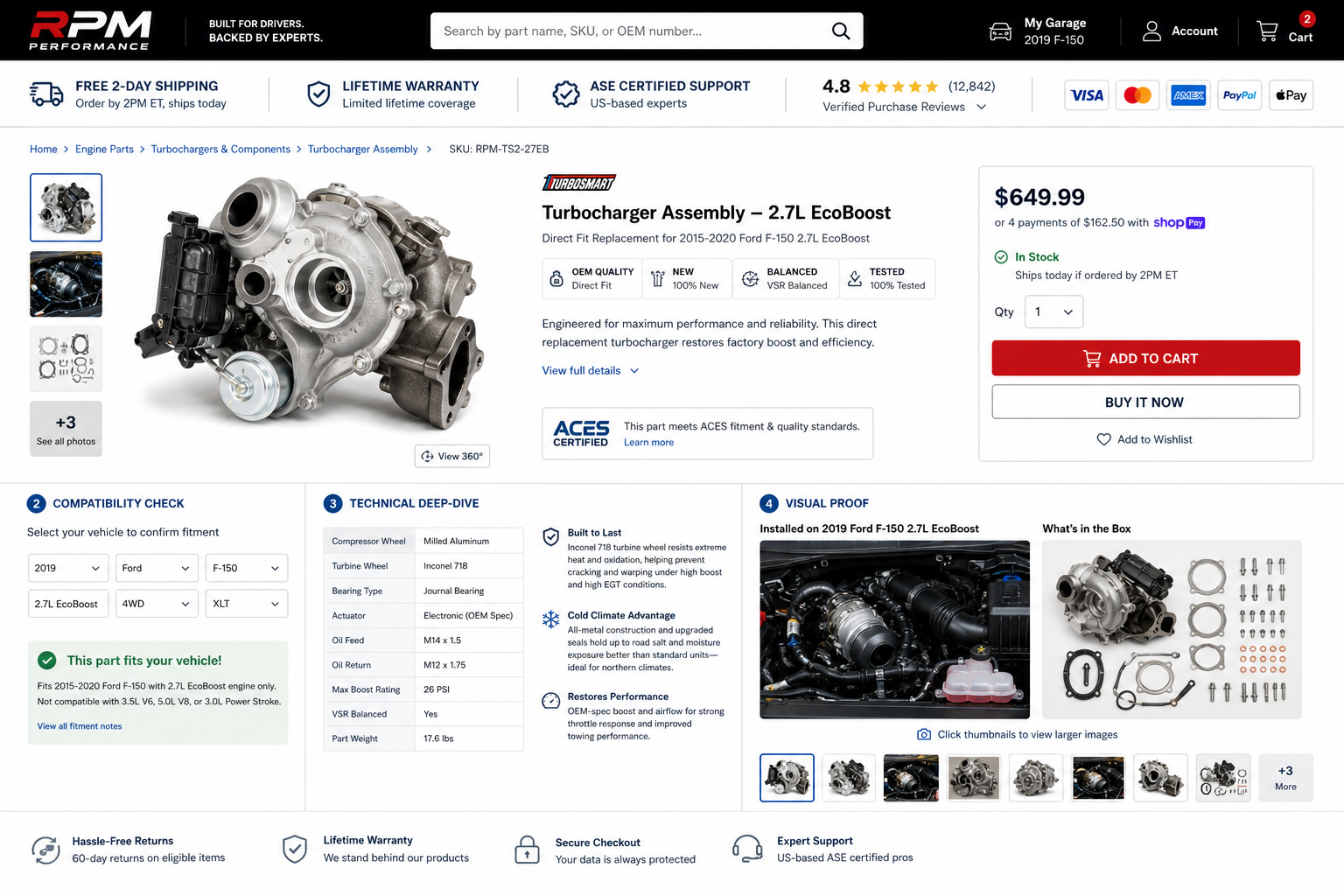
Good automotive listings in 2026 are built around four components. Missing any one of them creates a gap that tends to show up as a return or an abandoned cart.
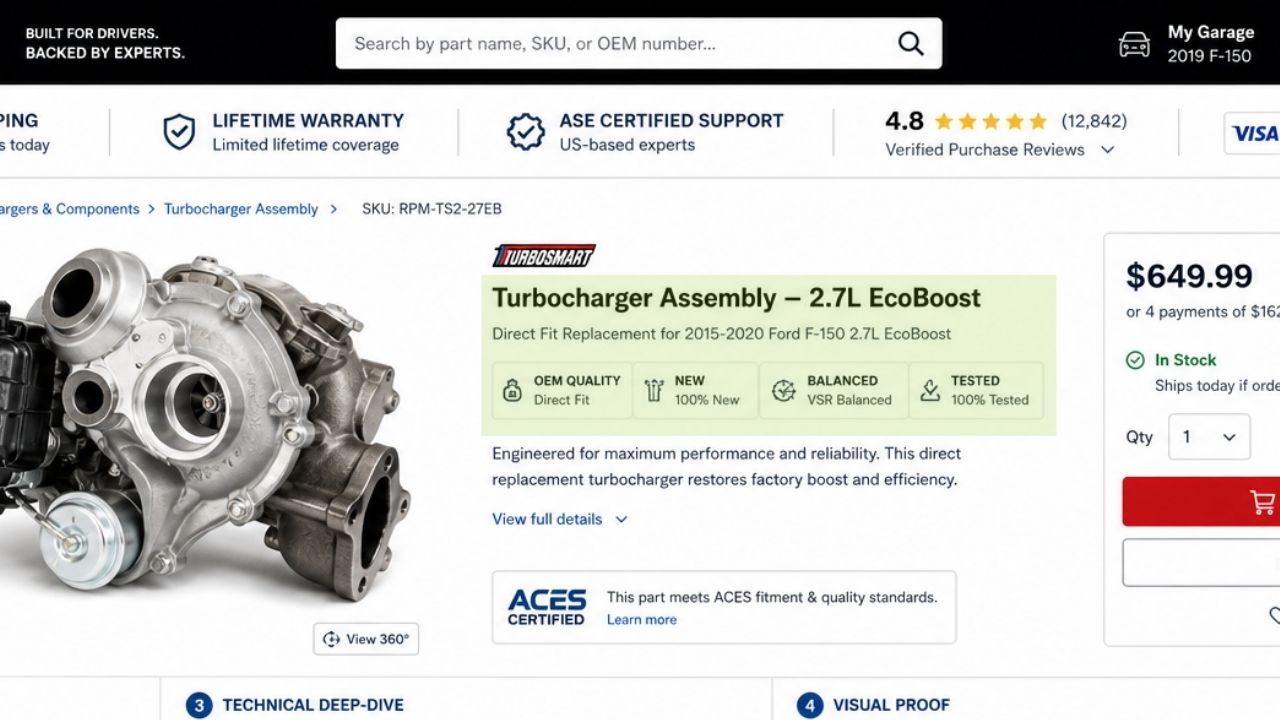
1. The Trust Header
People make subconscious judgments about a listing in about 0.05 seconds. The header needs to establish authority immediately — brand identity, shipping speed, warranty terms, and any relevant certifications (DOT, CAPA) should all be visible before the buyer scrolls. Payment logos and trust badges still matter, but in 2026 dynamic social proof carries more weight: real review counts, verified purchase signals, and ratings with enough volume to feel credible rather than manufactured.
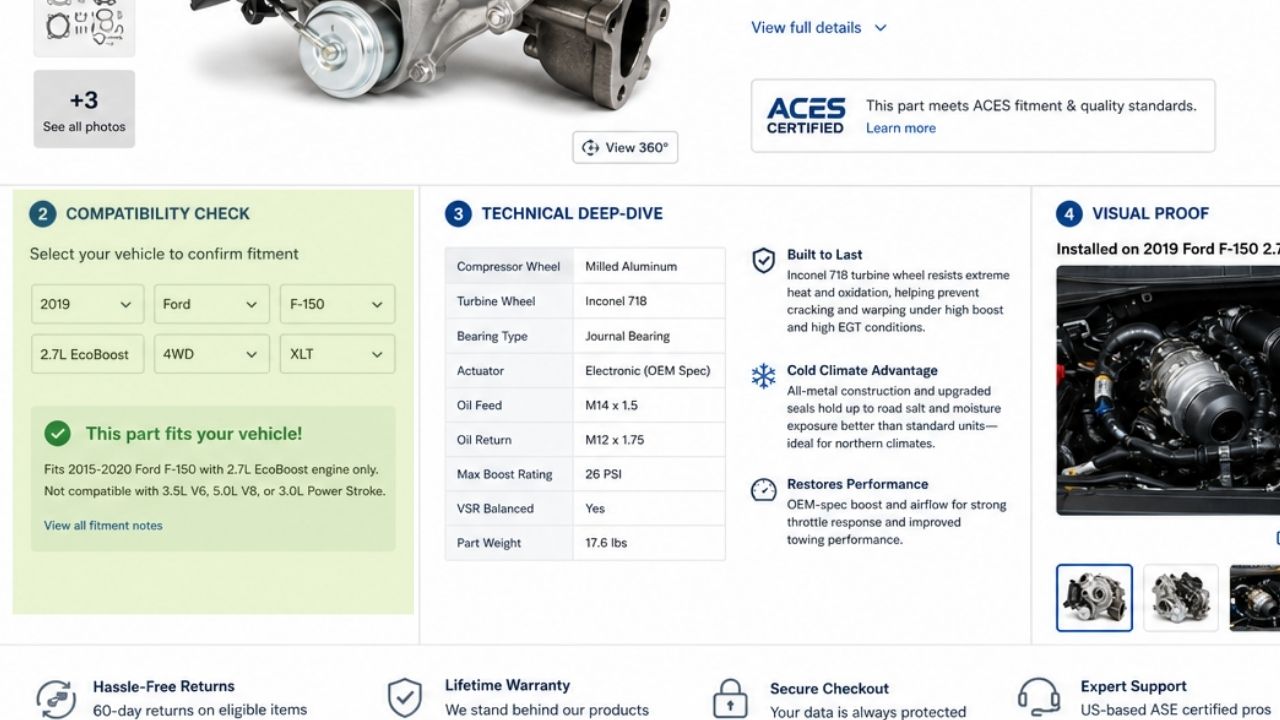
2. The Compatibility Block
This is the most important section of any auto parts listing. A year/make/model dropdown is the minimum. A current listing needs to go further — ACES qualifiers that specify trim level, engine configuration (e.g., “fits 2.7L EcoBoost only, not compatible with 3.5L V6”), and drivetrain type (e.g., “4WD models only”). About 33% of automotive e-commerce returns trace back to fitment data that wasn’t specific enough. That’s a preventable number.
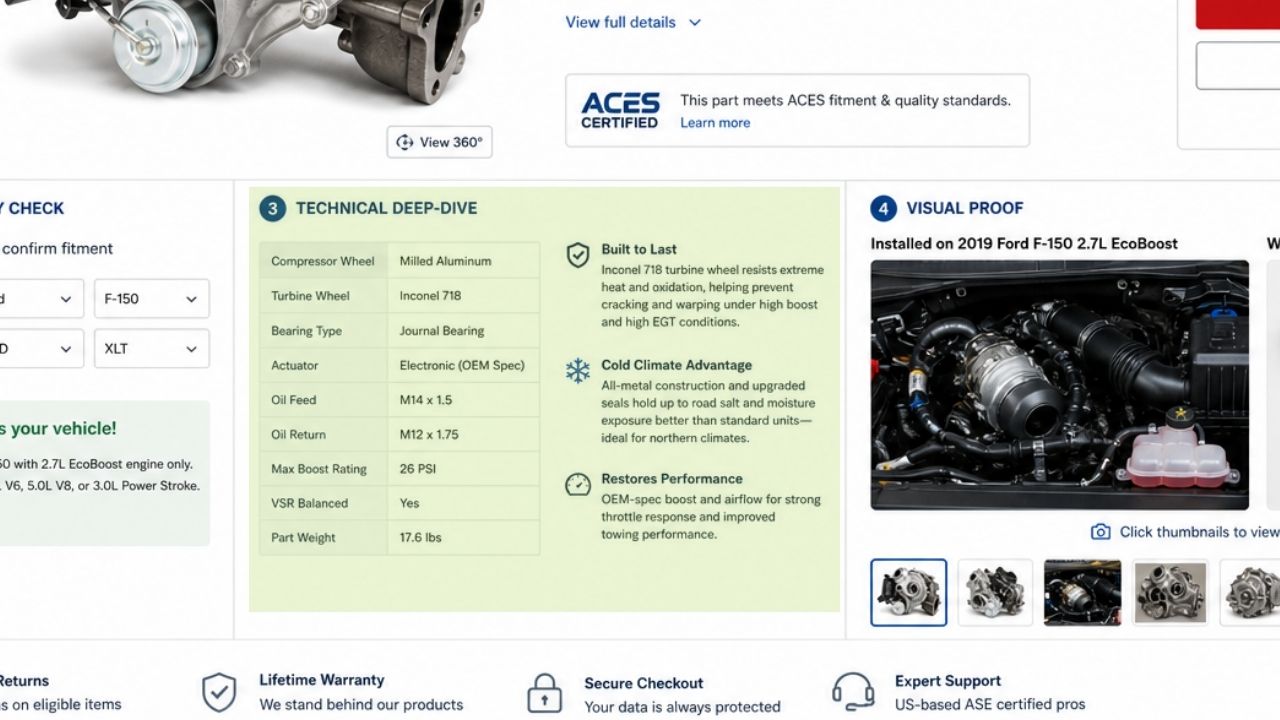
3. The Technical Deep-Dive
This section does double duty. A professional mechanic wants the material grade, the micron rating on a filter, the torque spec on a fastener. The detail-oriented DIYer wants to understand what those specs mean for their situation. The best listings give both — they list “304 stainless steel” and then explain, in plain terms, that it holds up to road salt better in northern climates than standard steel. Specifics build trust. Vague claims like “high quality” and “durable construction” erode it, because everyone says that.
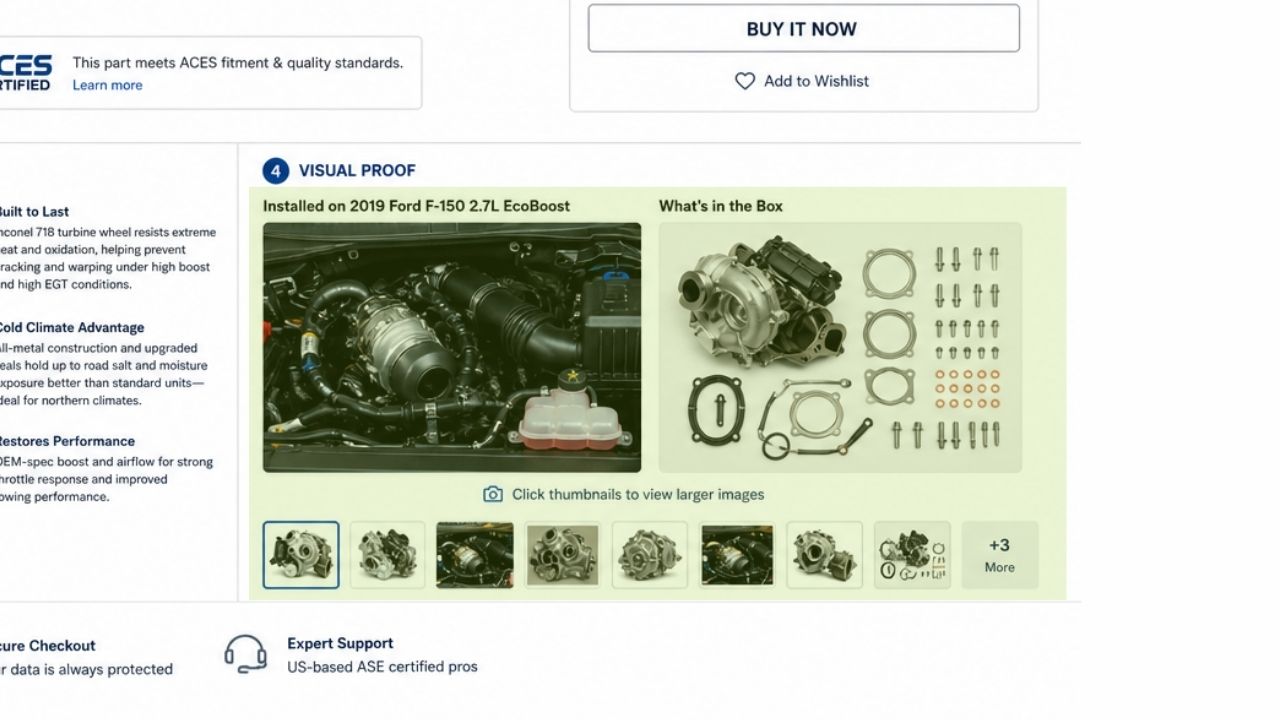
4. Visual Proof
High-resolution images are expected. What actually changes buyer behavior is context — specifically, photos of the part installed on the exact vehicle listed in the fitment guide, and “what’s in the box” shots showing every gasket, bolt, and piece of hardware. That second type of image alone cuts customer service contacts by roughly 30%, because it eliminates the “did I get everything I need?” question before the customer has to ask it.
Visual Merchandising Beyond Photos: 3D and AR
Static photography has a ceiling, and in 2026 a growing number of sellers have hit it. Product pages with 3D visualization and augmented reality features show conversion rates up to 94% higher than standard pages, and returns drop by roughly 40% on average.
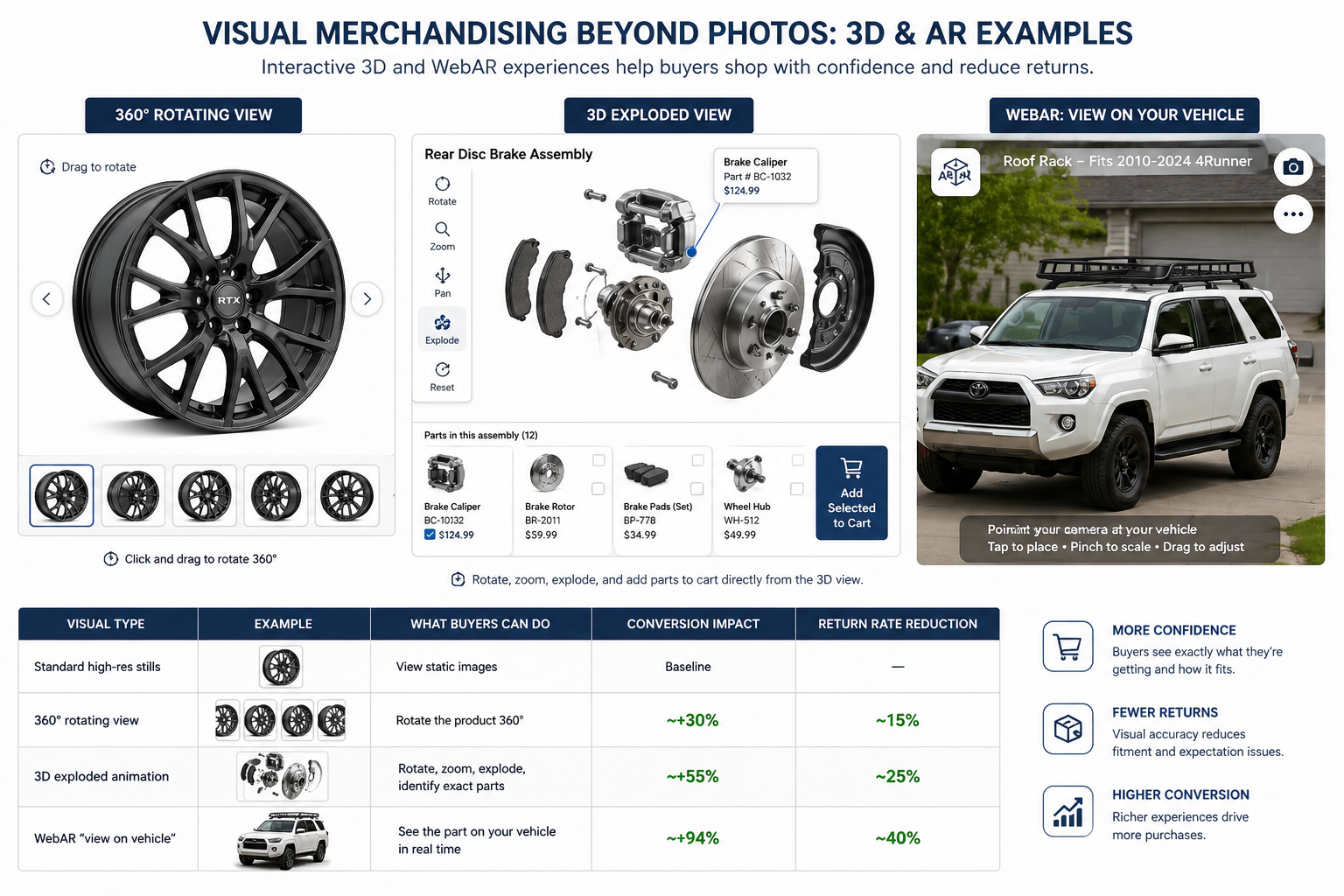
WebAR — browser-based augmented reality that doesn’t need a downloaded app — has become the practical standard. A buyer can hold their phone up to their car and see a wheel, bumper, or roof rack overlaid on the actual vehicle in real time. For exterior accessories where proportions matter visually, not just on a spec sheet, that’s a different kind of purchase confidence than any photo can provide.
3D exploded views work well for complex assemblies — transmissions, suspension systems, engine components. Instead of a flat 2D diagram, the buyer can rotate the model, zoom into a specific area, and identify the exact component they need. Some implementations let you add components directly to the cart from inside the 3D view, which cuts the path from “I think that’s the part” to “ordered.”
| Visual Type | Conversion Impact | Return Rate Reduction |
|---|---|---|
| Standard high-res stills | Baseline | — |
| 360° rotating view | ~+30% | ~15% |
| 3D exploded animation | ~+55% | ~25% |
| WebAR “view on vehicle” | ~+94% | ~40% |
Installed-context photos still matter alongside all of this. Seeing the part mounted on the specific vehicle from the fitment guide is the most reassuring single image you can include — it removes the last “but will it actually look right?” hesitation.
Why Your Product Descriptions Are a Revenue Problem, Not a Content Problem
The global automotive aftermarket is on track to hit $175 billion by 2032, growing at around 16% per year. That sounds comfortable. The reality for anyone actually selling parts right now is messier — growth has settled into the 3–4% annual range, borrowing costs are higher, and the vehicles people drive are older and more mechanically complex than they’ve been in a long time.

What that does to the buying experience is pretty specific. When someone’s car isn’t working, they’re stressed, they don’t have a lot of patience for ambiguous listings, and they cannot afford to order the wrong part. The average major vehicle repair runs about $4,500 now. A buyer who gets the wrong part doesn’t just return it and reorder — they often leave entirely.
Cart abandonment in automotive e-commerce sits around 70%. A lot of that is fitment anxiety — buyers who can’t confirm a part fits their specific vehicle before checking out, so they don’t. Listings without structured fitment data see return rates climb 15% or more compared to ones that include it.
That’s what a good product description actually solves. It’s not a marketing document. It’s the infrastructure that either gets you the sale or doesn’t.
The Data Standards Behind Every Listing: ACES 5.0 and PIES 8.0
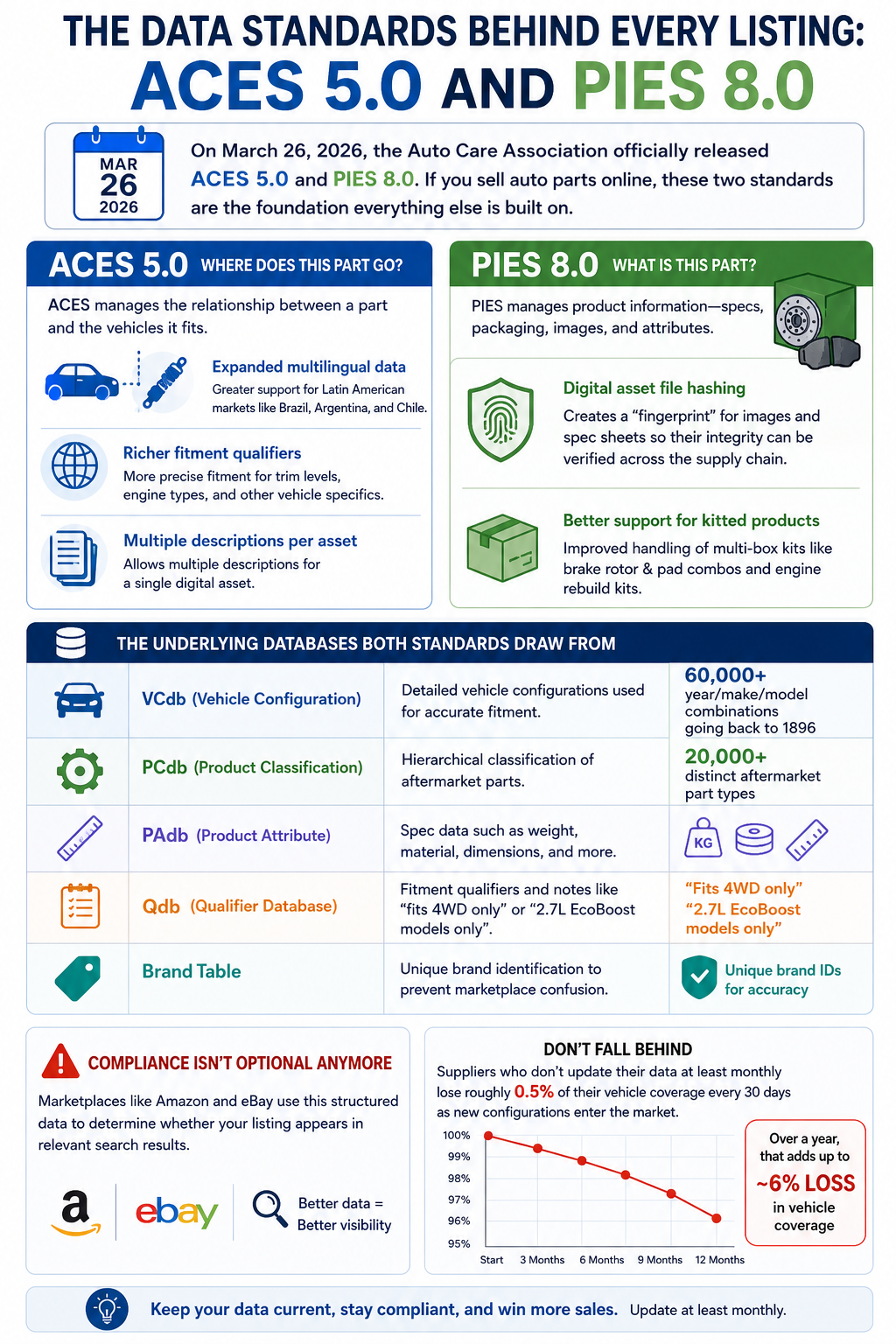
On March 26, 2026, the Auto Care Association officially released ACES 5.0 and PIES 8.0. If you sell auto parts, these two standards are what everything is built on, so it’s worth knowing what they actually do rather than treating them as back-office jargon.
ACES handles the “where does this part fit” question — the relationship between a part and the specific vehicles it’s compatible with. ACES 5.0 adds expanded multilingual support (useful if you’re selling into Latin American markets like Brazil, Argentina, or Chile), richer fitment qualifiers for trim and engine specifics, and the ability to attach multiple descriptions to a single digital asset.
PIES handles the “what is this part” question — specs, packaging, images, and attributes. PIES 8.0 introduces digital asset file hashing, which creates a verifiable fingerprint for product images and spec sheets, so data integrity can be confirmed across the supply chain. It also handles kitted products better — brake rotor and pad combos, engine rebuild kits, anything that ships as multiple boxes under one SKU.
Here’s the underlying database structure both standards draw from:
| Database | What It Covers |
|---|---|
| VCdb (Vehicle Configuration) | 60,000+ year/make/model combinations going back to 1896 |
| PCdb (Product Classification) | 20,000+ distinct aftermarket part types |
| PAdb (Product Attribute) | Specs like weight, material, and dimensions |
| Qdb (Qualifier Database) | Fitment notes like “fits 4WD only” or “2.7L EcoBoost models only” |
| Brand Table | Unique brand identification to prevent marketplace confusion |
Compliance with these standards isn’t optional if you care about search visibility on Amazon or eBay — both platforms use this structured data to determine whether your listing appears in relevant results. Suppliers who don’t update their data at least monthly lose roughly 0.5% of vehicle coverage every 30 days as new configurations enter the market. Over a year, that adds up in ways that are hard to recover.
The key differences between a backorder and out of stock for a seller is significant. A product page that just says “out of stock” converts no one. A backorder page can still convert customers who want the item badly enough to wait, which for the right product category is a meaningful portion of your audience.
The key question is whether that waiting period is worth it — for the customer’s patience and for the seller’s operational ability to follow through. We’ll cover both below.
Understanding Who’s Actually Buying: Two Very Different Buyers
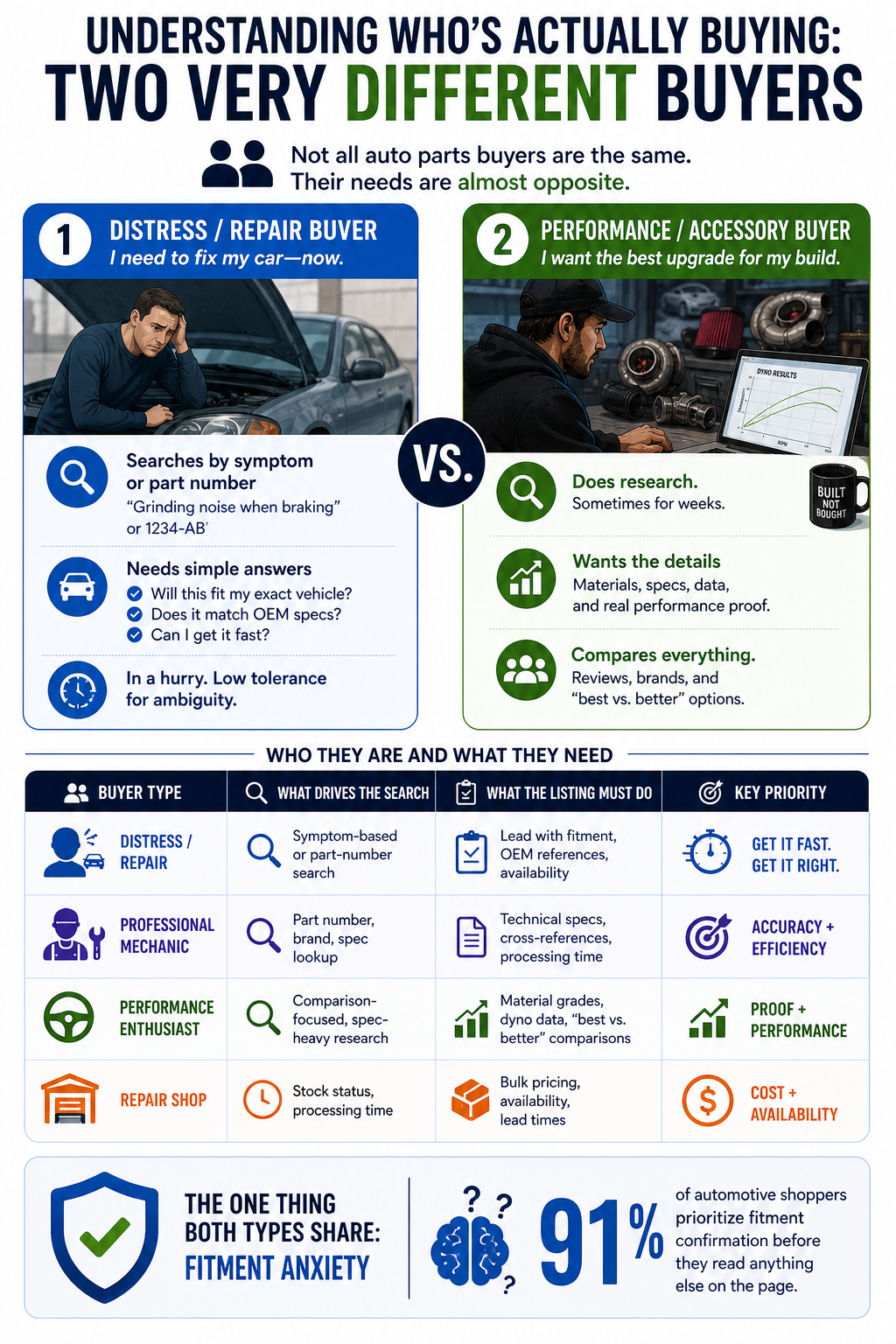
Not all auto parts buyers are the same, and a description written to serve all of them equally usually ends up serving none of them particularly well.
The replacement or repair buyer is often stressed — their car isn’t working, they need the right part quickly, and they’re searching by symptom (“grinding noise when braking”) or by part number. What they need from your listing is fast confirmation: does this fit my exact vehicle, does it match OEM specs, and can I get it soon? Any ambiguity on those points is enough to lose the sale.
The performance or accessory buyer is doing research, sometimes for weeks. They want to know the difference between 6061-T6 aluminum and standard alloy. They want to see proof that the upgrade does what it claims. They’re comparing materials, reading reviews from other enthusiasts, and looking for any sign that the seller actually understands the product they’re selling.
| Buyer Type | What Drives the Search | What the Listing Must Do |
|---|---|---|
| Distress/Repair | Symptom-based or part-number search | Lead with fitment, OEM references, availability |
| Professional Mechanic | Part number, brand, spec lookup | Technical specs, cross-references, processing time |
| Performance Enthusiast | Comparison-focused, spec-heavy research | Material grades, dyno data, “best vs. better” comparisons |
| Repair Shop | Stock status, processing time | Bulk pricing, availability, lead times |
Both types share one thing: fitment anxiety. When a listing is vague about what it actually fits, buyers start looking for the exit. Research suggests 91% of auto parts shoppers prioritize fitment confirmation before reading anything else on the page — before the price, before the reviews, before any of the marketing copy.
Using AI to Scale Without Creating Fitment Liability
Writing individual descriptions for a catalog covering tens of thousands of SKUs by hand isn’t realistic. AI-assisted workflows have reduced production time for technical listings by roughly 70%, and for large catalogs that’s a real operational difference.

The catch is important in automotive specifically, because the downside of getting fitment data wrong isn’t just a bad listing — it’s a wrong-fitment claim that triggers returns, complaints, and potentially legal exposure. The way you implement AI matters a lot here.
General-purpose LLMs — ChatGPT, off-the-shelf Gemini — will generate plausible-sounding fitment information that is sometimes factually wrong. They don’t have access to your ACES and PIES data, so they fill gaps with confident-sounding guesses. That’s a real problem for a product category where the buyer is asking “will this fit my 2019 F-150 with the 2.7L engine and 4WD” and expects a correct answer.
Custom AI agents trained on your internal catalog data work differently. They perform real-time lookups against your actual fitment database, which is why they achieve resolution rates of 85–92% on fitment queries. The implementation takes longer — typically a few weeks of setup — but for any seller with meaningful catalog depth, it’s the right tool for customer-facing fitment content.
| Tool Type | Handles Real Fitment Queries? | Typical Accuracy | Setup Time |
|---|---|---|---|
| Custom AI agent (ACES/PIES-trained) | Yes — real-time database lookup | 85–92% | ~4 weeks |
| General LLM (ChatGPT, etc.) | No — generates plausible-sounding errors | Not measurable | Same day |
| Macro/static chat | No — canned responses only | 20–30% | 1–3 days |
Multimodal AI tools like Gemini also offer something specifically useful for catalog management: you can feed them an image of a part and get a draft title, suggested attributes, and a working description generated from minimal input. For sellers bringing new products to market quickly, that workflow is genuinely faster than any manual process.
Fulfillment with a Personal Touch.
See How Using a 3PL like eFulfillment Service sellers saves time. Get a Free Quote from eFulfillment Service Today!
Compliance That Lives on the Product Page
Regulatory disclosures have moved from back-office paperwork to front-facing product content, and 2026 brings several specific deadlines.

Extended Producer Responsibility (EPR): Seven US states — including California, Oregon, and Colorado — now require producers to fund and participate in recycling programs. PIES 8.0 includes specific data fields for EPR packaging information. If you haven’t reviewed your packaging claims for compliance with state-level requirements, the timelines are real and the penalties for non-compliance are not minor.
California Prop 65: A grace period for newly listed chemicals, including Bisphenol S (BPS), expires December 8, 2026. After that date, enforcement kicks in. If your products contain newly listed substances above safe-harbor thresholds, your product pages need tailored warnings — not a blanket disclaimer, but specific language for the substance in question.
California SB 343: Starting October 4, 2026, recyclability claims on products and packaging face new restrictions. If your descriptions include environmental marketing language, that language needs a review against the updated standard.
Magnuson-Moss Warranty Act: This one is actually a selling opportunity. Many buyers believe that installing an aftermarket part automatically voids their factory warranty. It doesn’t — under Magnuson-Moss, a manufacturer can only deny warranty coverage for a specific system if they can show the aftermarket part caused that failure. Most sellers don’t say this anywhere on their product pages, which means they’re leaving a common buyer objection completely unaddressed.
Shipping Information: The Part of the Listing Buyers Actually Read at the End
Auto parts have a wider range of shipping complexity than almost any other product category — a sensor weighs a few ounces and ships in a padded envelope; an engine block goes freight. Your listing needs to be specific about which situation applies, because buyers who get a freight surcharge at checkout that they didn’t expect tend to abandon the order.

Research is consistent on this: 62% of consumers say an accurate estimated delivery date matters more to them than delivery speed. The separation between processing time and transit time is something a lot of listings blur. They’re different things, and stating them separately — “ships within 1 business day; transit 3–5 days” — is more useful and more trusted than “arrives in 4–6 business days.”
A few other things that belong on the product page and often don’t appear:
DIY difficulty and labor estimates. Using data from Mitchell 1 or ALLDATA, you can give buyers a realistic sense of how involved a repair is. A buyer who understands they’re looking at a 4-hour job will plan accordingly. One who doesn’t expect that may start the repair, run into complexity, and return the part out of frustration rather than because there was anything wrong with it.
Core charge disclosures. For batteries, alternators, calipers, and similar parts, the core charge should appear as a clearly labeled refundable deposit — not buried in fine print. Sellers who handle core returns cleanly (automated return labels, real-time credit tracking) tend to see meaningfully better repeat purchase rates, because the experience feels professional rather than like an afterthought.
In our experience at EFS, the packaging side of automotive parts also matters more than most sellers plan for. Parts need to arrive exactly as they left — no cosmetic damage that could be mistaken for a defect. We handle 76,000+ unique SKUs across 20 box sizes, which means most parts actually ship in a box that fits rather than one that’s mostly air.
Platform-Specific Notes: eBay, Amazon, and Shopify
Each platform has its own logic, and the same listing structure doesn’t perform equally across all three.

eBay Motors runs on the Cassini algorithm, which puts heavy weight on 100% completion of Item Specifics. Partial data gets buried. Use the Master Vehicle List (MVL) for compatibility tables — it’s the right tool for the platform’s fitment system. Mobile summaries cap at 250 characters, so whatever you lead with needs to work in that space.
Amazon Automotive is the most constrained environment. Descriptions often cap at 2,000 characters, HTML is largely restricted, and Amazon handles fitment verification through its own Part Finder tool rather than trusting your description copy. Bullet-pointed technical specs perform better here than narrative prose — that’s just how the platform’s search and display logic works.
Shopify gives you the most control, which means the most decisions to make well. Sellers with complex fitment databases are increasingly using headless or MACH (Microservices, API-first, Cloud-native, Headless) architecture to serve fitment data at speed — because every one-second delay in page load costs roughly 7% in conversions, and automotive buyers are not patient people.
Regardless of platform, maintaining one consistent data source across all your channels pays off. Sellers with consistent cross-channel product data see roughly 23% higher revenue growth than those with fragmented information — which makes intuitive sense, because fragmented data means different listings saying different things about the same part.
Conversion Benchmarks Worth Knowing
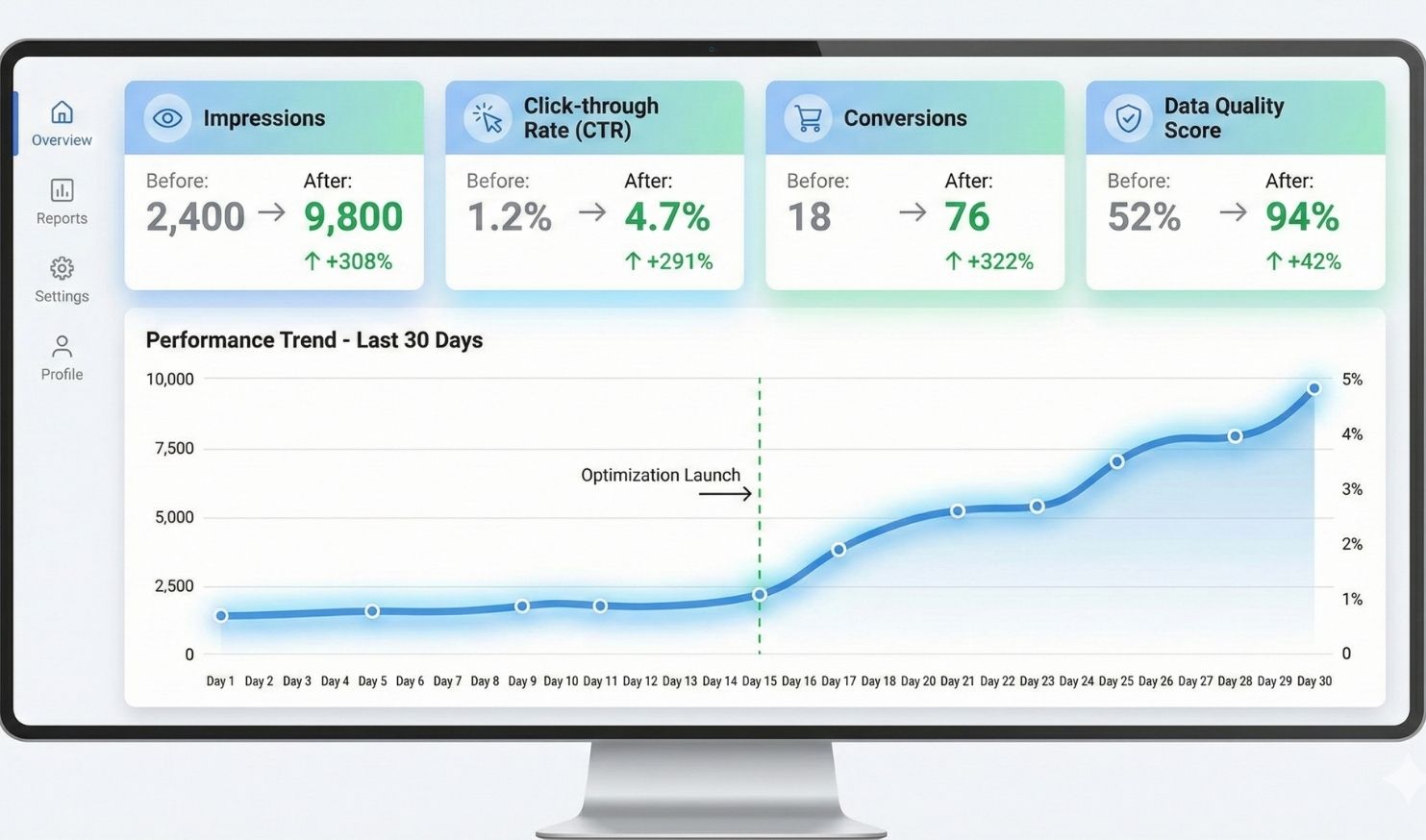
The global average e-commerce conversion rate sits around 2.15%. Auto parts outperforms that significantly:
| Segment | Conversion Rate | Average CPC |
|---|---|---|
| Auto parts & accessories | 12.61% | $2.46 |
| Tire & wheel alignment | 14.03% | $3.56 |
| Transmission & clutch | 13.45% | $6.89 |
| Automotive aftermarket avg. | 8.80% | $3.13 |
The mobile gap is the persistent problem. Desktop converts at about 3.1%; mobile converts at 1.65%, even though 73% of e-commerce traffic now comes from mobile devices. Listings designed for desktop first and adapted for mobile as an afterthought are leaving a lot of conversions on the table. It’s worth treating mobile as the primary design target for product pages at this point — the traffic data has been pointing that way for a while.
How EFS Fits Into the Fulfillment Side of This Picture
Writing a good product description gets the sale. Getting the right part to the right customer, packed correctly and on time, is what keeps the sale.

For auto parts sellers specifically, the fulfillment side has real complexity. Parts range from a $12 sensor clip to a 60-pound caliper assembly. The packaging needs to protect each one without being wasteful, and it needs to match what the listing describes — because a buyer who receives a kitted product missing half the hardware listed in the “what’s in the box” photo doesn’t see a shipping error, they see a product that doesn’t match what they ordered.
We’ve been doing this for 25+ years. EFS handles 76,000+ unique SKUs across 20 box sizes, and we don’t use styrofoam packing peanuts — we’ve diverted 3,500+ square feet of waste monthly through sustainable packing alternatives.
For kitted products — brake rotor and pad combos, tune-up kits, anything that ships as a set — our kitting and assembly capabilities handle the build side so the product arrives matching how it was described.
Auto Part Product Description FAQs
What is the most important element of an auto parts product description?
Fitment data. Research consistently puts this at 91% of auto parts buyers prioritizing fitment confirmation before anything else on the page — before price, before reviews. A compatibility block that specifies year, make, model, trim, engine, and drivetrain does more to prevent returns and build buyer confidence than any other single element. Everything else matters too, but fitment is where most sellers lose the sale without knowing it.
What are ACES and PIES, and do I actually need to use them?
ACES (Aftermarket Catalog Exchange Standard) manages fitment data — which vehicles a part is compatible with. PIES (Product Information Exchange Standard) manages everything about the product itself — specs, images, packaging. Both were updated to new versions (ACES 5.0, PIES 8.0) in March 2026. If you sell on Amazon or eBay, both platforms use this structured data to determine search visibility. That makes compliance effectively required for competitive selling, regardless of how you feel about the standards themselves.
How do I reduce automotive e-commerce returns?
Most returns in automotive trace back to fitment data that wasn’t specific enough. Year/make/model is a start — trim level, engine code, and drivetrain get you to a number where returns actually drop. “What’s in the box” photography also cuts a specific category of returns that happen because the buyer expected hardware that wasn’t included. And for parts with core charges, clear upfront disclosure prevents the post-purchase friction that sometimes turns into a return when a buyer feels surprised.
Should I use AI to write auto parts descriptions?
Yes, with an important distinction. General-purpose AI tools don’t have access to your fitment database, and they will generate wrong fitment claims with the same confidence as correct ones. Custom AI agents trained on your own ACES and PIES data do real-time lookups against actual vehicle data, which is why they reach 85–92% accuracy on fitment queries. For catalog-level description writing (titles, attributes, marketing copy), general AI tools work fine. For fitment-specific content, use tools trained on your actual data.
What schema markup should auto parts listings use?
Start with @type: Product and add aggregateRating, offers (for live pricing and stock status), and mpn/sku for part-number search visibility. For vehicle-specific listings, the vehicleEngine property connects your listing to engine-specific queries rather than just generic product searches. Schema-driven rich snippets — the star ratings and “In Stock” labels that appear directly in search results — typically improve click-through rates by 20–30%.
Does installing an aftermarket part void a vehicle's factory warranty?
No — not automatically. Under the Magnuson-Moss Warranty Act, a manufacturer or dealer can only deny warranty coverage for a specific system if they can demonstrate the aftermarket part caused that failure. The burden of proof is on them. Most buyers don’t know this, and most sellers don’t say it anywhere on their product pages, which leaves one of the most common objections to buying non-OEM parts completely unaddressed.
How should I handle shipping information for heavy auto parts?
State clearly whether an item ships via standard parcel or LTL freight, and separate processing time from transit time — they’re different, and conflating them creates frustration when reality doesn’t match expectations. Research puts 62% of buyers valuing an accurate delivery estimate more than fast delivery.
How do I set up backorders in Shopify?
In Shopify, go to the product settings for a specific variant and enable “Continue selling when out of stock.” To make this FTC-compliant and customer-friendly, you’ll also want to update your theme code so backordered products display a clear “Backorder” label and an estimated ship date rather than the standard “Add to Cart” button.
Ready to Handle the Automotive Part Fulfillment Side?
Getting the product listing right is half the work. The other half is making sure the part arrives correctly packed, in the right box, on time — especially when you’re managing a catalog with parts across multiple weight classes and configurations. eFulfillment Service has been doing exactly that for ecommerce sellers for 25+ years. If you’re scaling an auto parts business and the fulfillment side is getting complicated, we’d be glad to talk through what a partnership looks like.


0 Comments