
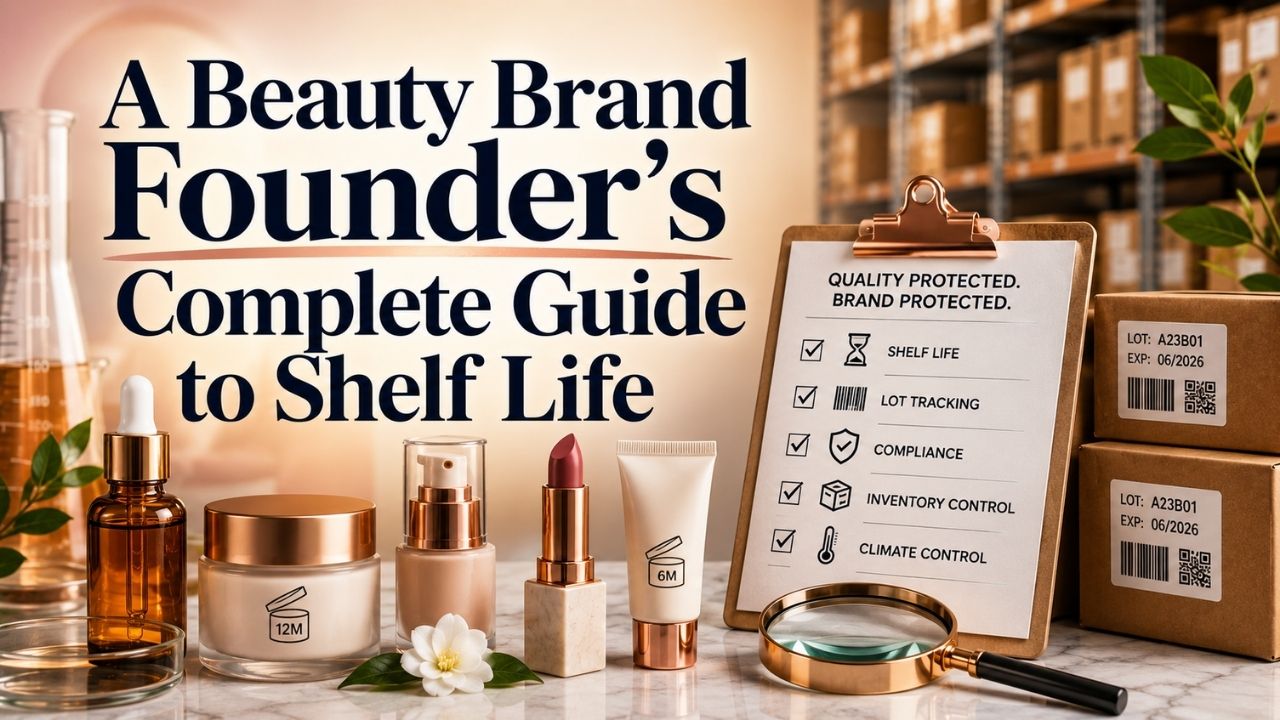
You built your brand on product quality. Every formula was obsessed over. Every shade was calibrated. Every unboxing moment was designed to feel like something.
And then a customer emails you. The Vitamin C serum they ordered turned dark orange. The foundation shade they received doesn’t match what’s on your website. Or worse — they had a reaction, and now they’re asking questions you don’t have clean answers to.
This isn’t just a customer service problem. It’s a brand protection problem. And in most cases, it traces back to the same root causes: products degrading faster than expected, inventory not rotating properly, lot tracking gaps, or a 3PL that treats your lipstick like it’s a box of phone cases.
This guide is written for founders who are running growth-stage beauty brands and who need to understand how shelf life actually works, what MoCRA requires of you right now, what your warehouse should be doing (and probably isn’t), and what a real operational protocol looks like.
Part One: What’s Actually Happening to Your Products Over Time

Two Clocks Are Ticking on Every Product You Ship
Most beauty founders know one of them. They don’t manage both.
Clock #1 — Unopened Shelf Life
Also called the Date of Minimum Durability (DOMD). This is how long your product stays stable, safe, and performing when it’s sealed and stored correctly. It’s the number your stability testing gives you. It’s what you print on the box.
Clock #2 — Period After Opening (PAO)
This clock starts the moment a customer breaks the seal. It measures how long the product stays safe and effective once it’s living on someone’s bathroom shelf — exposed to air, humidity, fingers, and whatever else is in their environment.
Why this matters operationally: A product that’s technically “unexpired” in your warehouse might already be past its safe window in a customer’s hands. A customer who gets a 12-month serum with only two months of warehouse shelf life left is getting a product that’s already running out the clock before they’ve barely started using it.
Both clocks affect your brand. You need to manage both.
Note: PAO requirements came out of EU Directive 2003/15/EC (2003, in effect since March 2005) and apply to products with an unopened shelf life of 30+ months. The FDA doesn’t currently require PAO labeling in the US — but does review your safety substantiation files during inspections.
What’s Actually Going Wrong (By Product Type)

Your products don’t just “go bad” in one generic way. Different formulas fail differently — and knowing the mechanism is what makes storage conditions and lot tracking make sense.
Water-based products (serums, toners, emulsions, foundations)
Anything with water in it can harbor bacteria and mold. Every time a customer dips their fingers into a wide-mouth jar, they introduce new microbes. Your preservative system fights that off — but it has a finite capacity. It gets overwhelmed. The system that looked great at month three of stability testing can be exhausted by month ten on a customer’s vanity.
Vitamin C and retinol products
These are the most unstable actives in beauty. Vitamin C (L-ascorbic acid) starts oxidizing the moment it’s exposed to light and air. That color shift from clear to dark orange? That’s not a dye issue. That’s the active ingredient breaking down. Retinol does the same under UV light and heat. This is why Vitamin C and retinol serums often have PAOs of only 3–6 months — and why packaging (airless pumps, opaque bottles, UV-protective glass) isn’t just aesthetics. It’s the difference between a formula that works and one that’s dead before the customer finishes it.
Oil-based and anhydrous products (balms, facial oils, wax lipsticks)
No bacterial contamination problem — but a different enemy: rancidity. When unsaturated fatty acids in botanical oils (coconut, jojoba, argan) are exposed to oxygen, they break down. You can smell it — that off, crayon-like odor. Beyond the smell, rancid oils can produce compounds that cause skin sensitivity reactions. Heat and oxygen are the accelerants.
Dry products (pressed powders, eyeshadow palettes)
Actually quite stable — no water means no microbial growth. Their main enemy is humidity. Moisture absorption causes binder degradation, pan cracking, and eventually mold. Keep them dry and they’ll last.
Your Shelf Life Reference: What’s Actually on the Clock
| Product Type | Sealed Shelf Life | Safe Period After Opening | What Goes Wrong |
| Cleansers with active acids | 24–36 months | 12–24 months | Preservative breakdown, bacterial growth |
| Active serums (Vitamin C, retinol) | 12–24 months | 3–12 months | Oxidation, light degradation, potency loss |
| Moisturizers in jars | 24 months | 12 months | Formula separating, mold, air exposure |
| Moisturizers in pumps | 24 months | 18 months | Minimal — protected by the airtight pump |
| Water-based foundations | 24–36 months | 12 months | Pigment clumping, bacterial growth |
| Pressed powders and palettes | 36 months | 36 months | Moisture absorption, pan cracking |
| Mascara and eye products | 12–24 months | 2–4 months* | Repeated microbial exposure, severe drying |
| Oil and wax balms | 12–24 months | 6–12 months | Oils going rancid |
| Alcohol-based fragrances | 36–60 months | 36–60 months | Top note fade, UV degradation |
*Mascara PAO is 2–4 months because every application introduces bacteria from the eye area directly into the tube.
Three things worth flagging:
- Mascara is your highest-risk product. 2–4 months after opening. Customers who hold onto mascara for a year may be applying a bacterial culture to their eyes. Say this clearly on your packaging and website.
- Jar vs. pump matters more than you think. Pump-dispensed moisturizers outperform jar versions of the same formula significantly. If you’re selling a flagship moisturizer in an open jar and getting quality complaints, the packaging is at least partly the problem.
- Active serums are your most brand-sensitive category. A customer who pays premium for a Vitamin C serum and watches it turn orange is not going to quietly accept a refund. They’re going to post about it.

Before MoCRA, the FDA’s authority over cosmetics was minimal. A brand could sell a product without any pre-market review. Facility registration was voluntary. The FDA could act after a product caused harm but had almost no tools to prevent it. MoCRA gave the FDA mandatory registration authority, product listing requirements, the power to order recalls, and the foundation for formal manufacturing standards.
The requirements did not all take effect at once. Use this timeline to understand where you stand:
|
Requirement |
Large Business Deadline |
Small Business Deadline |
|---|---|---|
|
Facility Registration |
Dec 29, 2023 |
Dec 29, 2024 |
|
Product Listing |
Dec 29, 2023 |
Dec 29, 2024 |
|
Adverse Event Reporting |
Dec 29, 2023 |
Dec 29, 2023 |
|
Updated Labeling (contact) |
Dec 29, 2023 |
Dec 29, 2023 |
|
Good Manufacturing Practices |
TBD — final rule pending |
TBD |
|
Fragrance Allergen Labeling |
TBD — final rule pending |
TBD |
If your brand crossed the $1 million average revenue threshold, your registration and product listing deadlines have already passed. If you are under that threshold, your deadlines passed at the end of 2024. The clock is not still running — it has already stopped.
Fulfillment with a Personal Touch.
See How Using a 3PL like eFulfillment Service sellers saves time. Get a Free Quote from eFulfillment Service Today!
Part Two: What the Law Actually Requires of You

If You Sell in Europe or the UK
The EU and UK rules are the clearest in the world. Everything turns on a single threshold: 30 months.
Sealed shelf life ≤30 months:
Display the hourglass (egg timer) symbol on both primary and secondary packaging, plus the date of minimum durability (month/year or day/month/year). Most common for clean beauty formulations and mineral sunscreens.
Sealed shelf life >30 months:
No specific expiration date required. Display the open jar symbol with the number of months safe after opening (e.g., “12M”). Single-use sachets, aerosols, and high-alcohol fragrances are exempt — they’re physically protected from the degradation that makes PAO relevant.
What you need to operate on these markets:
- Responsible Person (RP) — physically based in the EU or UK; compiles and maintains your PIF
- Product Information File (PIF) — must include a full Cosmetic Product Safety Report (CPSR) backed by stability testing and microbiological challenge data; retained for at least 10 years after the last batch is sold
- Product registration via EU CPNP portal or UK SCPN portal
If You Sell in the US: MoCRA Is Now Real and Enforced
The US is in the middle of the most significant overhaul of cosmetics regulation since 1938. MoCRA (Modernization of Cosmetics Regulation Act of 2022) has changed what’s expected of you — and the enforcement machinery is catching up fast. For a deeper look at how these requirements connect to your fulfillment operation, see our full MoCRA compliance guide for ecommerce brands.

Biennial Facility Registration
Any facility that manufactures or processes cosmetics for US distribution must register with the FDA via Cosmetics Direct. In February 2026, FDA updated the portal to include active registration status tracking — meaning they’re watching who’s current and who isn’t.
If your contract manufacturer isn’t registered, your products can’t legally be marketed in the US. Confirm their status before your next production run.
Annual Product Listing
You must file a product listing for every cosmetic SKU you market in the US, updated annually.
The part that surprises founders: Every individual shade gets its own listing. A 20-shade foundation line = 20 separate filings. Build this into your annual calendar now.
Mandatory Adverse Event Reporting
Serious adverse event (hospitalization, disfigurement, acute infection) → report to FDA within 15 business days. You must also maintain comprehensive complaint records.
- Standard brands: retain records for 6 years
- Qualified small businesses (under $1M avg gross sales): 3 years
“I didn’t know” is not a regulatory defense. Build the logging system now, before you need to demonstrate it retroactively.
Labeling Requirements
- Labels must include domestic contact information (address, phone, or website)
- Products for professional use must be labeled “for professional use only” — required since December 2024
- Products that degrade over time must display expiration dates or shelf-life disclosures — moving the US significantly closer to the European model
What About GMP?
MoCRA mandated formal GMP regulations, but a final rule isn’t expected before late 2026. The practical standard in the meantime is ISO 22716. Brands that haven’t adopted it are taking on unnecessary risk at inspection.
EU/UK vs. US: The Side-by-Side
|
Compliance Area |
EU and UK |
US (MoCRA) |
|
Governing law |
Regulation (EC) No 1223/2009 / UK Cosmetics Regulation |
FD&C Act, amended by MoCRA |
|
Safety documentation |
Mandatory PIF with full CPSR |
Mandatory safety substantiation files |
|
Short shelf life labeling (≤30 months) |
Hourglass symbol + expiration date |
Mandatory calendar dates for OTC hybrids |
|
Long shelf life labeling (>30 months) |
Open jar symbol + months after opening |
Calendar expiration dates for sensitive formulas |
|
Adverse event reporting |
Immediate notification |
Within 15 business days |
|
Record keeping |
10 years after last batch sold |
6 years (3 years for small businesses) |
|
Facility registration |
Via CPNP or UK SCPN portal |
Biennial via Cosmetics Direct |
|
Product listings |
Full ingredient disclosure |
Annual per SKU and per shade |
Part Three: Clean Beauty’s Harder Problem

Formulating Without Synthetic Preservatives — What’s Actually Holding Your Products Together
If your brand is clean, COSMOS-certified, NATRUE-certified, or USDA Organic, your formulator is working without the most effective preservation tools in cosmetic chemistry — parabens, methylisothiazolinone, formaldehyde donors. Prohibited for legitimate reasons. But the trade-off is real.
Clean formulations typically achieve 18–24 months of commercial shelf life versus 24–36 months for conventional formulas. Here’s what your formulator should be using to compensate:
pH-Dependent Organic Acid Preservation
Natural preservatives (benzoic acid, sorbic acid, salicylic acid, dehydroacetic acid) only work within a narrow pH window — typically below 5.5. If your formula’s pH drifts upward over time, the preservative system loses effectiveness and you can have microbial spoilage within weeks.
Practical implication: Your stability testing must monitor pH drift over time, not just at manufacture. A formula that’s pH-stable at month one but drifts to 6.0 by month six is a liability.
The “Hurdle” Approach — Layering Multiple Barriers
Rather than depending on one preservative, effective clean formulations stack overlapping barriers: natural glycols to reduce available water for microbial growth, chelating agents like phytic acid to bind the trace metals bacteria need to divide. No single barrier is enough — the system works because the layers reinforce each other.
Multi-Functional Preservation Ingredients
Some clean ingredients do double duty — conditioning skin while disrupting microbial cell membranes. Glyceryl caprylate, caprylyl glycol, and botanical fermentation filtrates like Lactobacillus ferment all produce natural antimicrobial effects. These need to be validated in your stability testing, not just listed on your spec sheet.
Protecting Oil Blends from Rancidity
For anhydrous formulas (balms, facial oils, oil-based serums), the threat is oxidation. The best defense: fat-soluble Vitamin E (tocopherol) working alongside water-soluble rosemary extract. Used together, they’re significantly more effective than either alone. If your oil-based products are developing off smells or causing skin sensitivity, rancidity is the first thing to investigate.
Packaging as a Preservation System
This one is underappreciated: your packaging directly affects how long your formula stays effective. Opaque UV-protective glass, aluminum tubes, and airless pump dispensers all protect against light and air in ways that clear glass or open jars simply can’t.
For Vitamin C or retinol products, the right packaging can extend shelf life by up to 1.5x compared to an open jar. Paula’s Choice C15 Super Booster illustrates this: highly unstable Vitamin C, 3-month PAO, 18-month sealed shelf life — and the brand places the PAO symbol directly near the barcode. That’s transparency-as-brand-strategy.
If you’re formulating with high-performance actives and selling in open-jar packaging, you’re eroding both product performance and brand trust simultaneously.
Fulfillment with a Personal Touch.
See How Using a 3PL like eFulfillment Service sellers saves time. Get a Free Quote from eFulfillment Service Today!
Part Four: Your 3PL Is Either Protecting Your Brand or Undermining It

The Warehouse Reality Most Beauty Founders Find Out Too Late
Here’s a scenario that plays out constantly in the 300–2,000 orders/month tier:
Brand is growing. They hand off fulfillment to a 3PL. Six months later, complaints start coming in — expired product, wrong shades, degraded formulas, products that “didn’t look right.” They call their 3PL. The 3PL says everything was picked correctly. The founder doesn’t know what to look for. The brand takes the hit.
Most 3PLs are built for general e-commerce. They think in boxes, SKUs, and ship dates. They do not think in expiration dates, lot numbers, temperature zones, or shade accuracy. For beauty, that’s not good enough. However, eFulfillment Service specializes in fulfillment for Beauty and Cosmetic brands just like your’s!
FEFO: The Only Inventory Rotation That Makes Sense for Beauty

Standard e-commerce warehousing runs on FIFO — First-In, First-Out. The oldest received inventory ships first. Fine for t-shirts. A real problem for beauty.
FIFO assumes the earliest-received inventory is the oldest. In beauty fulfillment, that’s often not true. A second production run may arrive before the first is fully shipped. International shipments with different manufacturing dates arrive out of sequence. In these scenarios, FIFO ships the wrong inventory — and your customers end up with products running out the clock before they’ve barely started.
FEFO — First-Expired, First-Out ships whatever has the nearest expiration date, regardless of when it arrived. eFulfillment Service supports both FIFO and FEFO inventory rotation — a critical capability for time-sensitive beauty products. What that means for your brand:
- Customers get maximum remaining shelf life
- Near-expiry inventory doesn’t get buried behind newer stock until it’s too late
- You stop shipping expired product accidentally
Questions to ask every 3PL:
|
Question |
What a Good Answer Looks Like |
|
“Do you operate FEFO or FIFO?” |
FEFO — or a clear explanation of how they manage beauty-specific expiration |
|
“How do you capture expiration dates at receiving?” |
Scanning GS1 DataMatrix / 2D barcodes into their WMS — not manual spreadsheets |
|
“What happens to short-dated inventory?” |
Routed to dedicated zones or dynamic flow shelving — if they can’t explain this, they don’t have a system |
|
“Do you require single-date pallets from suppliers?” |
Yes — mixed-expiration pallets create lot confusion and picking errors |
Fulfillment with a Personal Touch.
See How Using a 3PL like eFulfillment Service sellers saves time. Get a Free Quote from eFulfillment Service Today!
Lot Tracking: Your Insurance Policy Against the Worst-Case Scenario

Lot tracking is the difference between a precision recall and a blanket product withdrawal that takes everything offline. For a deep dive, see Lot Tracking Explained: The Comprehensive Guide to Smarter Inventory Management.
Imagine: A specific batch of your active serum tests positive for microbial contamination.
With clean lot tracking: Your 3PL places a hold on just that lot number. All other inventory keeps flowing. Only affected customers are notified. A distribution report goes to FDA if needed.
Without lot tracking: You pull everything. You spend days manually reconstructing records. You may miss the 15-day FDA reporting window.
Under MoCRA, your fulfillment partner needs to pull distribution records for specific lots on demand. If they can’t do that, you can’t meet your compliance obligations — and the liability falls back to you as the Responsible Person.
Questions to ask every 3PL:
|
Question |
What a Good Answer Looks Like |
|
“Do you track lot numbers at the SKU level?” |
Yes — and they can demonstrate it |
|
“Can you generate a lot distribution report?” |
Yes — they can tell you which customers received which lots |
|
“How do you handle shade-level picking accuracy?” |
Mobile barcode scanners + scan-to-verify picking, not eyeballing |
|
“Can you hold one lot without stopping all other fulfillment?” |
Yes — a clear process exists. If they look confused, that’s your answer |
Climate and Storage: What Your Products Actually Need
Different product categories need genuinely different conditions — and a 3PL storing your Vitamin C serums and pressed powders in the same unmonitored room is degrading your products before they ever ship.
| Product Category | What It Needs | What Happens When It Doesn’t Get It |
| Active serums (Vitamin C, retinol) | 50–70°F (10–21°C) | Oxidation and potency loss accelerate — serums degrade on the shelf |
| Creams and lotions | 59–77°F (15–25°C), stable | Freezing breaks emulsion structure; heat causes separation and oil bleed |
| Pressed powders and palettes | <60% relative humidity | Moisture absorption, binder degradation, mold growth |
| Alcohol-based fragrances | 41–59°F (5–15°C), secured zone | Flammable hazmat — legally requires ADR-certified transport and specialized storage |
The Two Metrics That Tell You If Your Operation Is Actually Working
Fulfillment Accuracy (FEFO)
What percentage of units shipped had acceptable remaining shelf life? A well-run beauty operation should be at 99%+. Below that is a sign of systemic problems — and something your 3PL should be reporting to you proactively.
Storage Loss Rate
Units written off due to expiry ÷ total on-hand inventory × 100.
If you’re running 20% gross margins and writing off 3% of inventory to expiration annually, you’re losing a meaningful percentage of operating income to a preventable problem. Cutting from 3% to 1% through better FEFO discipline directly recovers margin — not by selling more, but by not wasting what you already have.
Tech Stack: What a Beauty-Capable 3PL Should Be Running
Disconnected spreadsheets create blind spots, compliance risk, and costly write-offs. A 3PL managing your expiration dates in a spreadsheet is not a partner — it’s a liability.

Purpose-built platforms used by capable beauty 3PLs and brands:
- Cosmetri — formulation development, batch management, raw material inventory, EU/US regulatory compliance
- BatchMaster / ProcessPro — process manufacturing ERPs with formulation management and quality control
- STTARK — PLM and supply chain tool for beauty brands (product development, packaging specs, FDA/EU documentation)
- Trace One — full lifecycle PLM from concept through regulatory approvals
- Megaventory / Unleashed — multichannel inventory synchronization. See how eFulfillment Service integrates with 40+ ecommerce platforms.
What these systems do that matters to you: cradle-to-grave lot traceability, automated expiration alerts, barcode/scanner integration for shade-level picking accuracy, and real-time multichannel sync across Shopify, Amazon, TikTok Shop, and wholesale.
When evaluating a 3PL, ask directly: what WMS do you use, and does it support lot-level tracking and FEFO enforcement natively?
Fulfillment with a Personal Touch.
See How Using a 3PL like eFulfillment Service sellers saves time. Get a Free Quote from eFulfillment Service Today!
Part Five: Batch Codes, Consumer Behavior, and Product Authenticity
What That Code on the Bottom of Your Bottle Actually Does
Every batch of product you manufacture gets a unique batch code — a string of letters and numbers stamped, printed, or embossed on the container base or tube crimp. This code exists for your operations (inventory tracing, lot control, quality management) — but increasingly, it also matters to your customers.
How batch codes typically work:
- “A23B01” → A = manufacturing facility, 23 = year (2023), B01 = production run
- “23015” → 23 = year, 015 = the 15th batch of that year
Your format is yours to define — but you need a defined format, documented internally, and your 3PL needs to understand it well enough to capture and track it accurately.
What Customers Are Doing With Your Batch Codes Right Now
Consumers are more ingredient-aware than ever. Third-party tools like CheckFresh, Cosmetic Checker, and Cosmetic Calculator are widely used — customers enter a batch code and the tool attempts to decode the manufacturing date to estimate freshness.
This creates three risks for your brand:
- Gray market and secondhand sales — customers may use these tools to investigate product age. A product decoding to an old manufacturing date — even technically unexpired — generates doubt and drives customer service contact.
- Indie brand blind spots — if your format isn’t indexed in these databases (common for emerging brands), customers may assume the product is suspicious. A FAQ on your website and clear lot info on packaging can preempt the confusion.
The authenticity trap — these decoders cannot verify authenticity. A counterfeiter can print a valid-looking batch code just as easily as you can. Real authenticity protection requires your own systems: unique QR codes, NFC tags, serialized lot numbers.
Efficacy Decline vs. Safety Expiration: A Distinction Worth Making
These are two different things — and the distinction matters for how you communicate with customers.
Efficacy decline: Product performance degrades — Vitamin C potency drops, retinol becomes less effective, pigment oxidizes. The product may technically be safe to use, but it’s not delivering what your customer paid for.
Safety expiration: A legitimate safety concern exists — microbial overgrowth, rancidity causing skin sensitization, preservative failure. This is when the product should be discarded.
Teaching customers to do a simple sensory check before using a product that’s been sitting is genuinely useful education — and it demonstrates that you care about the experience they’re actually having.
Signs a product is no longer safe to use:
- Rancid or off smell
- Visible oil separation
- Clumping or texture changes
- Visible mold
Any of these = discard.
PFAS
In December 2025, the FDA published a safety review of the 25 most commonly used PFAS in cosmetics, drawing on the new product listing data MoCRA created. PFAS appear in products to improve texture, shine, and water resistance. If you use ingredients in these categories, confirm with your supplier whether PFAS are present in your formulations.
Part Six: The Environmental Cost of Expired Product

What Happens When Beauty Waste Hits the Landfill
The beauty industry generates approximately 120 billion units of packaging waste annually. In the US alone, cosmetic waste exceeded 7.9 billion units in 2018.
When expired cosmetics reach landfills, they create toxic runoff — landfill leachate — containing heavy metals (lead, cadmium, mercury) and persistent synthetic chemicals including phthalates and parabens. This seeps into surrounding soil and groundwater.
Specific ingredients, specific environmental harms:
- Parabens — enter wastewater systems and disrupt hormone function in aquatic life
- Microbeads and microplastics — wash into marine environments and move up the food chain
- Expired fragrances — release chemical vapors in landfills that contribute to air pollution
- Sunscreen UV filters (oxybenzone, octinoxate) — wash off in coastal waters and bleach coral reefs
Your Regulatory Obligations on Waste
Many beauty products — aerosol deodorants, hairsprays, fragrances, nail polish removers — are classified by the EPA as Contaminants of Emerging Concern. Under RCRA, returned, recalled, or expired inventory of these products must be handled as hazardous waste. Improper disposal = regulatory fines.
Under MoCRA, you need a documented process for returned products: restock vs. recycle vs. hazardous waste disposal. Not optional — and not just about being green. It’s about not having an improper disposal incident surface during an FDA inspection.
How to Recover Value From Near-Expiry Inventory
DTC flash sales — selling short-dated inventory at a discount is better for your margin, better for the environment, and better for customers who will use it promptly. Be transparent about the remaining shelf life.
Donate to nonprofit networks — Project Beauty Share and the Beauty Bus Foundation accept unexpired, overproduced, or short-dated inventory for underserved communities. Diverts waste from landfills, improves your ESG profile, and may qualify for tax incentives.
Transition packaging formats — fully compostable or bio-based packaging (bamboo, limestone paper, compostable bioplastics) reduces the footprint of both normal product turnover and disposal.
This Is Brand Protection Work
Everything in this guide — the shelf life science, the MoCRA compliance, the 3PL standards, the lot tracking, the waste protocols — connects back to one thing: the brand you’ve built.
When a customer receives a product that’s degraded, the wrong shade, or expired, they don’t blame the warehouse. They blame you. Your brand is what absorbs every operational failure upstream of the customer experience.
The founders who scale successfully through the growth stage aren’t always the ones with the best formulas. They’re the ones who built the operations to protect those formulas — from the moment the batch leaves the contract manufacturer to the moment it’s in the customer’s hands. Working with a beauty-specialized 3PL that understands FEFO, lot tracking, and climate-controlled storage is one of the highest-leverage decisions you can make.
You don’t have to be an expert in every technical detail in this guide. But you do have to know enough to ask the right questions, hold your partners to the right standards, and build systems that catch problems before they become brand moments of the wrong kind.
Note: Regulatory requirements under MoCRA continue to evolve. Consult with a qualified regulatory affairs professional for advice specific to your product line and business structure.





0 Comments