Quick Answer:
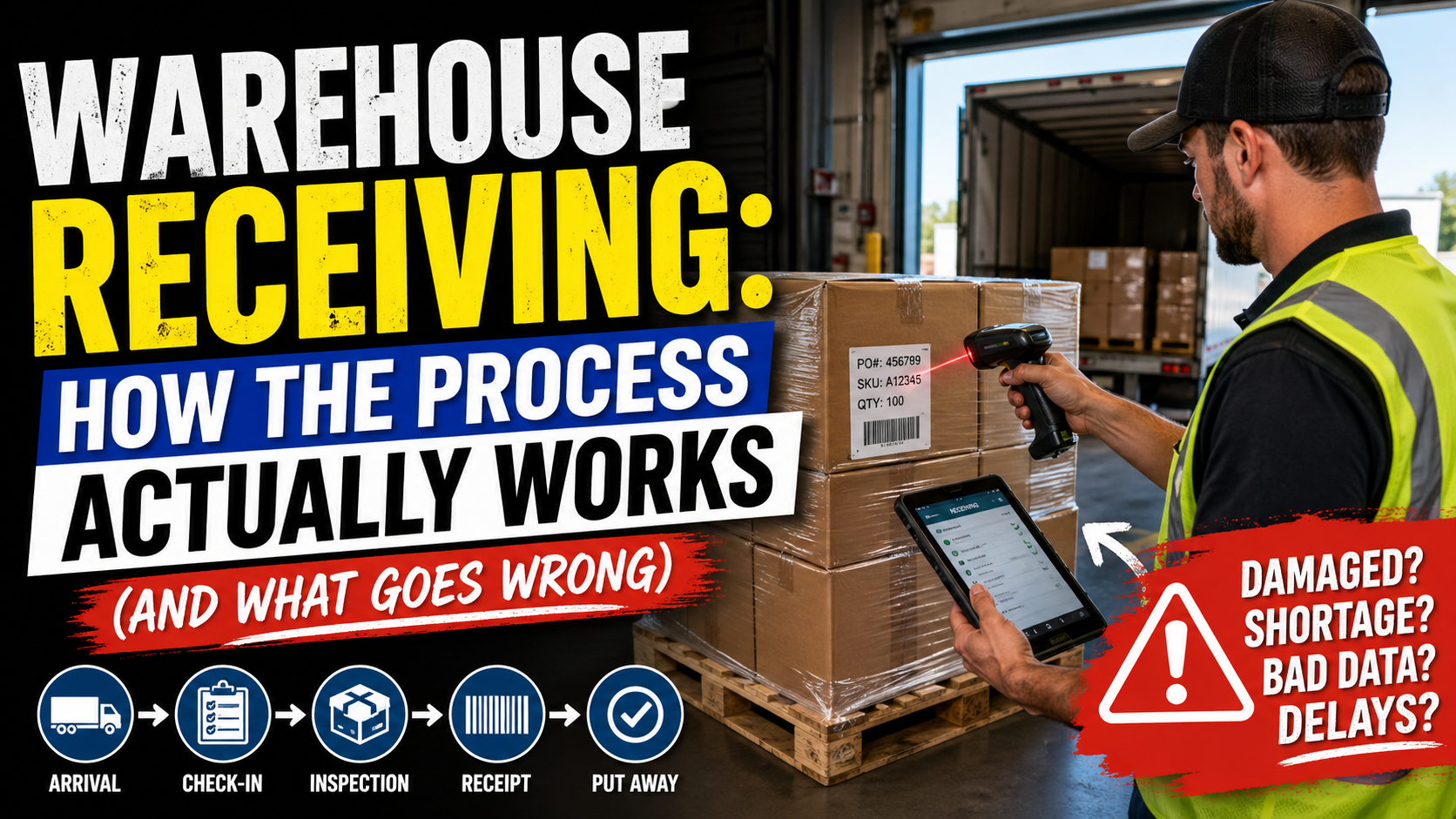
Warehouse receiving is the process of accepting, verifying, and recording inbound shipments before they enter your inventory system. It covers everything from pre-shipment data (ASNs), dock safety, and physical counting to quality inspection, damage claims, and putaway.
Most fulfillment problems don’t start at the packing station or the shipping dock. They start at receiving.
A mislabeled pallet accepted without a real count. A damaged case signed off as clean. A supplier who skipped the Advance Shipping Notice, so your team is improvising when the truck pulls up. These are the moments that quietly wreck inventory accuracy, generate chargebacks, and leave customers waiting on orders that don’t exist in your system yet.
At eFulfillment Service, we’ve been running receiving operations for over 25 years across 76,000+ unique SKUs — lightweight apparel, heavy specialty goods, and everything in between. Here’s what we’ve learned about doing it right, and what the research backs up.
Why Receiving Is the Foundation of Accurate Inventory
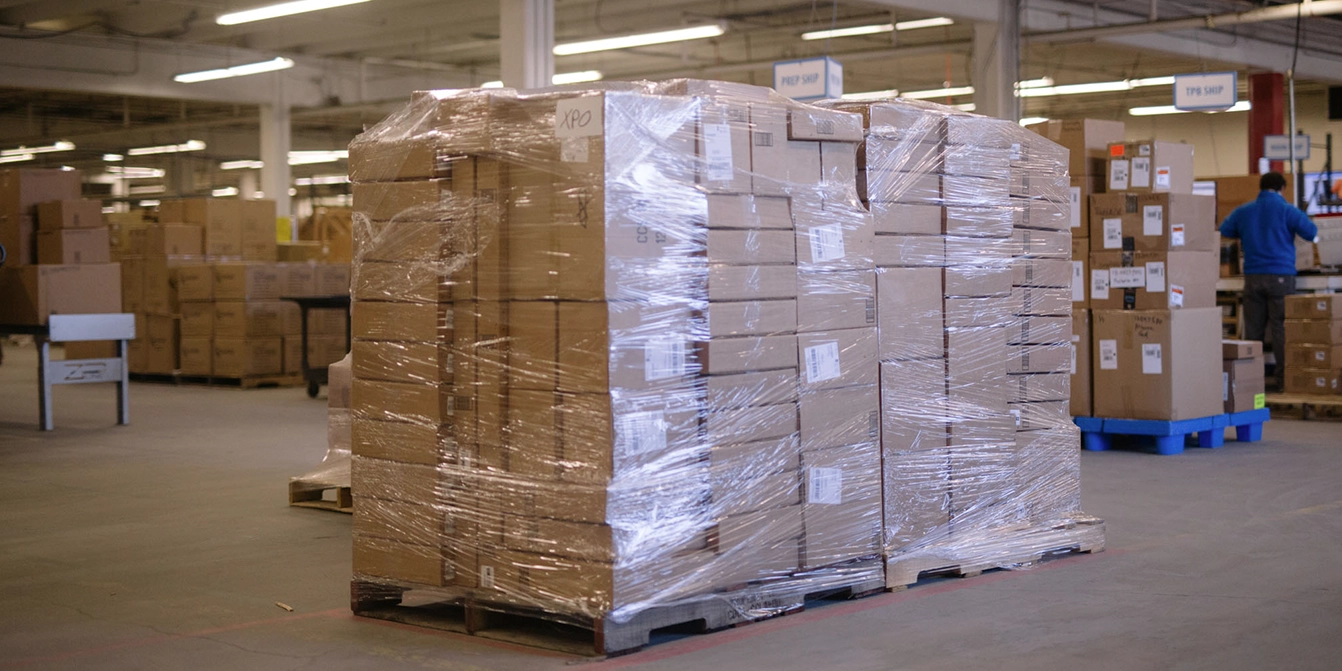
Think of receiving as the front door to your entire fulfillment operation. Whatever walks through that door — accurate data, clean product, correct quantities — shapes everything that follows. Inventory management, knowing when you’ll need to reorder, order accuracy, customer satisfaction: all of it traces back to what happens at the dock.
When receiving is clean, you get a single source of truth from the moment a shipment arrives. When it’s sloppy, you get what people in the industry call “data drift” — your system says you have 500 units of a product, your shelves say 420, and nobody knows which number to trust. That mismatch leads to:
- Products showing as “in stock” when they aren’t, which causes order cancellations
- Hours of manual reconciliation work that shouldn’t need to happen
- Lost or stolen items that never get traced back to their source
- A general erosion of confidence in your own inventory numbers
The statistics are pretty clear on this. Facilities using RFID and AI-assisted receiving routinely hit 99%+ inventory accuracy. Those relying on manual processes often sit well below that, and the gap compounds quickly at volume.
| Metric | When Receiving Works | When It Doesn’t |
|---|---|---|
| Inventory accuracy | 99%+ with RFID/AI systems | Lost items, phantom stock, order cancellations |
| Dock-to-stock time | Minimized via cross-docking and automated verification | Dock congestion, delayed fulfillment |
| Labor efficiency | 25–45% reduction in manual dependency with AI/RFID | High error rates, staff burnout |
| Compliance | Full OSHA and HAZMAT adherence | Regulatory penalties, injuries |
Pre-Receiving: ASNs and Dock Scheduling
Efficient receiving actually starts before the truck arrives. The best operations invest real time in pre-receiving preparation, and it pays off every day.

What’s an ASN and Why Does It Matter?
An Advance Shipping Notice (ASN) is a digital heads-up from your supplier that describes exactly what’s coming: which products, how many units, how they’re packaged, and when they’ll arrive. It’s transmitted electronically — usually via a standard EDI document called an EDI 856 — and it lands in your warehouse management system before the truck does.
For long-haul shipments, you want the ASN 12–24 hours in advance. For local loads, 2–4 hours is workable. Either way, having that data ahead of time lets you:
- Pre-stage dock equipment and the right number of workers
- Pre-assign storage slots so there’s no scrambling when the pallet hits the floor
- Automatically generate receiving tasks in your warehouse management system
- Route trailers to the correct dock door before they even pull in
Without an ASN, you’re staffing blind, improvising on space, and manually cross-referencing paper packing slips under pressure. In Tier-1 retail environments, inaccurate ASNs trigger financial penalties — sometimes $50–$500 per bad file. That adds up quickly.
| ASN Data Element | Why It Matters |
|---|---|
| PO Number | Links the shipment to procurement contracts and financial records |
| Product ID and Quantity | Enables storage slot pre-allocation and pick-face planning |
| Packaging Hierarchy | Informs equipment selection — forklifts, conveyors, pallet positions |
| Carrier / Tracking Info | Real-time progress monitoring |
| Special Handling | Flags cold chain or hazardous materials requirements before arrival |

Scheduling the Dock
Dock congestion is one of the most avoidable receiving problems, and it’s almost entirely a scheduling issue. An appointment system — either a standalone dock management tool or a module within your warehouse management system — lets carriers book specific time slots and spreads unloading activity throughout the day rather than having four trucks show up at once.
Good scheduling also lets you match labor to the actual workload, confirm the trailer type so you have the right equipment at the right door, and use ASN data to assign bays based on proximity to where the goods will ultimately be stored. Less walking, less waiting, less chaos at the dock.
Dock Operations and Safety
Loading docks are genuinely hazardous environments — constant forklift movement, time pressure, heavy freight. OSHA has specific standards for dock operations because this is a place where shortcuts get people hurt.

A few requirements that apply directly to receiving:
- OSHA 1910.176: Aisles must be clear, marked, and physically separated from vehicle traffic
- OSHA 1910.26: Wheel chocks or vehicle restraints must prevent trailers from moving while workers are on a dockboard — modern facilities often use integrated restraint systems with LED status indicators
- OSHA 1910.22(b): Dockboards must support the maximum intended load and prevent vehicles from running off the edge
- OSHA 1910.28: Workers on elevated docks four feet or more above a lower level need guardrails, safety nets, or personal fall protection
These aren’t suggestions. Non-compliance means citations, but more importantly, it means avoidable injuries.

Unloading and Staging
Before anyone opens a trailer, the receiving clerk should verify the seal. A broken or mismatched seal is a red flag for tampering or theft, and it needs to be documented before anything else happens.
Once you’re into the trailer, your warehouse management system should be directing the unloading sequence: urgent backordered items first, then fast-moving products, then the rest. Everything coming off the truck goes to a designated staging area — a clearly bounded buffer zone where goods stay organized and traceable before they enter your inventory system.
The goal is a clean handoff. No product disappearing into the general warehouse floor in an ambiguous state.
Verification, Documentation, and Counting
This is where the physical shipment gets reconciled with your digital records. It’s the moment of truth, and it’s where a lot of operations cut corners they later regret.

The Three Documents That Matter
Your receiving team needs to cross-reference three things: the physical goods, the Purchase Order (PO), and the packing slip. Each one serves a distinct role.
| Document | What It Is | What It’s For |
|---|---|---|
| Purchase Order (PO) | Commercial contract | Defines the quantity and price agreed during procurement |
| Bill of Lading (BOL) | Legal contract of carriage | Receipt for the shipment and evidence of its condition at delivery |
| Packing Slip | Shipping manifest | Details the contents of the specific trailer or container |
| Delivery Receipt | Proof of delivery | Where the receiver notes any discrepancies |
The Bill of Lading signing is especially important. Don’t sign it until you’ve counted and inspected. Signing “free and clear” before you discover damage or a shortage means you’ve effectively waived your right to file a claim.
How to Count: Blind Counts and Barcode Scanning
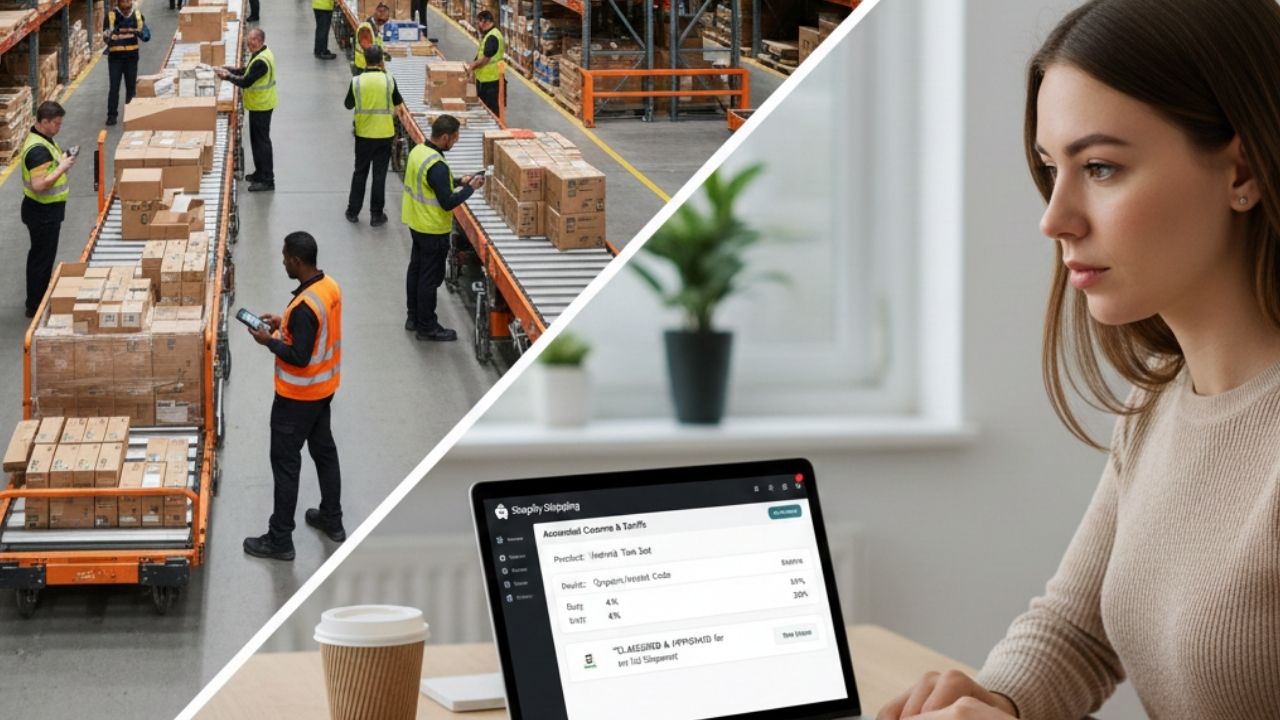
For high-value or high-volume products, use blind counts. The receiving staff counts the physical goods without access to the expected quantities listed on the PO. This prevents the very human tendency to “confirm” a number that matches the paperwork rather than independently counting what’s actually there.
Barcode scanning at each transition point creates a chain of accountability. Scan when goods arrive. Scan again before putaway. Every scan creates a timestamped record and catches discrepancies before they become invisible.
At high-volume facilities, RFID readers at dock doors can capture entire pallets in seconds — no line-of-sight required, no manual scanning. RFID can push inventory accuracy from the mid-90s to over 99% in busy operations.
Quality Control and OS&D Claims
Counting gets you quantity. But you also need to know what condition the goods are in.

What to Look For During Inspection
- Broken seals or tamper-evident damage on packaging
- Crushed, wet, or structurally compromised cartons
- Signs of moisture or mold
- Internal quality issues (sampled from high-risk batches)
Anything damaged or incorrectly delivered gets set aside immediately — not into regular inventory. It goes to a designated quarantine area where it can be assessed and processed for returns or claims.
OS&D: Over, Short, and Damaged
OS&D is the formal process for handling shipment discrepancies. Filing an OS&D report promptly is what makes insurance claims possible and keeps the supply chain accountable.
| Category | Definition | What to Do |
|---|---|---|
| Overage | You received more than the BOL states | Note on BOL; update inventory records |
| Shortage | You received less than the BOL states | File concealed shortage claims within 5 business days |
| Visible Damage | Obvious defects on arrival | Photograph everything; note on BOL before signing; file within 9 months |
| Concealed Damage | Damage found after unpacking | Most carriers allow only 5 business days to file |
| Total Loss | Entire shipment lost by carrier | Carrier typically has 1 week to locate before payout |
A successful freight claim requires: the Proof of Delivery with discrepancy notations, the original Bill of Lading, a merchandise invoice, and detailed photos. Keep all packaging and damaged freight until the claim is officially approved — carriers can and do request physical inspections.
Cold Chain and Hazardous Materials Receiving
Some products need receiving workflows that go well beyond a standard count and inspect. Temperature-sensitive goods and hazardous materials both require specific protocols, and getting them wrong isn’t just operationally costly — it’s a potential regulatory and safety issue.

Cold Chain: Temperature-Sensitive Products
Cold chain means maintaining a continuous, controlled temperature environment from origin through to storage. For pharmaceuticals like vaccines, that typically means 2°C to 8°C (36°F to 46°F). Some products need even colder conditions.
When cold chain products arrive, the priority is speed: get them to cold storage immediately and don’t let them sit on a staging dock. You should also check cold chain monitors or heat indicators to see whether temperature limits were exceeded in transit, and review Digital Data Logger (DDL) data if present, since these devices provide continuous temperature records throughout the shipment. Anything that dropped below its minimum threshold needs to be quarantined — it may be completely ineffective.
Standard domestic refrigerators have a “holdover time” of only about 4 hours after a power loss before the internal temperature exceeds the maximum allowed limit. That’s why purpose-built cold chain equipment isn’t optional for pharmaceutical or medical receiving.

Hazardous Materials: Segregation and Compliance
Receiving hazardous materials is governed by DOT’s 49 CFR 177.848 segregation rules. Every incoming chemical needs a verified Safety Data Sheet (SDS) on file before it’s accepted into the facility.
Chemical compatibility determines where things get stored. Flammable liquids can’t be near oxidizers. Acids stay away from bases. The practical rule of thumb is a 20-foot separation between incompatible hazard classes, using separate rooms or non-combustible barriers.
| Hazard Class | Typical Requirement | Primary Risk |
|---|---|---|
| Corrosive Substances | Reinforced containment rooms with ventilation | Severe burns, structural damage |
| Oxidizers | Separate from organics and flammables | Accelerated combustion |
| Pressurized Gases | Securely fastened upright | Explosion risk if ruptured |
| Flammable Liquids | Explosion-proof rooms, fire-rated cabinets | Fire and explosion |
These areas also need spill containment — secondary containment trays and bund walls at least 12 inches high — and only certified personnel should work in these zones.
Is Your Business Ready for Professional Order Fulfillment Services?
Take our 3-minute assessment to discover if partnering with a fulfillment service could help scale your business.
Storage Solutions
Optimize your inventory management
Scale Operations
Support your business growth
Save Time
Focus on core business activities
Improve Accuracy
Enhance customer satisfaction
Takes 3 minutes • Get instant results • Free analysis
Business Metrics
Assessment Questions (1-4)
Assessment Questions (5-8)
Assessment Results
Putaway Strategies and Storage Optimization
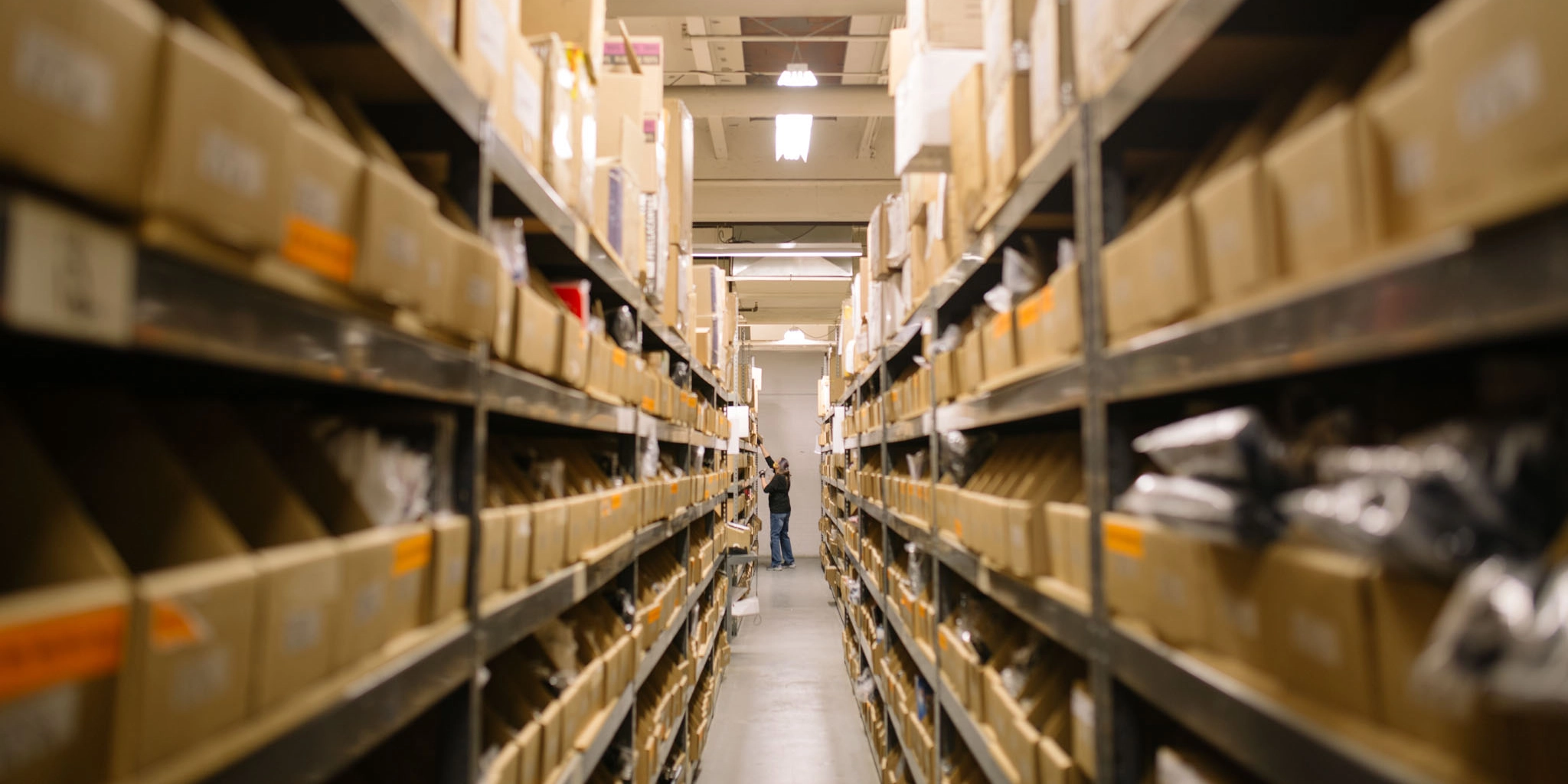
Once goods are verified and cleared, they need to go somewhere. Putaway sounds like the boring last step, but where you put things has a direct impact on picking speed, labor costs, and order accuracy.
Walking to pick items accounts for more than 50% of total picking labor costs in many facilities. Location decisions matter enormously.
The Main Putaway Approaches
Velocity-based slotting: Fast-moving products go in “golden zones” — waist height, near the shipping area. Less reaching, less walking, faster picks across the board.
Fixed vs. dynamic locations: Fixed locations are easier to train on but waste space when a product sells out. Dynamic putaway, managed by a warehouse management system, places goods in any available slot and maximizes density.
Affinity-based slotting: Products that get ordered together go in adjacent locations. This shortens the path workers travel for common order combinations.
Cross-docking: High-velocity items that don’t need storage go straight from receiving to shipping without ever being put away. This eliminates an entire handling step for the fastest-moving products.
In our experience at EFS, spreading high-velocity items across multiple pick zones is one of the most underrated moves in warehouse optimization — it prevents congestion during peak demand without requiring any additional infrastructure. We also maintain 20 different box sizes precisely because matching the right packaging to each order type is part of the same optimization logic.
Fulfillment with a Personal Touch.
See How Using a 3PL like eFulfillment Service sellers saves time. Get a Free Quote from eFulfillment Service Today!
Technology: RFID, AI, and the Future of Receiving
The gap between a technology-driven receiving operation and a manual one isn’t closing — it’s widening.
RFID vs. Barcoding: The Real Difference
Barcode scanning requires a deliberate human action at a specific point in time. The system only knows what someone tells it. This creates what you might call a “scan gap” — the difference between what the system thinks is happening and what’s actually on the floor, which grows whenever scanning falls behind the flow of goods.
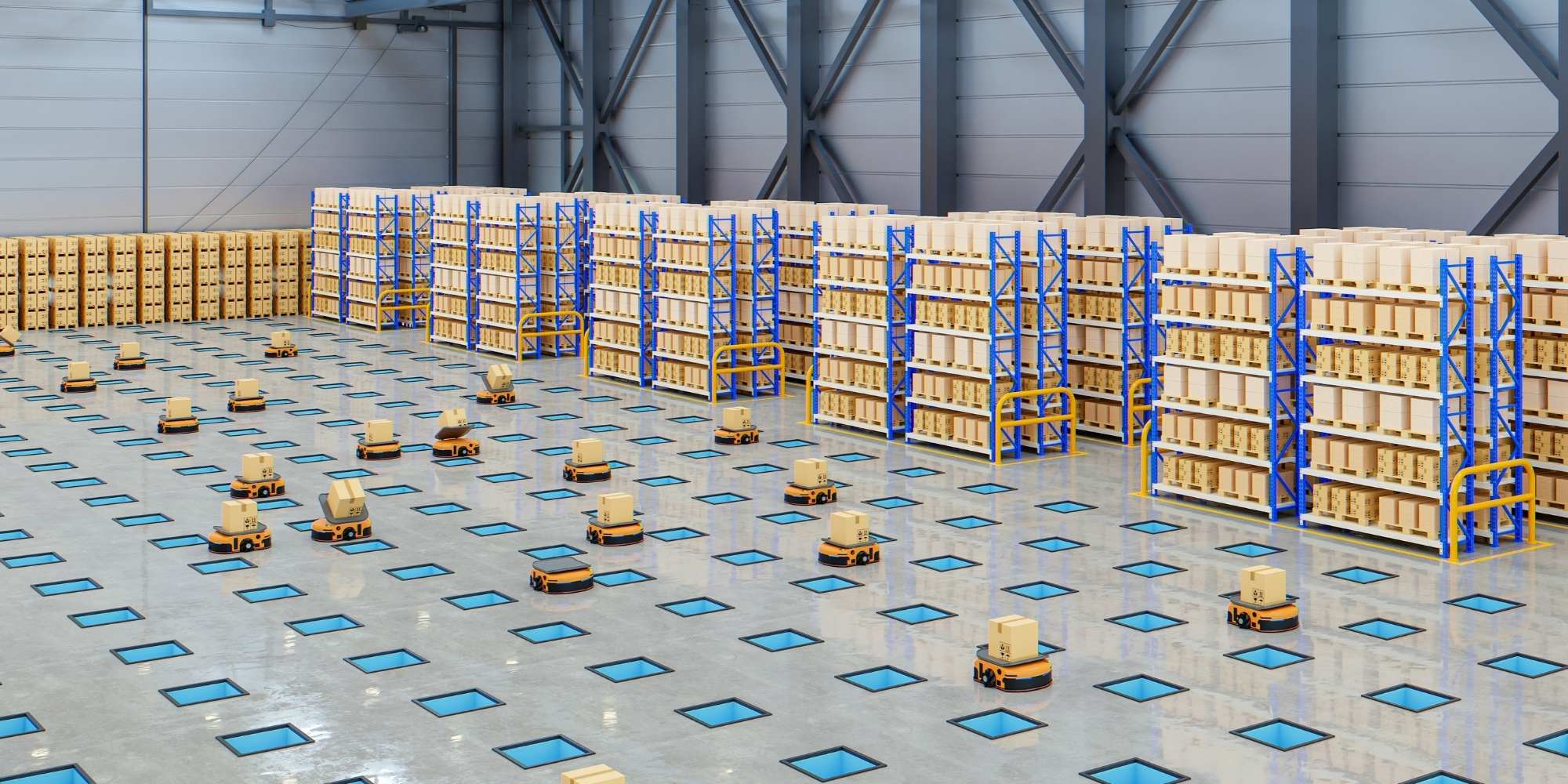
RFID works differently. As a forklift moves a pallet through an RFID-instrumented dock door, the system detects and records the movement automatically — no manual scan required, no line-of-sight needed. Inventory updates at the speed of the forklift. In high-volume facilities, RFID can push accuracy from the mid-90s to over 99%.

AI and Computer Vision
AI-powered cameras at dock doors now do things that weren’t practical just five years ago: counting and verifying items against purchase orders in real time, flagging physical defects before products enter the system, and detecting misplacements the moment they happen. Computer vision can reduce picking errors by over 80% and eliminate receiving mistakes that historically generated a significant share of all inventory inaccuracies.
| Technology | What It Does | Typical Payback |
|---|---|---|
| Computer Vision | 99.5% inventory accuracy; 80%+ reduction in picking errors | 6–9 months |
| Machine Learning | Predictive labor allocation; 25–45% reduction in labor dependency | Varies by facility size |
| Robotics (AGVs/AMRs) | 2–3× increase in picking and packing throughput | Varies by scope |
| Predictive Maintenance | Sensor-based failure prevention on material handling equipment | Long-term risk reduction |
The shift to technology-driven receiving isn’t just about speed — it’s about building a continuous, automatic view of inventory state rather than a series of manual snapshots that gradually drift from reality between scans.
Summary
Warehouse receiving isn’t a single task. It’s a coordinated sequence that runs from supplier ASNs through final putaway, touching dock safety, document compliance, quality inspection, OS&D protocols, cold chain, hazardous materials rules, and storage strategy along the way.
The facilities that get it right don’t treat receiving as a cost center. They treat it as what it actually is: the foundation of inventory accuracy, and the gateway to everything else in the operation.
When receiving is clean, orders ship correctly. Customers get what they ordered. Inventory counts mean something. And the time you’d otherwise spend chasing discrepancies goes toward growing the business instead.
At EFS, we’ve been doing this for over 25 years. We divert 3,500+ square feet of waste material monthly through responsible packaging practices — no styrene peanuts — and our low shipping cost program specifically addresses the challenges of shipping heavy products, because the cost of getting goods from your supplier to their storage location isn’t separate from the receiving equation. It’s all connected.
Ready to Hand Off Your Receiving Headaches?
eFulfillment Service handles warehousing, receiving, kitting, and fulfillment for growing ecommerce brands. No setup fees. No long-term contracts. Just accurate inventory and orders that ship on time.
Warehouse Receiving FAQs
What is the warehouse receiving process?
Warehouse receiving is the end-to-end process of accepting inbound shipments, verifying their contents against purchase orders and packing slips, inspecting for damage, recording inventory in the warehouse management system, and moving goods to their storage locations. It begins before the truck arrives — with ASN data and dock scheduling — and ends with confirmed putaway.
What is an ASN and why do warehouses need one?
An Advance Shipping Notice (ASN) is an electronic document sent by a supplier that describes the exact contents, packaging, and expected arrival time of an inbound shipment. Warehouses use ASNs to pre-stage labor and equipment, pre-allocate storage slots, and automatically generate receiving tasks — all before the truck arrives. Without an ASN, receiving becomes reactive and error-prone.
What does OS&D mean in freight shipping?
OS&D stands for Over, Short, and Damaged. It’s the formal process used to document and file claims when a shipment arrives with more goods than expected (over), fewer than expected (short), or with physical damage. Filing OS&D reports promptly — in some cases within 5 business days — is essential for successful freight claims.
What is the difference between RFID and barcode scanning for receiving?
Barcode scanning requires a deliberate human scan at a specific point in time, which creates gaps between system data and physical reality whenever scanning falls behind the actual movement of goods. RFID automatically detects and records inventory movement as it happens, with no manual intervention needed. RFID systems can push inventory accuracy above 99% in high-volume fulfillment environments.
How do you handle damaged goods in warehouse receiving?
Damaged goods should be identified during inspection, separated from general inventory, and documented with photos before the Bill of Lading is signed. Filing an OS&D report immediately is critical. Keep all damaged packaging and product until the claim is officially resolved, as carriers may request a physical inspection. For visible damage, claims can typically be filed within 9 months; for concealed damage discovered after unpacking, most carriers require filing within 5 business days.
What is a blind count in warehouse receiving?
A blind count is a method where receiving staff count physical goods without access to the expected quantities listed on the PO or packing slip. This prevents confirmation bias — the tendency to “confirm” a number that matches the paperwork rather than independently verifying the actual quantity. Blind counts are standard practice for high-value or high-volume products.
Can a 3PL handle warehouse receiving for my ecommerce business?
Yes. A third-party logistics provider like eFulfillment Service handles all aspects of warehouse receiving on your behalf — accepting inbound shipments from your suppliers, verifying counts and condition, recording inventory in real time, and managing putaway. This eliminates the need to lease warehouse space, staff a receiving team, or invest in warehouse management technology yourself.


0 Comments