
It’s Sunday evening. You shipped 200 orders over the weekend, mostly solo, and you are exhausted in the way that only founders who pack boxes in their living room understand. Monday morning, you open your phone to a notification. A customer with 80,000 TikTok followers has posted an unboxing. She ordered a medium. She received an extra-large. Her caption: “this brand can’t even get a size right.”
By the time you see it, there are 40 replies. Three of them are from previous customers confirming it happened to them too. By Tuesday, you have four new 1-star reviews, all citing wrong sizes.
This is not bad luck. This is a picking accuracy problem, and it gets worse as order volume grows.
The math is straightforward: more orders mean more picks, more picks mean more opportunities for human error, and in apparel, a wrong size is not a minor inconvenience. It is a return, a reship, a refund, and sometimes a public post from someone with a meaningful audience.
This guide is for founders shipping 100 to 2,000 orders per month who are currently self-fulfilling and genuinely wondering whether the numbers tip in favor of a 3PL. There is no universal answer, but there are specific signals, real cost comparisons, and a clear framework for making the call.
Ready to stop absorbing mispick costs?
At 500 orders a month, a 2% mispick rate produces over $400 in direct waste every month — before a single customer posts about it. eFulfillment Service uses scan-verify on every pick, for every order.
What is apparel fulfillment, and why is it harder than regular ecommerce?
Apparel fulfillment is the end-to-end process of receiving, storing, picking, packing, shipping, and managing returns for clothing, footwear, and fashion accessories.
That definition applies to any fulfillment operation. What makes apparel different is structural, not cosmetic. Three things specifically make clothing harder to fulfill than almost any other ecommerce category.

The SKU math is brutal
Take a modest apparel line: 10 styles, 5 sizes each, 3 colorways per style. That is 150 unique SKUs. Not 10 products. One hundred and fifty distinct inventory locations, each requiring its own bin, its own receiving process, and its own pick verification.
Compare that to a supplement brand selling a single product in one size. One SKU. One bin. The picker either grabs it or does not. There is almost no surface area for error.
In apparel, a size S and a size M in the same colorway are often identical to a glancing look. A navy crew neck in small and a navy crew neck in medium can differ only by a small printed label on a poly-bag or a heat-transfer tag inside the collar. At 200 orders on a weekend with no barcode scan-verify, the question is not whether a mispick happens. It is how many.
And when a mispick does happen, the consequence is immediate and specific: wrong size equals return. The customer cannot use the item. They want either the right size or their money back. You pay to ship the wrong one, pay again to return it, pay again to reship the correct one, and you have introduced a delay that the customer will remember.
Return rates are structurally higher
Online apparel returns run at 20 to 40 percent of orders, depending on category and customer base. Approximately 70 percent of those returns are driven by size and fit. That is not a brand failure. It is a category reality.
But it means that for every 500 orders you ship, you should expect 100 to 200 returns coming back through your operation. At that volume, returns are not a side task. They are nearly a second fulfillment operation running in parallel.
Self-fulfilling founders often discover this the hard way. They scale their outbound process, add some help for packing, start to feel like they have it under control, and then the return backlog accumulates. Items pile up uninspected, inventory counts drift out of sync, customers wait for refunds, and the whole system starts to degrade from the back end.
Garments have special handling requirements
A pair of jeans is not a bottle of vitamins. How an item arrives matters to the customer in a way that is specific to apparel and adjacent categories. A crumpled garment stuffed into a generic brown box is a brand signal, and not a good one.
Proper apparel fulfillment involves poly-bagging to protect against moisture and handling, folding to a defined standard, hang tag preservation, tissue paper or interior packaging per your brand spec, and sometimes garment-on-hanger (GOH) storage and shipping for wholesale or retail clients.
Not all 3PLs are set up for this. A warehouse that handles sporting goods, electronics, and clothing under the same operational roof may not have apparel-specific SOPs, may not train pickers on folding standards, and may not have GOH racking infrastructure. When you are evaluating 3PLs, apparel handling capability is a direct question, not an assumption.

The math on one mispick
At 500 orders per month, manual pick-and-pack without barcode scan-verify runs at roughly a 2 percent error rate. That is 10 wrong orders per month. It sounds manageable until you price each one out.
A single mispick in apparel carries these hard costs:
- Outbound shipping for the wrong item: approximately $7
- Return label for the customer: approximately $7
- Reship of the correct item: approximately $7
- Labor to receive the return, re-pick, re-verify, and repack: approximately $7
- Total per mispick: approximately $28
At 10 mispicks per month, that is $280 per month in direct, measurable waste. Before any brand impact enters the calculation.
Now add the brand impact. A single viral wrong-size post from a customer with a meaningful following can suppress your store’s conversion rate. A 0.5 percent conversion drop on a $50,000 per month store is $250 per month in lost revenue, per incident. These are not rounding errors. At 500 orders per month, mispick costs are likely running between $400 and $600 per month once both direct and indirect costs are counted.
Returns eating your weekends?
At a 30% return rate on 500 orders, you have 150 incoming shipments to inspect, refold, and restock every month — on top of 500 outbound. eFulfillment Service handles the full returns workflow so your inventory stays accurate and refunds go out fast.
Why manual fulfillment has a structural error floor
The problem is not effort. Founders packing orders personally are careful. Often more careful than any employee would be, because they know the stakes.
The problem is that manual pick-and-pack without barcode scan-verify has an error floor that human attention cannot reliably beat at volume. When you are picking 200 orders and every size S, M, and L in the same colorway looks nearly identical in a poly-bag, the brain starts to pattern-match on visual cues rather than verifying each unit. This is not carelessness. It is how human attention actually works under repetitive, high-volume conditions.
No amount of slowing down or double-checking fully closes that gap when you are operating without a systematic verification step.

How scan-verify eliminates the mispick problem
Here is how scan-verify works in a well-run 3PL: when a picker selects an item, they scan the barcode. The warehouse management system confirms it matches the order. Wrong size, wrong color, wrong style: the scan fails, and the picker is alerted before the item enters the box.
Well-run 3PLs achieve mispick rates below 0.1 percent. At 500 orders per month, that is the difference between 10 wrong shipments and fewer than one. The technology is not exotic. It is standard in any fulfillment operation that takes accuracy seriously. But not every 3PL uses it on every pick, for every order type. Ask directly before you commit to anyone.
Your packing SOP, executed on every order.
EFS follows brand-specific instructions for every shipment — poly-bag, tissue paper, hang tags, custom box, branded sticker. Your unboxing experience, not a generic warehouse default.
The apparel fulfillment process, step by step

Step 1: inbound receiving
Inventory arrives at the warehouse. The receiving team counts, inspects, and verifies against your purchase order. For apparel, this means checking that sizes and colorways match what was ordered, that items are properly tagged, and that quantities are correct by SKU.
This step matters more than most founders realize. If a supplier shorts you 30 units of size medium and no one catches it at receiving, you will have phantom inventory in your system. Customers will order a medium, the warehouse will confirm it in stock, a picker will go to the bin and find nothing, and the error will surface as either a mispick or a customer service failure. Catching discrepancies at receiving, before items enter live inventory, is the only place in the process where you can catch supplier errors before they become customer problems
Step 2: storage
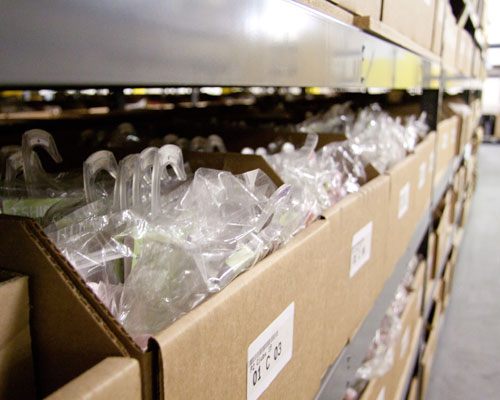
Folded items go to shelved bin locations organized by SKU. Hanging garments use GOH rack systems. Storage is typically billed by cubic foot per month or by pallet and shelf position, depending on the 3PL’s pricing model.
Bin organization directly affects pick speed and accuracy. A well-organized 3PL warehouse assigns each size-color-style combination its own discrete bin location with a scannable barcode. A poorly organized one might group similar SKUs together in ways that increase mispick risk. Ask specifically how apparel bins are organized when you evaluate a 3PL.
Already past the inflection point?
If you’ve shipped a wrong size in the last 30 days and don’t have scan-verify in place, the next one is already on its way. See what outsourcing would actually cost with your real order volume — no minimums, no commitment required.

Step 3: picking and packing
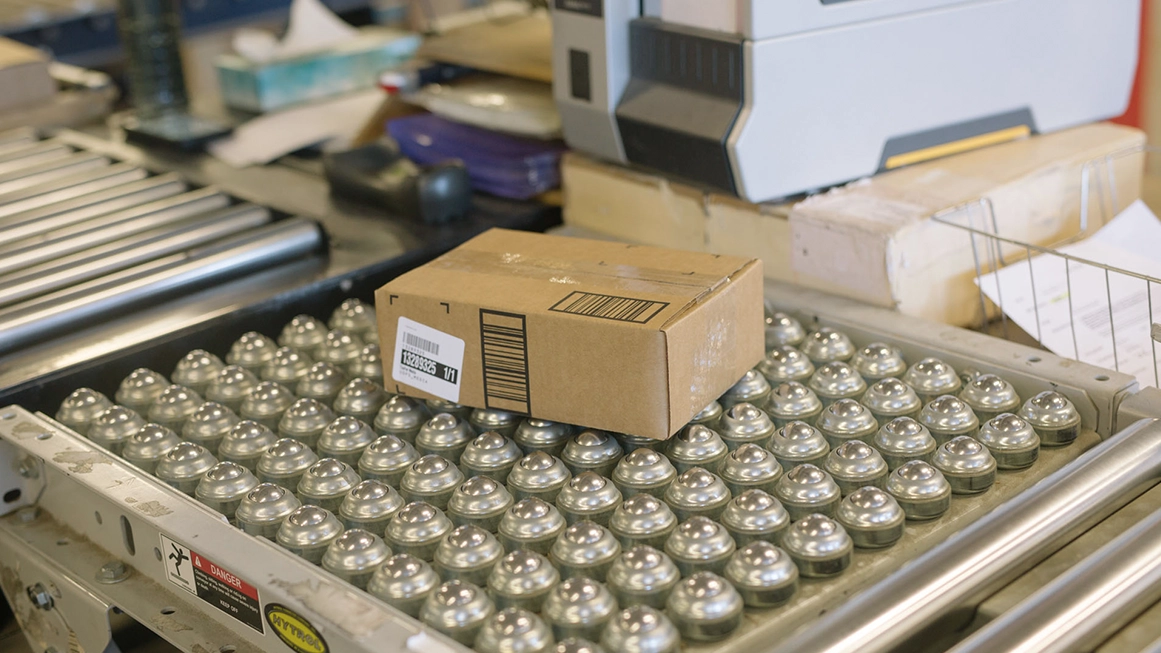
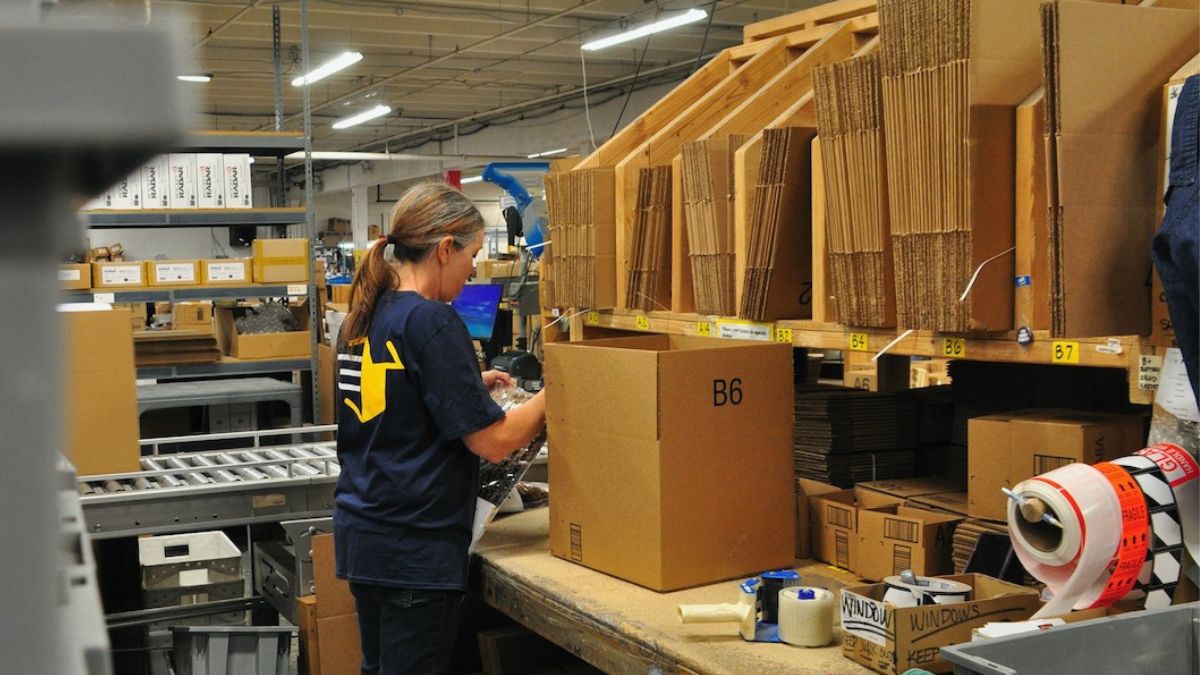
Orders flow in from Shopify, WooCommerce, or whatever platform you are on, directly into the warehouse management system. A picker is routed to the correct bin, scans to verify the item (in a good 3PL operation), and brings it to the packing station. Packers follow brand-specific SOPs that you provide: poly-bag and fold, tissue paper, custom box, branded sticker, whatever you have specified. Each order is checked before sealing.
The quality of the packing SOP process is something you should verify directly. Ask to see examples of how a 3PL captures and enforces custom packing instructions. Some use digital SOP documents that pickers reference at the station. Others rely on verbal training that degrades over time. The difference shows up in your unboxing experience.

Step 4: outbound shipping
The 3PL’s software compares rates across carriers including USPS, UPS, and FedEx, then selects the best available rate for the weight, dimensions, and destination zone of each individual order. Because 3PLs are shipping high volume every day, they access negotiated carrier rates that most individual brands cannot qualify for on their own.
At 200 orders per month, you are likely paying retail carrier rates. A 3PL passing through their negotiated rates on the same package profile will often charge meaningfully less per shipment. The difference compounds across every order you ship, and it is one of the reasons the 3PL math starts to close faster than most founders expect.
Step 5: returns processing
A customer ships back a return. The 3PL receives it, inspects the item (is it resellable? damaged? did the customer return the wrong item?), updates the inventory system, and either triggers a refund notification or restocks the item for future sale.
For apparel, this step includes refolding, re-poly-bagging, and checking for wear, staining, or damage that would make an item non-resellable. Some 3PLs charge a per-return fee that covers this full inspection process. Others charge a base fee and add on for more involved assessments. Know exactly what the returns processing fee includes before you sign, because at a 20 to 40 percent return rate, the returns line is one of your larger operational cost items.
What apparel fulfillment actually costs: DIY vs. 3PL with real numbers
3PL pricing is quote-based and varies by provider, order profile, SKU count, and location. Rather than publish numbers that may not reflect what you would actually be quoted, this section focuses on understanding the cost categories and building a framework for comparing your own self-fulfillment costs against a 3PL quote.

What you actually pay a 3PL for apparel
3PL pricing is not one-size-fits-all. Every quote is based on your specific order volume, SKU count, packaging requirements, and return rate. That said, understanding what you are being charged for helps you compare quotes accurately and ask the right questions.
The cost components of apparel 3PL fulfillment typically include:
- Receiving: charged by the hour, by the carton, or by the unit at inbound, depending on how the 3PL structures it
- Storage: typically billed by cubic foot per month or by shelf/pallet position; GOH and hanging storage is usually priced separately from flat-folded shelved storage
- Pick fee: charged per item picked; the first item in an order is often priced differently than additional items in the same shipment
- Pack and materials: a per-order fee that may or may not include packaging materials depending on the 3PL
- Outbound shipping: typically passed through at the 3PL’s negotiated carrier rates, which are usually below what an individual brand pays at retail
- Returns processing: a per-return fee covering inspection, re-fold, re-bag, and restock; the scope of what is included varies by provider
- Account or platform fee: some 3PLs charge a monthly account fee or minimum; others do not
When you are comparing quotes, make sure you are comparing the same scope. A lower pick fee that does not include materials is not necessarily cheaper than a higher pick fee that does.

What self-fulfillment actually costs at different order volumes
Before you can evaluate whether a 3PL makes financial sense, you need to know what you are currently spending. Most founders underestimate their true self-fulfillment costs because the inputs are spread across multiple line items they do not add together.
The main cost categories for self-fulfillment:
|
Cost category |
200 orders/month |
500 orders/month |
1,000 orders/month |
|---|---|---|---|
|
Labor (packing + returns) |
~25 hrs |
~62 hrs |
Part-time hire needed |
|
Packaging materials |
Low |
Moderate |
High |
|
Outbound shipping (retail rates) |
$X |
$X |
$X |
|
Space and overhead |
Low |
Moderate |
Significant |
|
Returns processing labor |
Low |
Moderate |
High |
Add up your actual numbers in each category and you have your real self-fulfillment cost per month. Then get quotes from 3PLs and compare against that number, not against a benchmark from an article.
One consistent advantage 3PLs have on the shipping line: because they ship high volume every day, they access negotiated carrier rates that most individual brands cannot qualify for on their own. Depending on your average package weight and zones, this rate difference can be meaningful across hundreds or thousands of monthly shipments.

The time cost you are probably not counting
The cost comparison above uses labor hours, but most founders do not price their own time at what it is actually worth. At 200 orders per month, you are spending roughly 25 hours per month on fulfillment tasks including packing, receiving, and processing returns. At 500 orders, that climbs to 60-plus hours.
Those are hours you are not spending on collection development, wholesale outreach, paid acquisition, or anything else that compounds over time. The financial case for outsourcing fulfillment is not just the direct cost comparison. It is what you do with the hours you get back.
When does a 3PL make financial sense for an apparel brand?
The inflection point most apparel brands hit between 300 and 500 orders per month
For general ecommerce, the commonly cited benchmark for 3PL readiness is around 2,500 orders per month. Apparel brands typically hit the inflection point much earlier, usually somewhere between 300 and 500 orders per month, for three specific reasons.
First, higher return volume means the fulfillment workload is not just outbound. At a 30 percent return rate on 500 orders, you have 150 returns to process every month in addition to 500 outbound shipments. That is a material operational burden that compounds as volume grows.
Second, SKU count multiplies faster than order count. A brand that adds a new colorway or a new size run has not added one product to manage. It has added 5 to 10 new SKUs, each requiring its own bin, receiving verification, and pick accuracy protocol.
Third, a single mispick in apparel carries more brand damage than in most categories. A wrong-size shipment is not something a customer can work around. It is a dead end that requires a return, a wait, and a resolution, all of which they may document publicly.
At 300 orders per month, the 3PL math is close to breakeven on direct costs and typically positive once founder time is priced in honestly. By 500 orders per month, the cost gap is clear.
Three signals you have crossed the inflection point
Some signals are more reliable than others. These three tend to appear together when a brand is ready.
Returns are consuming as much time as outbound packing. When you are spending more hours processing what comes back than what goes out, your operation has inverted in a way that self-fulfillment cannot fix.
You have made a wrong-size shipment in the last 30 days and do not have a systematic way to prevent the next one. Not a system you are planning to build. A system that exists and works today.
You delayed a collection launch, a new colorway, or a wholesale partnership because you did not have bandwidth to onboard more SKUs into your current operation. When fulfillment is capping your growth rather than supporting it, the inflection point has passed.
No minimums. No contracts. No slow-month penalties.
eFulfillment Service charges for what you ship — not what you projected. Get a line-item quote based on your actual order profile: volume, SKU count, package weight, and return rate.
How to choose a 3PL for your apparel brand
Not all 3PLs are built for apparel. A generic warehouse that handles everything from supplements to electronics to clothing often has no apparel-specific quality control protocols, no documented folding standards, and no trained eye for what a garment presentation should look like when it arrives at a customer’s door. Here is how to evaluate whether a prospective 3PL is actually equipped for your product type.
Eight questions to ask every 3PL before you commit
1. Do you use barcode scan-verify on every pick, or only on certain SKUs or order types? This is non-negotiable for apparel. If the answer is “mostly” or “for high-value orders,” keep asking.
2. What is your documented order accuracy rate, and how is it measured? A 3PL that cannot give you a number does not track it. A number without a methodology behind it is not meaningful. Ask how they measure and how often they audit.
3. How do you store apparel: shelved by SKU or in bulk bins? Can you accommodate garment-on-hanger storage if needed now or in the future?
4. What is your returns processing SLA? How quickly do returned items get inspected and restocked into available inventory after they arrive at your warehouse?
5. Can you follow custom folding and packaging SOPs? How are those communicated to your warehouse team, and how do you verify that new staff are trained on brand-specific packing requirements?
6. What are your monthly minimums, and what happens in slow months when volume drops below them? A 3PL with steep minimums will charge you for volume you did not ship.
7. How do you handle pre-orders or inventory embargoes where product cannot ship until a specific date? This matters for any brand that does seasonal drops or pre-sale campaigns.
8. What Shopify, WooCommerce, and TikTok Shop integrations do you support, and how long does onboarding typically take for a brand at my volume?

The no-minimum advantage for growing apparel brands
One of the most consistent complaints about ShipBob and ShipMonk from smaller apparel brands is the structure of monthly minimums and fees that penalize you when volume dips seasonally. Fashion is seasonal by nature. A brand doing 400 orders in October and 1,200 in November should not be paying for 1,200-order-equivalent minimums in October.
A 3PL that charges for minimums you cannot hit in off-peak months is, in effect, working against your margins during your slowest periods. For a category where cash flow is already compressed by inventory cycles and return processing costs, that structure adds unnecessary pressure.
eFulfillment Service is worth evaluating specifically because there are no order minimums and no long-term contracts. You pay for what you ship. For a brand where demand is seasonal and sometimes lumpy, that pricing structure protects your margins when volume is down and scales with you when it spikes.
FAQs: Apparel Fulfillment
What is apparel fulfillment?
Apparel fulfillment is the end-to-end logistics process of receiving, storing, picking, packing, shipping, and managing returns for clothing and fashion products. It is categorically more complex than general ecommerce fulfillment because of high SKU counts driven by size and color variations, elevated return rates of 20 to 40 percent, and special handling requirements for garment presentation that do not apply to most other product categories.
How much does apparel fulfillment cost with a 3PL?
3PL pricing for apparel varies based on your order volume, SKU count, packaging requirements, and return rate. Because every brand's order profile is different, most 3PLs provide custom quotes rather than published rate cards. The cost components you are typically quoted on include receiving, storage (usually by cubic foot or shelf position), pick and pack fees per order, outbound shipping at negotiated carrier rates, and a per-return fee for inspection and restock.
To understand what it would actually cost for your specific operation, the only reliable approach is to get direct quotes from two or three 3PLs with your real order data: average monthly volume, average items per order, packaging spec, and estimated return rate. That lets you compare apples to apples rather than benchmarking against industry averages that may not reflect your product mix.
When should a clothing brand switch to a 3PL?
Most apparel brands hit the financial inflection point between 300 and 500 orders per month, significantly earlier than the conventional 2,500-order benchmark that applies to general ecommerce. The earlier trigger for apparel comes from return volume (20 to 40 percent return rates that effectively double the fulfillment workload), SKU complexity (size runs and colorways that multiply picking complexity beyond what most other categories face), and mispick risk (wrong-size shipments that carry higher brand damage than most ecommerce errors).
What is garment-on-hanger (GOH) fulfillment?
Garment-on-hanger, or GOH, is a storage and fulfillment method where garments are kept on hangers throughout the warehousing and shipping process rather than folded and poly-bagged. It is primarily used for wholesale and retail shipments where retailers require garments to arrive ready-to-rack, and for higher-end DTC brands where presentation standards make folding inappropriate. Not all 3PLs offer GOH. It requires specific racking infrastructure and is typically priced separately from standard shelved storage.
What makes apparel fulfillment different from general ecommerce fulfillment?
Three structural differences set apparel apart. First, SKU counts are orders of magnitude higher than most categories because every style-size-color combination is a separate SKU with its own bin and pick verification requirement. Second, return rates of 20 to 40 percent mean reverse logistics is nearly as large an operational burden as forward shipping. Third, garment presentation including folding, poly-bagging, hang tags, and tissue paper is a brand quality signal in ways that packaging for most other product categories simply is not.
How do I prevent wrong-size shipments when using a 3PL?
Ask specifically whether the 3PL uses barcode scan-verify on every single pick. With scan-verify, the picker scans the item barcode and the warehouse management system confirms it matches the order before the item enters the box. This reduces mispick rates to below 0.1 percent at well-run operations. Without scan-verify, manual fulfillment typically runs a 1 to 3 percent error rate on apparel because size variations are visually similar and human attention alone cannot scale reliably at high pick volumes.
Key takeaways
- Apparel is harder to fulfill than almost any other ecommerce category because of SKU count (sizes × colors × styles), structurally high return rates of 20–40%, and garment presentation requirements that don’t apply to most products.
- Manual pick-and-pack has a structural error floor. At 500 orders per month, a 2% mispick rate produces 10 wrong-size shipments monthly. Scan-verify drops that below 0.1%.
- Apparel brands hit the 3PL inflection point at 300–500 orders per month — far earlier than the 2,500-order benchmark for general ecommerce — because return volume, SKU complexity, and mispick risk compound faster in this category.
- Returns are nearly a second fulfillment operation at scale. At a 30% return rate on 500 orders, you’re processing 150 incoming shipments per month on top of 500 outbound.
- When evaluating a 3PL, ask about scan-verify, returns SLA, folding SOPs, and monthly minimums. A 3PL with steep minimums will penalize you during fashion’s off-peak months.
0 Comments