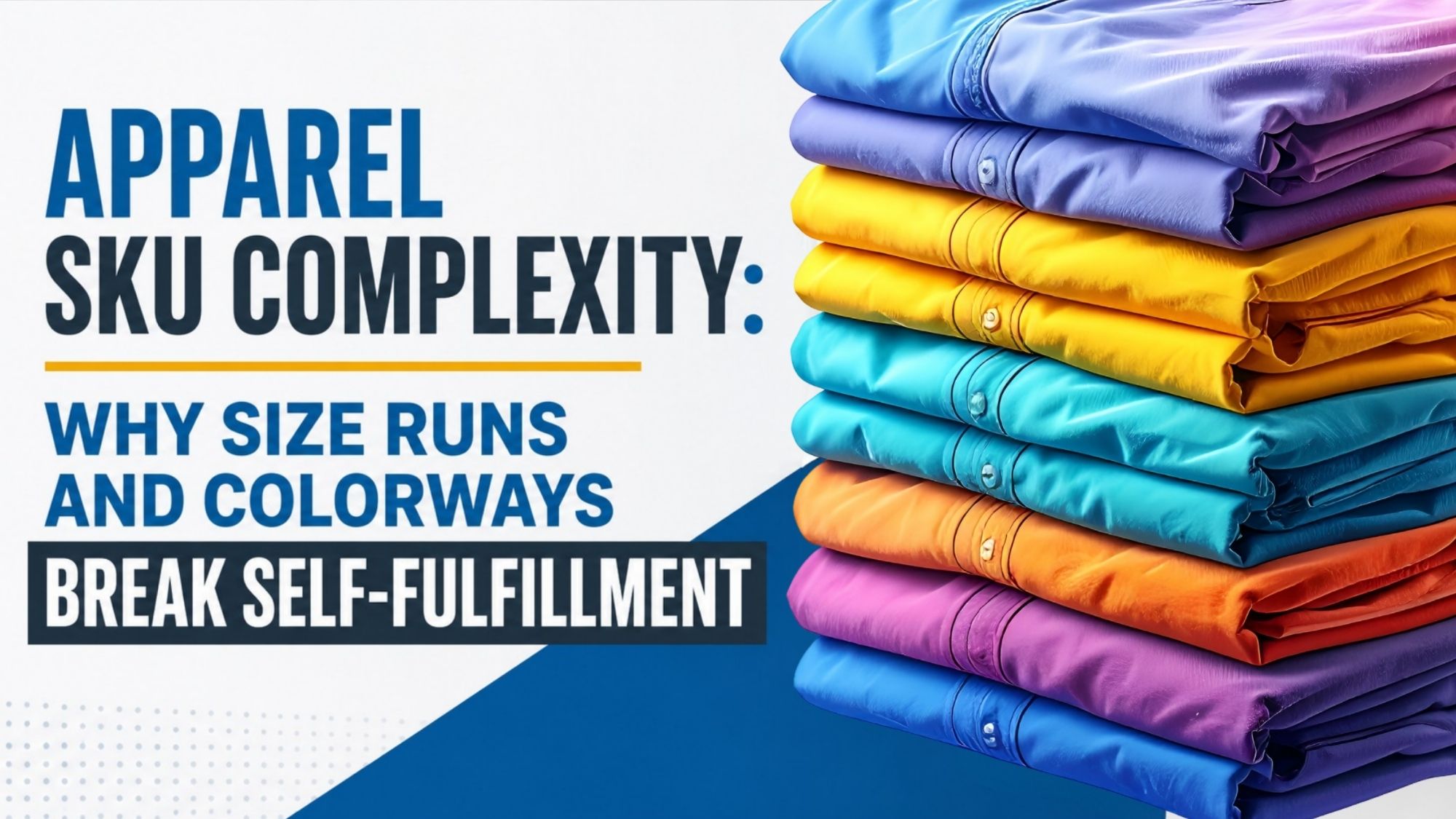
You launched with 8 SKUs. Six months later you had 40. Add a spring collection and a second colorway and you’re looking at 160.
Nothing about your product changed. You didn’t get more complicated. You just did what apparel brands do: you added sizes, you added colors, and the SKU count multiplied.
The warehouse didn’t scale with it. The pick process didn’t scale with it. And now you have a growing pile of wrong-size returns, an inventory spreadsheet you’ve quietly stopped trusting, and a product idea — a navy version of your best-selling tee — that’s been sitting on the roadmap for three months because you already can’t keep the four colors you have straight.
This guide breaks down why apparel SKU complexity compounds faster than almost any other ecommerce category, and what changes when the right infrastructure is in place.
Ready to stop absorbing mispick costs?
At 500 orders a month, a 2% mispick rate produces over $400 in direct waste every month — before a single customer posts about it. eFulfillment Service uses scan-verify on every pick, for every order.
Why apparel SKU math is different from every other category
Most ecommerce products add one SKU when you add one product. In apparel, every decision multiplies.
| Product decision | SKUs added |
|---|---|
| 1 new style | 1 |
| 1 new style × 5 sizes | 5 |
| 1 new style × 5 sizes × 4 colors | 20 |
| 2nd fabric weight added | 40 total |
| Women’s cut added alongside unisex | 80 total |
One hoodie. Eighty SKUs.
Brands actively managing 500 to 15,000 SKUs across collections are common in apparel. A brand with just 10 hero styles in five sizes and four colorways is already running 200 discrete inventory locations, each requiring its own bin, its own receiving count, and its own pick path to get right on every order.
The SKU count isn’t just a storage problem. At the bin level, a size S and size M in the same colorway look identical in a poly bag. The only thing distinguishing them is a small printed label. A tired picker moving fast on a busy Saturday can absolutely miss it.
The three things SKU complexity breaks in self-fulfillment
These failures don’t happen one at a time. They hit simultaneously and compound each other.
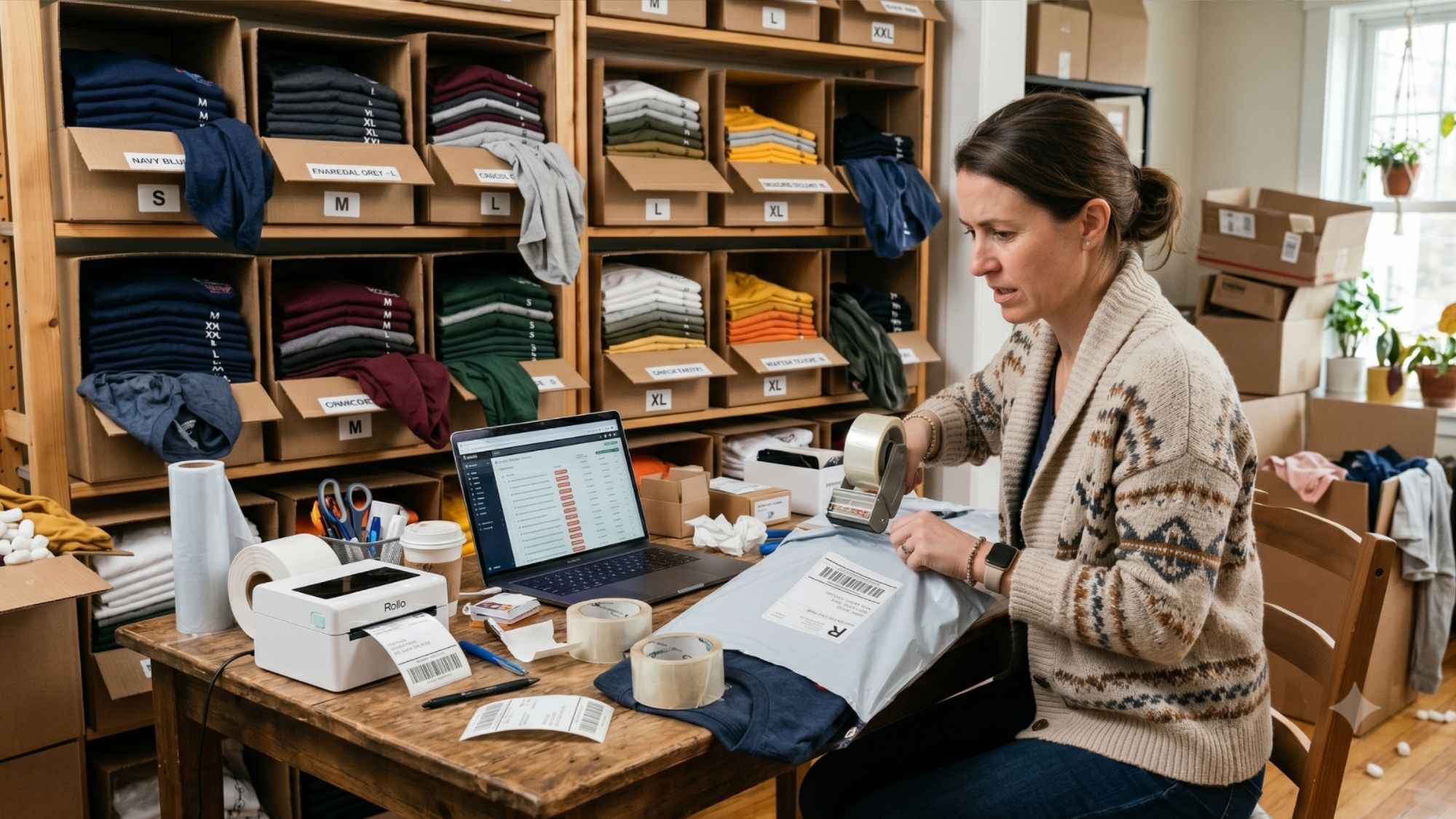
1. Picking accuracy: the visible failure
The industry error rate for manual pick-and-pack without barcode verification runs 1 to 3 percent. At 400 orders per month, that’s 4 to 12 wrong-size shipments every month.
What makes apparel worse than other categories: mispicks cluster. The same visual similarities exist between the same bins, so pickers make the same mistakes on the same SKU pairs. You’ll see wrong-size complaints concentrated on specific styles and size combinations, not spread evenly across your catalog.
Each mispick costs approximately $28 in direct expenses:
- ~$7 outbound shipping for the wrong item
- ~$7 return label for the customer
- ~$7 reship of the correct size
- ~$7 labor to receive, inspect, and repack
At 10 mispicks per month, that’s $280 in direct waste before a single customer posts about it.
Stop absorbing mispick costs every month
At a 2% error rate, a 400-order month generates up to $280 in direct fulfillment waste — before a review is posted or a customer is lost. eFulfillment Service’s scan-verify process flags the wrong item before it reaches the box, not after you get the complaint.
2. Inventory accuracy: the invisible failure
Every mispick corrupts two inventory counts. The wrong bin gets overcounted; the right bin gets undercounted. Over time, that drift accumulates faster than any manual reconciliation can catch it.
The pattern self-fulfilling founders describe over and over:
“I thought I had 40 units of size M. Turns out 8 of them were size L sitting in the wrong bin from a busy receiving day. I shipped ‘size M.’ Customer got a large.”
The inventory system said it was available. The physical product said otherwise. You can’t catch this without verification at both receiving and pick.
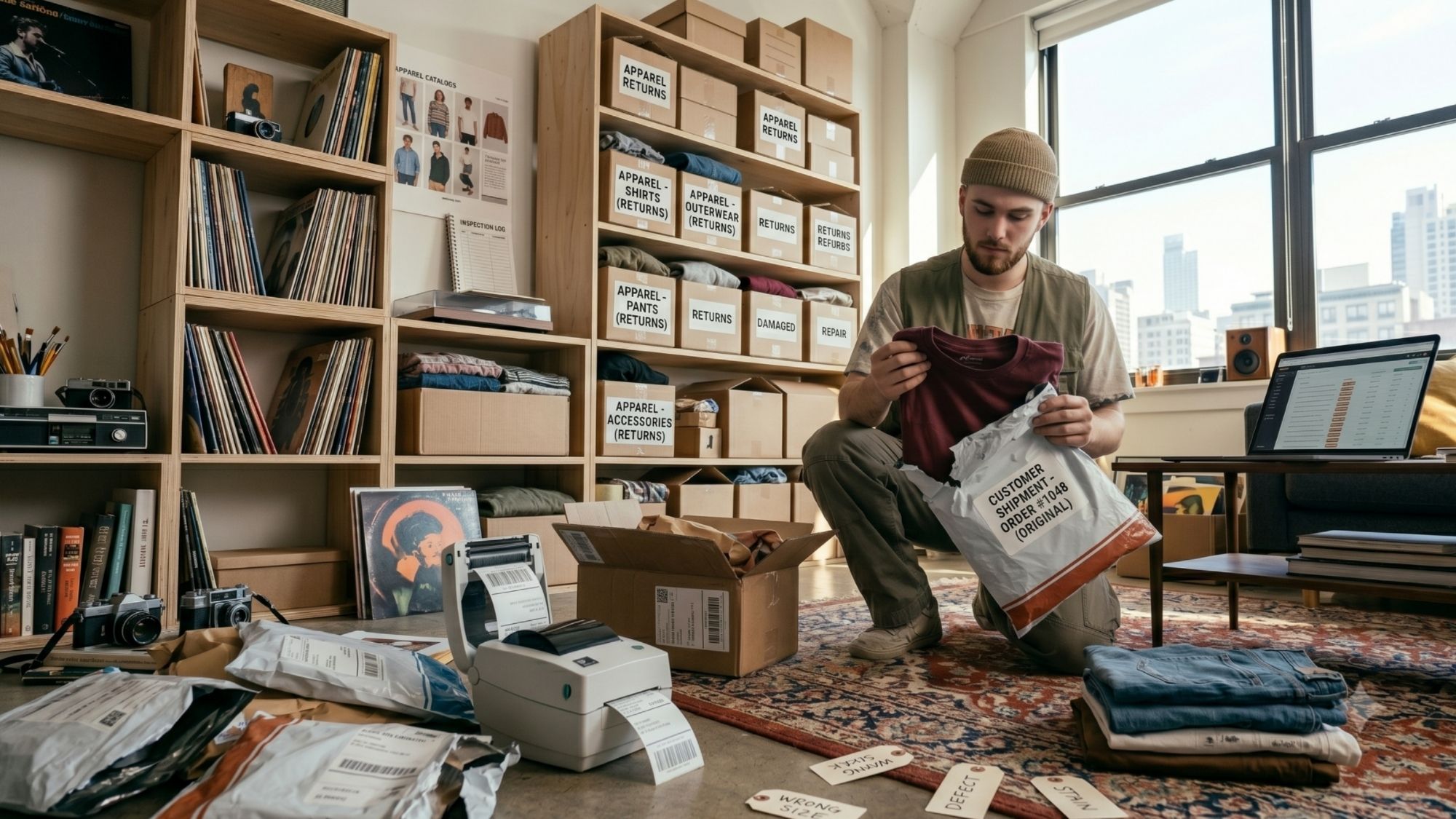
3. Returns restock: the compounding failure
Here’s the math most founders don’t run until they’re already in trouble:
- 400 orders/month × 25% return rate = 100 returns to process every month
- Each one needs inspection, grading, refolding, and routing back to the correct SKU bin
- Not a general returns pile. The correct bin. Size M into size M. Size L into size L.
At that volume, returns aren’t a side task anymore. They’re nearly a second fulfillment operation running in parallel with your outbound, using the same space, the same team, on the same days.
Your packing SOP, executed on every order.
EFS follows brand-specific instructions for every shipment — poly-bag, tissue paper, hang tags, custom box, branded sticker. Your unboxing experience, not a generic warehouse default.
The launch you keep not making
The clearest signal isn’t the mispick count or the return pile. It’s the product idea you’re not launching because the variants would break your operation.

“We can’t add another color because I can’t manage the SKUs.”
A new colorway is 15 minutes of design work. The operational overhead (new bins, receiving verification, pick training, return routing) has no end date. So the colorway stays a draft. The size extension stays on the wishlist. The seasonal variant doesn’t happen this year.
When fulfillment complexity starts shaping product decisions, the ceiling has arrived. The warehouse is running your roadmap.
Your product roadmap deserves better infrastructure
If the reason a colorway stays a draft is that your operation can’t handle more variants, outsourcing fulfillment breaks the ceiling. eFulfillment Service specializes in high-SKU apparel brands — no order minimums, no long-term contract required.
What changes when a 3PL handles variant complexity
Three things work differently at a 3PL built for apparel.

1. Barcode scan-verify on every pick When a picker selects an item, they scan it. The WMS confirms: correct style, correct size, correct color. Any mismatch gets flagged before the item ships. Well-run 3PLs hit accuracy rates above 99.9% on apparel.
2. Bin assignment at the SKU level Size M black tee and size L black tee are not in the same location. Every size-color-style combination gets its own discrete bin with its own scannable location barcode, verified at receiving, not just at pick. Inventory drift from receiving errors is closed at the source.
3. Returns routed by variant, not by pile A returned size medium goes to the size medium bin, inspected, graded, and restocked per a defined SOP. The returns-to-restock SLA (how quickly returned items reenter available inventory) is one of the most important specs to ask any 3PL before signing.
eFulfillment Service is built specifically for this. No order minimums, scan-verify on every pick, returns processed to a defined SOP. For a brand managing hundreds of SKUs across size runs and colorways, that’s the difference between an operation that scales and one that caps your product roadmap.
Six questions to ask any 3PL about variant management
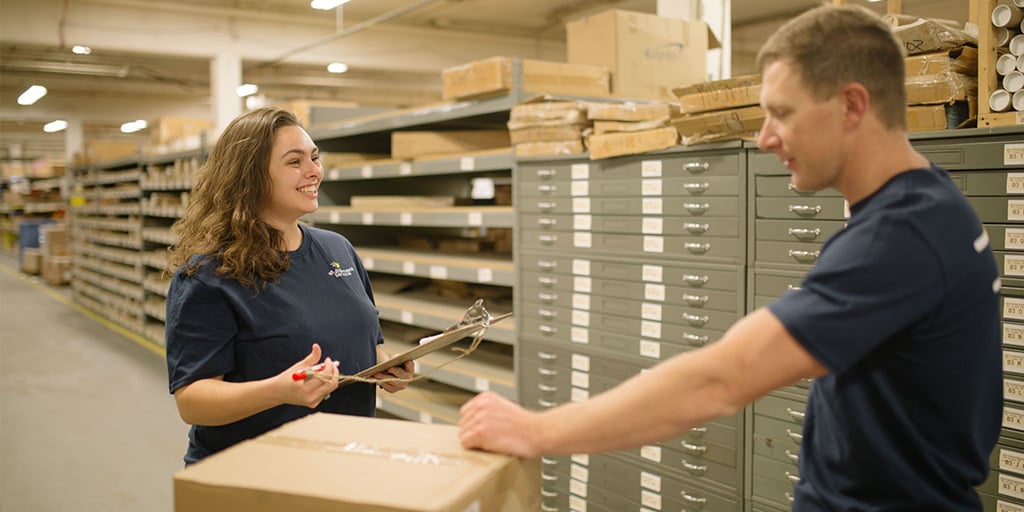
1. How are bins organized: by style, or by style-size-color? You want every SKU in its own discrete location. A warehouse that stores all sizes of the same style together is recreating the visual-similarity problem you’re trying to solve.
2. Is barcode scan-verify used on every pick, or only high-value orders? If the answer is “mostly” or “on certain SKUs,” keep pushing. For apparel, every pick needs verification. A $30 tee in size M looks identical to a $30 tee in size L.
3. What is your documented order accuracy rate on apparel, and how is it measured? A number without a methodology isn’t meaningful. Ask how they track errors and how often they audit by SKU.
4. What is your returns-to-restock SLA? At a 20–40% return rate, slow returns processing means your available inventory counts are permanently understated. Ask for the specific number of hours or days.
5. How do you handle receiving verification for size runs? When a supplier ships 30 units of size M and 30 of size L, what’s the process for verifying counts and catching supplier discrepancies before items enter live inventory?
6. What platform integrations do you support (Shopify, WooCommerce, TikTok Shop)? Variant-level inventory accuracy has to sync across every channel in real time, or stockout and oversell problems multiply across platforms. See EFS integrations for what’s supported.
For the full 3PL evaluation framework (cost comparisons, returns benchmarks, packing SOPs), see the complete apparel fulfillment guide.
Use the full framework to evaluate any 3PL
The six questions above are a start. The complete apparel fulfillment guide covers cost comparisons, returns benchmarks, packing SOPs, and everything else a founder managing size runs needs before signing with a 3PL.
FAQs: Apparel SKU Complexity
What is SKU complexity in apparel ecommerce?
SKU complexity in apparel is the exponential growth in inventory line items created by combining styles with size runs and colorways. A single shirt in five sizes and four colors is 20 SKUs. Each one needs its own bin location, receiving count, and pick path. Apparel brands with modest catalogs commonly manage 200 to 1,500 active SKUs, an inventory burden with no real equivalent in most other ecommerce categories.
At what SKU count does self-fulfillment start breaking down?
Most apparel founders hit the wall between 100 and 250 active SKUs. Visual-similarity mispicks become frequent enough to generate consistent customer complaints at that threshold, and returns volume creates a restock backlog that actively degrades inventory accuracy. The compounding effect accelerates fast past that point: mispicks create inventory drift, and drift creates more mispicks.
To understand what it would actually cost for your specific operation, the only reliable approach is to get direct quotes from two or three 3PLs with your real order data: average monthly volume, average items per order, packaging spec, and estimated return rate. That lets you compare apples to apples rather than benchmarking against industry averages that may not reflect your product mix.
How much does a wrong-size shipment actually cost?
A single mispick runs approximately $28 in direct costs: ~$7 outbound shipping for the wrong item, ~$7 return label, ~$7 reship of the correct size, ~$7 labor to process the return. At a 2% mispick rate on 400 monthly orders, that's ~$224/month in direct waste before you factor in customer service time, review damage, or the brand cost of a public wrong-size post.
Does a 3PL with scan-verify actually solve the problem?
Yes, specifically because scan-verify closes the visual-similarity gap. The WMS confirms the correct SKU before the item enters the box. It doesn't rely on the picker visually distinguishing a size M from a size L. Well-run 3PLs with scan-verify on every pick achieve accuracy rates above 99.9% on apparel. Without it, a 3PL has the same structural error floor as self-fulfillment.
When should I start evaluating 3PLs?
Before you hit the wall, not during a crisis. If you've shipped a wrong size in the last 30 days without a systematic fix in place, the signal is already there. If you're avoiding product launches because you can't manage more SKUs, the ceiling has arrived. Getting quotes and onboarding takes 30 to 60 days. Start the process before you actually need to move. Our complete apparel fulfillment guide covers what to look for and how to compare costs.
How does returns volume interact with SKU complexity?
At a 25% return rate on 400 monthly orders, you're routing 100 inbound garments to the correct variant bins per month, on top of 500 outbound shipments. Returns amplify SKU complexity in two ways: every returned item needs variant-level routing (a size M return in the size L bin poisons your counts), and high return volume means the restock backlog is always competing for the same labor as your outbound operation.
Make returns a strength, not a liability
At a 25% return rate, your returns workflow is nearly as large as your outbound operation. eFulfillment Service routes every return to the correct variant bin — so returned items restock accurately and reenter sellable inventory fast.
Key takeaways
- Apparel SKU math is multiplicative. One style × five sizes × four colors = 20 SKUs. A 10-style brand with standard size runs and colorways is already managing 200+ discrete inventory locations.
- Mispicks cluster around visually similar SKUs. Without barcode scan-verify, the same errors hit the same SKU pairs repeatedly. The visual-similarity problem doesn’t improve with more effort. It requires systematic verification.
- Every mispick corrupts two inventory counts. The overcounted bin and the undercounted bin both drift. That drift compounds over time and can’t be manually caught at speed.
- Returns at scale are a second fulfillment operation. At 25% returns on 400 monthly orders, you’re processing 100 inbound items per month, each requiring variant-level routing, not a general pile.
- The ceiling shows up as a product decision you’re avoiding. When you stop launching colorways because the SKU overhead is prohibitive, fulfillment is capping your revenue, not just creating friction.
- Scan-verify at pick is the specific fix. Ask every 3PL whether it’s used on every single pick, not just high-value orders or certain SKU types.

0 Comments