
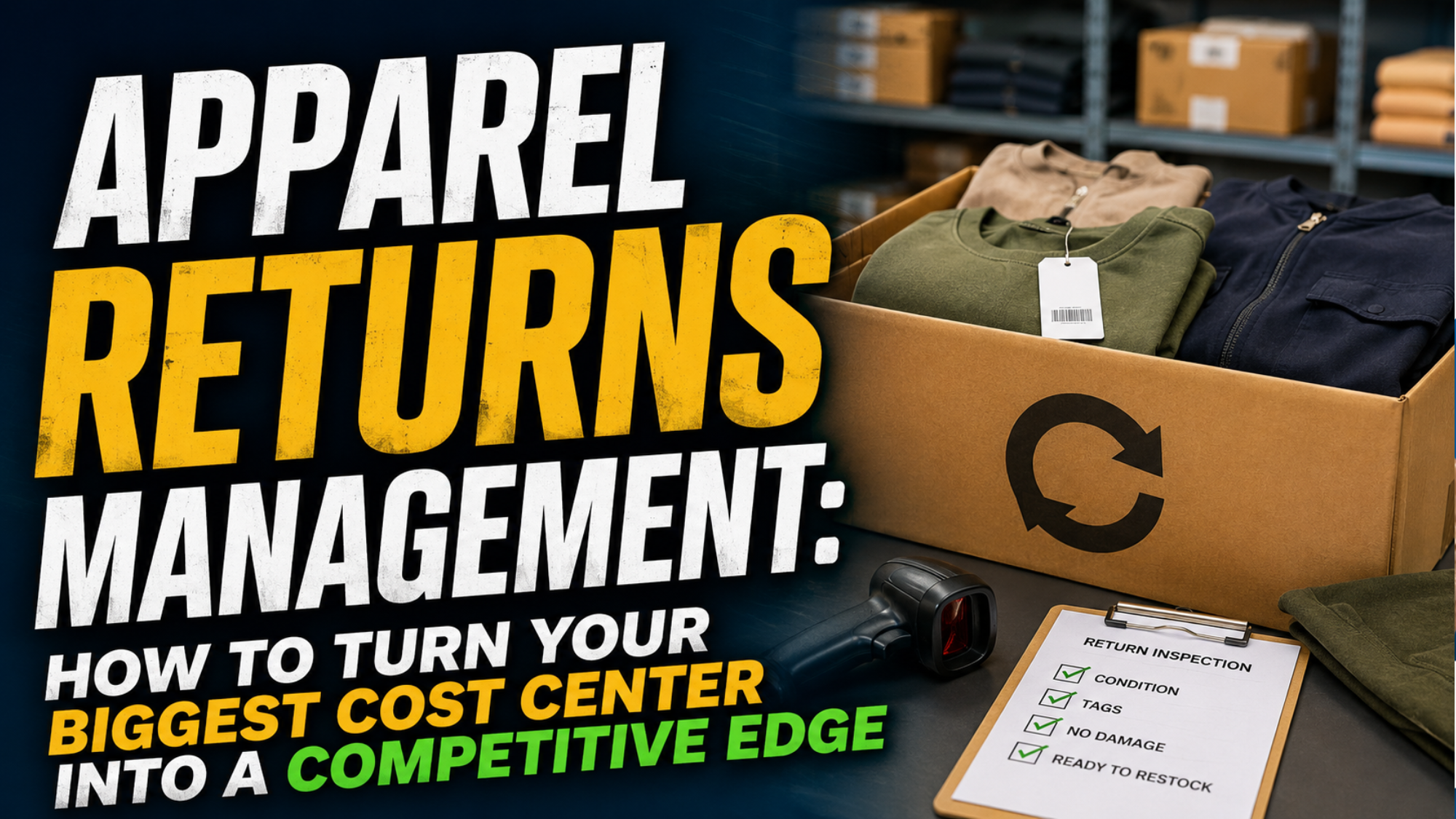
You were reconciling Q1 numbers on a Tuesday morning. Revenue looked right. Cost of goods looked right.
Then you hit the returns line.
31% of shipped orders came back that quarter. You’d been treating returns as a shipping cost, a regrettable line item. Seeing it as a percentage of gross revenue changed the math. Add in inspection labor, re-folding time, the inventory that sat uninspected for ten days, the sizes your system said were available but weren’t, and you realize you’ve been running a returns operation with a clothing brand attached.
Ready to stop absorbing mispick costs?
At 500 orders a month, a 2% mispick rate produces over $400 in direct waste every month — before a single customer posts about it. eFulfillment Service uses scan-verify on every pick, for every order.
Why apparel return rates will always be high
Apparel returns run 20 to 40% of online orders, depending on category and customer base. This isn’t a reflection of poor product quality. It’s a fit uncertainty problem, and a structural one.
Fit and sizing drive 52 to 70% of all apparel returns. A customer who orders a medium based on your size chart and finds the fit too narrow across the shoulders isn’t unhappy with the garment. They’re navigating the gap between a measurement on a screen and a physical item on their body. Better photography and detailed size guides help at the margin. They don’t close the gap.
Size bracketing compounds the volume. Many shoppers deliberately order two or three sizes, keep the one that fits, and return the rest. Fit inconsistency across brands has trained customers to do this, and it’s entirely rational from their side. Your return volume doesn’t correlate with product satisfaction. You can have a well-made product and a 35% return rate simultaneously.
The practical implication: stop trying to build operations around reducing returns to zero. Reduce the cost per return instead.
The real cost of a return — beyond the refund
Most founders track returns as a refund figure and stop there. The refund is the visible line item. The operating cost compounds beneath it.

According to Eightx’s 2026 apparel returns analysis, the fully loaded cost of processing a returned apparel item (return shipping, inspection, handling, and markdown on items that can’t resell at full price) runs approximately $30 per item. Only 48% of returned apparel items resell at full price. The rest require markdowns, rework, or write-offs.
When a return comes in, this is what actually happens:
- Receiving and logging — the package is opened, the item checked against the order, and the return recorded in your system
- Inspection and grading — the garment is examined for condition: tags attached, no odor, no visible wear, no damage
- Decision and routing — resalable items go to refolding and restock; borderline items go to rework; damaged items get flagged and written off
- Variant-accurate restock — the item goes back to the correct bin for that specific size and color, not to a general “hoodies” shelf
At 30 outbound orders per day with a 30% return rate, you’re processing 9 returns per day. At 200 outbound orders per day, that’s 60 returns, a separate operational function running simultaneously with your outbound picking.
Where the cost actually comes from:
|
Cost category |
What it includes |
|---|---|
|
Labor |
Inspection, grading, refolding, restocking |
|
Carrier cost |
Return shipping if you offer free returns |
|
Inventory lag |
Revenue locked while items sit uninspected |
|
Accuracy erosion |
Items restocked to wrong bin corrupt live counts |
|
Customer service |
Handling refund and exchange inquiries |
None of these appear as a single line item. They distribute across payroll, shipping spend, and customer service hours. That’s why most founders underestimate the true cost until they actually run the numbers.
Still running returns from a corner shelf?
eFulfillment Service processes apparel returns with a structured inspection and restock workflow — so your inventory reflects what’s actually available, size by size and color by color.
What happens without a returns process
Returns arrive. They pile up somewhere: a tote, a table, a spare shelf. Outbound orders are more urgent, so the pile grows.
By the end of the week, you have 40 items. Some are clearly resalable. Some are worn. Most are mixed together. Nobody inspected anything, and nothing got restocked. Your inventory system shows 12 available size-M black hoodies. Eight of them are in that pile.
A customer orders a size-M black hoodie. Your system says it’s in stock. Your picker can’t find it.
Now you have a stockout on a product you technically have. You issue a refund or delay the order. You’ve lost the sale twice. Once when the first buyer returned it, once when the next buyer tried to order it.
This is inventory shrinkage through process failure. It’s nearly invisible until you look for it. Brands without a returns SOP often discover it through a wave of customer service complaints or a surprise stockout on a product they believed was available. The EFS guide to apparel fulfillment identifies this inventory drift as one of the most common (and underdiagnosed) problems for growing apparel brands.
Q4 shouldn't break your returns operation every year
eFulfillment Service runs the same inspection and restock process during peak weeks as during the rest of the year. Seasonal volume is predictable — your returns process should be too.
What a proper apparel returns workflow looks like
A functional returns process has four components: a receiving protocol, a grading standard, a variant-accurate restock procedure, and a timeline.
Receiving protocol
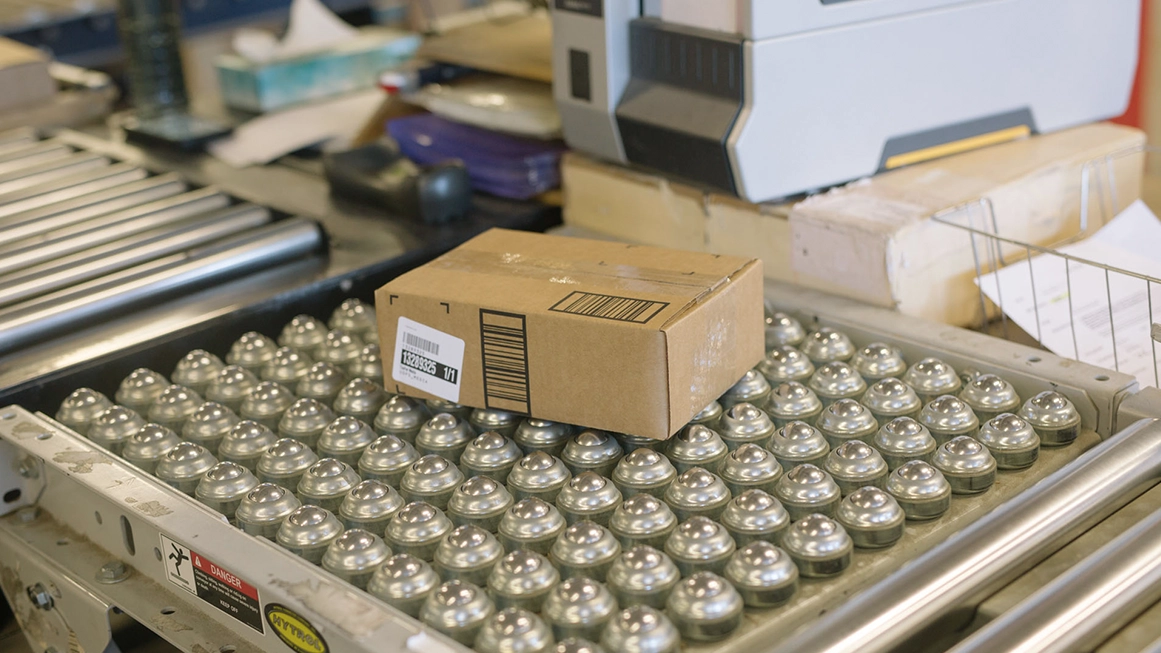
Every return is verified against the original order before it moves anywhere. The item, size, and color are confirmed. This catches returns where customers send back the wrong item entirely, whether by mistake or intentionally, before a mis-logged return corrupts your inventory counts.
Grading standard
Four conditions, applied consistently to every item that comes back:
- A-grade / resalable — Unworn, tags intact, no odor, no visible damage. Restock immediately.
- B-grade / needs prep — Minor wrinkling, slight packaging wear. Steam, re-fold, re-tag, then restock.
- C-grade / rework needed — Minor visible issue (loose thread, faint mark). Evaluate repair cost versus markdown or salvage value.
- D-grade / unsaleable — Damaged, heavily worn, or non-returnable by policy. Write off and log.
Without a documented grading standard, condition decisions get made differently by whoever handles the pile that day. That inconsistency creates margin leakage in both directions: resalable items get discarded, borderline items get restocked and generate a second return.
Returns taking longer than five days to restock?
That’s revenue sitting idle while the next customer tries to order the same item and can’t. eFulfillment Service targets a 48–72 hour return-to-available timeline for apparel clients.
Variant-accurate restock
Restocking means placing the item in the correct bin for that specific SKU, not the nearest open space. An extra-large burgundy fleece restocked to the large burgundy fleece bin creates a mispick on the next outbound order. For a detailed look at how barcode scanning prevents variant errors at the pick step, the EFS post on apparel quality control walks through the mechanics.
Timeline
The benchmark for a well-run apparel returns process is 48 to 72 hours from receipt to restocked and available. Brands managing returns in-house without dedicated staff routinely see 7 to 14-day timelines. Every day an item sits uninspected is a day that item’s revenue is locked out of your business.
How returns data becomes a product advantage
Most apparel brands treat return data as a cleanup task. The better use is as product feedback.

Your return reasons, tracked by SKU and size, reveal things your customer reviews won’t. A 40% return rate on a specific size-L item with “too tight across the hips” as the common reason is a sizing calibration signal. A disproportionate return rate on a colorway with “looks different in person” tells you something about your product photography, not the product. A spike in damaged returns after a new supplier run is a quality control flag.
What systematic return tracking gives you:
- Which SKUs to prioritize for sizing recalibration
- Which product images need to be retaken
- Which suppliers are producing inconsistent batches
- Which size categories have the best fit-to-return ratio
This data already exists in your returns. Capturing it costs almost no additional effort. Ignoring it means paying the cost of the same returns quarter after quarter without the product intelligence that would reduce them over time.
Good apparel inventory management depends on return data being both accurate and timely. Returns that sit uninspected for two weeks produce SKU counts that don’t reflect reality, and product decisions end up two weeks behind.
Returns are product feedback
eFulfillment Service tracks returns at the item, size, and condition level. That data comes back to you, tagged by SKU and reason code, for every return we process.
Seasonal return spikes and why they’re different
Returns follow the same seasonal pattern as sales, but with a lag. Your Q4 holiday orders generate a January return wave. Your spring launch generates April returns. If your process is already struggling at baseline volume, a 3x return spike won’t slow you down gradually. It breaks the process.

The compounding problem during peaks:
- Outbound order volume is highest precisely when return volume arrives
- Staff are focused on picking and packing, not inspecting returns
- The pile grows for two to three weeks before anyone can address it
- Inventory counts drift further from reality throughout the peak period
- You emerge from the season with a backlog of uninspected returns and SKU data you can’t trust for replenishment decisions
This is why apparel brands that manage returns reasonably well at steady-state still get crushed during Q4. A process built for 50 returns per week won’t hold at 250. The inspection standard slips, the 48-hour restock timeline stretches to 10 days, and inventory counts drift further each week. The brands that depend on accurate inventory to manage holiday replenishment end up making decisions on numbers that no longer reflect what’s actually on the shelf.
Scalable returns handling means running the same SOP regardless of volume. The inspection standard can’t flex when your business depends on the data it produces. That consistency only comes from dedicated infrastructure: either a large enough in-house team, or a 3PL with apparel-specific returns capacity.
When to hand apparel returns to a 3PL
For most apparel brands, returns handling is the last fulfillment function they outsource. Often, it’s the one that should have gone first.
Returns require more variable judgment per unit than outbound picking. They’re inconsistent in volume and timing. A returns error (a wrong-bin restock, a missed grade, a 14-day lag) produces inventory accuracy problems that ripple through the entire operation. The case for outsourcing returns early is stronger than most founders expect before they’ve run the numbers.
Signs that in-house returns handling is costing more than a 3PL would:
- Your available inventory regularly doesn’t match your system’s count
- You have regular stockouts on items you know are physically in the building
- Returns are sitting longer than five days before anyone inspects them
- You’ve hired someone specifically to manage returns, and they’re still behind
- Customer service tickets about “still waiting for my refund” show up every week
- Seasonal returns are still being processed two or three weeks after the peak
For apparel brands with return rates above 25%, the per-unit economics often favor outsourcing at 300 to 500 monthly orders, the same apparel fulfillment inflection point where forward fulfillment outsourcing starts making financial sense.
FAQs: Apparel Returns Management
What's a realistic return rate for an apparel brand, and should I try to lower it?
The NRF's 2025 retail returns landscape report puts online apparel returns at 20 to 40% depending on category. Fit-related returns drive the majority, and they don't disappear with better descriptions or size charts, but they do reduce. Plan operations around a structural return rate of 25 to 35% and focus on reducing the cost per return rather than eliminating the volume.
How do I handle size bracketing — customers ordering multiple sizes to try?
You can discourage bracketing with return policies: charging a flat return fee above a certain order size, or limiting free returns to one item per transaction. Both approaches carry a conversion tradeoff. More practically, accept bracketing as a category behavior, build your process to handle the volume efficiently, and let your return data tell you which sizes are most frequently sent back, so you can improve sizing guidance on the product page over time.
To understand what it would actually cost for your specific operation, the only reliable approach is to get direct quotes from two or three 3PLs with your real order data: average monthly volume, average items per order, packaging spec, and estimated return rate. That lets you compare apples to apples rather than benchmarking against industry averages that may not reflect your product mix.
What grading information should I capture per return?
At minimum: item condition (resalable, needs prep, damaged), reason for return if the customer provided one, and the specific SKU and variant. If you're using a 3PL, confirm they're capturing reason codes and returning that data to you. It's your product intelligence. It shouldn't disappear at the receiving dock.
Should I offer free returns?
Free returns increase conversion and reduce purchase hesitation for apparel, but they also increase return volume and size bracketing. The decision turns on your AOV and margin structure. Brands with AOV above $80 and gross margins above 50% typically find free returns net-positive. Brands with thinner margins often shift to store-credit-only or a flat return fee to offset the volume cost.
How quickly should returns be restocked to available inventory?
The benchmark for a well-run apparel returns workflow is 48 to 72 hours from receipt to restocked and available. Past five days, your live inventory is unreliable. Past a week, you're regularly losing sales to stockouts on products you physically have. The reverse logistics breakdown from EFS covers why restock speed is the metric that matters most in this process.
Can a 3PL maintain my packaging standards when restocking returned items?
Yes, and this is worth asking about explicitly in any 3PL evaluation. If your brand ships garments in a specific fold, poly bag size, or with a tissue insert, the restocked version should meet the same standard before it ships again. A returned item restocked out-of-spec and shipped to the next customer creates a brand presentation failure through no fault of the product. The EFS overview of value-added services for apparel fulfillment covers what garment prep looks like as part of a standard 3PL workflow.
Running 200 or more returns per month?
The per-unit economics of 3PL returns handling versus in-house almost always favor outsourcing at that volume for apparel. eFulfillment Service’s returns team handles receiving, inspection, grading, and variant-accurate restock.
Key takeaways
- Apparel’s 20–40% return rate is fairly standard — fit uncertainty drives 52–70% of returns regardless of product quality; build operations around the cost of returns, not their elimination.
- The fully loaded cost per return runs ~$30 in-house — labor, shipping, inventory lag, and markdown on items that can’t resell at full price are distributed across multiple budget lines and easy to undercount.
- Inventory accuracy depends on returns accuracy — items sitting uninspected or restocked to wrong bins create stockouts on products you technically have in stock.
- 48–72 hours is the restock benchmark — every day past that locks revenue out of your business and makes your inventory data unreliable for purchasing and replenishment decisions.
- Returns data is product intelligence — reason codes by SKU surface sizing calibration needs, photography gaps, and supplier quality issues before they show up in your reviews.
- The 3PL returns break-even is lower than most expect — at 25%+ return rates, outsourcing often becomes cost-positive at 300–500 monthly orders, not 1,000+.



0 Comments