

A campaign that raises $50,000 on Kickstarter hands the creator roughly $45,000 to $46,000. Kickstarter keeps a 5% platform fee, and Stripe takes roughly 3% to 5% for payment processing, before manufacturing or a single shipping label gets paid for.
Those fees are known in advance. Fulfillment is the major cost that usually isn’t, because reward tiers get priced months before anyone quotes the warehouse work and postage against the finished box. This guide breaks the fulfillment bill into its line items, with industry averages where a clean number exists, so the estimate can happen before the campaign launches.
The full cost stack, from funded total to delivered box
The platform, its payment processor, and the pledge manager each take a percentage. The warehouse and the carrier bill for work done, and most of that work grows with the number of boxes.
| Cost | Who charges it | How it’s billed |
|---|---|---|
| Platform fee | Kickstarter | 5% of funds collected |
| Payment processing | Stripe | Roughly 3% to 5% |
| Pledge manager | BackerKit, PledgeBox, Gamefound, etc. | Percentage of funds, plus transaction fees on money collected through it |
| Receiving | 3PL | Per pallet, per container, or per hour |
| Storage | 3PL | Per pallet, bin, or cubic foot, per month |
| Kitting | 3PL | Usually per hour or per kit |
| Pick and pack | 3PL | Per order, plus a charge for extra items |
| Packaging | 3PL or creator | Per box or mailer |
| Postage | Carrier, through the 3PL | Per package, by billable weight and zone |
| Duties and VAT | Destination country | Per international package |
Platform and payment-processing rates vary by region and plan; 3PL line items depend on your product, order profile, and volume. Figures above are typical ranges, not a quote.
Manufacturing and ocean freight sit outside this list, and our guide to pricing a crowdfunding campaign covers how they fit into reward-tier pricing. They’re usually the largest checks a creator writes, but they get quoted early because nothing ships without them.
Why percentages and per-backer fees behave differently
Percentage fees shrink the pot by the same share whatever the campaign raises. Postage, pick and pack, and packaging are charged box by box, so a campaign that overfunds also multiplies its fulfillment bill. A tier that undercharges for shipping loses more money the more successful the campaign gets.
What a 3PL charges for a crowdfunding campaign
The most useful public benchmark is the 2025 warehousing costs and pricing survey from WarehousingAndFulfillment.com, now published on The Fulfillment Advisor. The survey gathers rates from more than 600 warehouses.
| Line item | 2025 survey average |
|---|---|
| Pick and pack, one-item B2C order | $3.20 |
| Receiving per pallet | $10.52 |
| Receiving per container | $500 |
| Receiving per hour | $45.67 |
| Storage per pallet, per month | $20.17 |
| Storage per bin, per month | $3.08 |
| Kitting, per hour | $43.30 |
| Account setup fee 51% of warehouses charge one | $333 |
| Minimum monthly spend | $517 |
Source: 2025 Warehousing Costs and Pricing Survey, WarehousingAndFulfillment.com (published on The Fulfillment Advisor), based on 600+ warehouses. Industry averages, not eFulfillment Service rates.
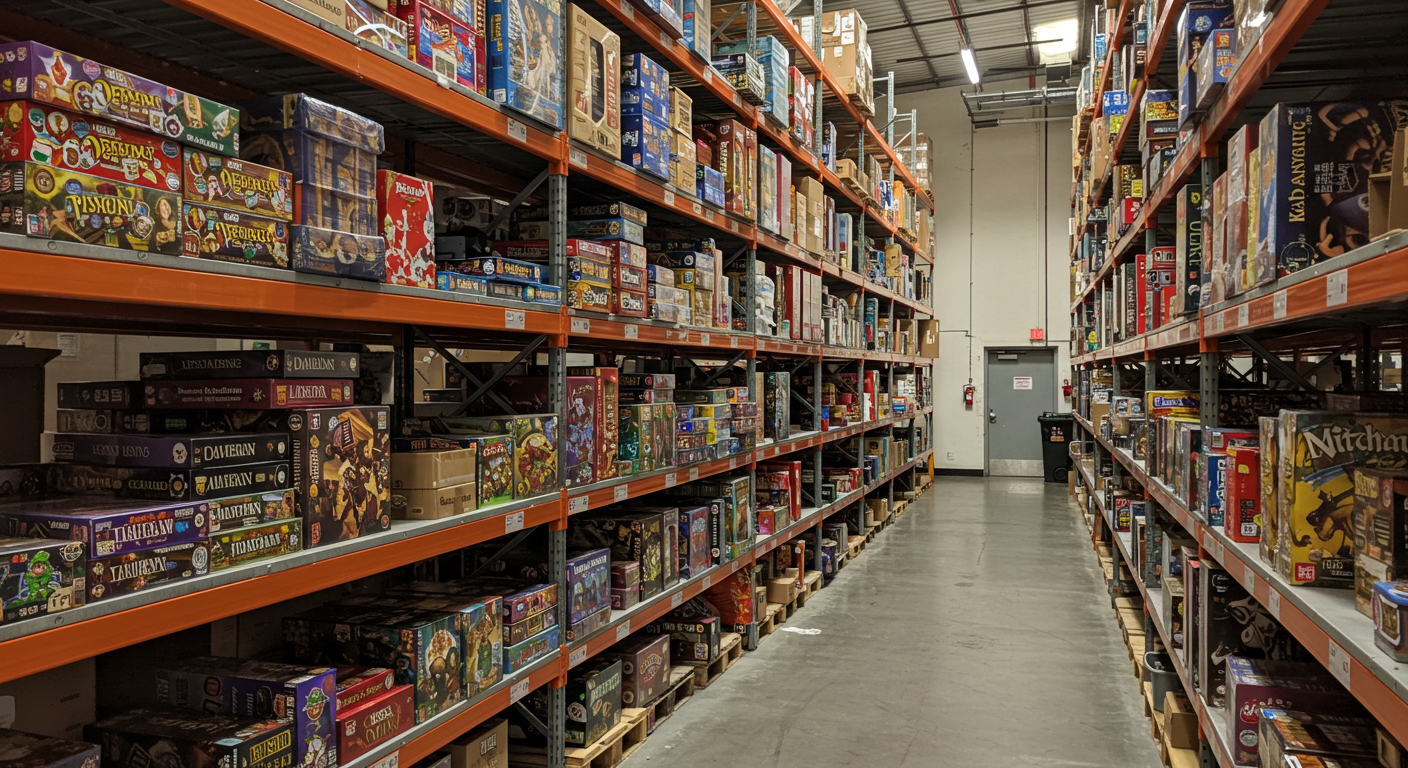
These are survey averages across more than 600 warehouses and every kind of ecommerce client — not eFulfillment Service rates. A crowdfunding campaign uses them in an unusual pattern: everything arrives at once and gets kitted in a burst, and then activity nearly stops once the wave ships. EFS quotes each campaign against that exact profile, and on the line items that move a campaign’s total the most, its pricing frequently lands below these benchmarks.
The two lines that hurt campaigns most
Kitting is where reward tiers get expensive. A base game plus two add-ons and a stretch-goal insert is an assembly job before it’s a pick, and hourly kitting labor adds up across every tier combination.
Monthly minimums hurt after the wave. A campaign that ships 1,000 rewards in one week and then sells 30 units a month through a store can end up paying a monthly minimum (the survey’s average is $517) for months of near-zero activity.
eFulfillment Service charges no setup fees, doesn’t charge long-term storage fees on crowdfunding inventory, and has no minimum order requirements on the ongoing orders that follow the wave.
Pledge manager fees
A pledge manager collects addresses and add-on purchases after the campaign closes, often along with shipping charges, and it takes its own cut.
BackerKit’s published pricing for campaigns that ran on Kickstarter or another outside platform is a tiered campaign fee of 2% on the first $50,000 raised, dropping in steps for larger campaigns, plus a 3.5% transaction fee on money processed through the pledge manager itself. That second fee applies to shipping charges collected there, which matters if shipping is billed after the campaign instead of during it.
Billing shipping during the campaign skips the pledge manager’s transaction fee, though Kickstarter’s 5% and payment processing still apply to that money. It also forces an estimate before addresses are known. Billing it in the pledge manager allows exact rates by destination, at the cost of the 3.5% fee.
For how pledge manager exports reach a warehouse, see our guide to how BackerKit, Gamefound, and PledgeBox connect to your 3PL.
Ship late pledges with the original rewards
Once your production run lands, eFulfillment Service ships late pledges and pre-orders alongside the original backer rewards, so latecomers aren’t stuck in a separate queue.
A worked example: 1,000 backers
The example below uses the survey averages plus a few stated assumptions. Swap in your own numbers. The 30-kits-per-hour figure is the shakiest assumption here, since assembly speed swings widely with the number of components in each kit.
Assumptions: 1,000 backers, $50,000 raised, BackerKit as the pledge manager, one shipping container of product (the survey doesn’t split receiving by container size), 10 pallets stored for two months, 30 reward kits assembled per labor hour, $1.50 of packaging per box, and $12 average domestic postage.
| Line item | Calculation | Per backer |
|---|---|---|
| Receiving | $500 per container ÷ 1,000 | $0.50 |
| Storage | 10 pallets × $20.17 × 2 months ÷ 1,000 | $0.40 |
| Kitting | $43.30 per hour ÷ 30 kits | $1.44 |
| Pick and pack | Survey average, finished kit counted as one item | $3.20 |
| Packaging | Assumption | $1.50 |
| Postage | Assumption | $12.00 |
| Total | $19.04 |
Illustrative math on 2025 survey averages plus the stated assumptions — not an eFulfillment Service quote. Excludes any setup fee, monthly minimum, or pledge-manager transaction fee, which vary by provider.
What the example shows
Postage is about 63% of the per-backer cost. The warehouse and packaging lines combined come to about $7. The same percentage error costs far more on postage than on any warehouse fee, and postage is also the one big line here that’s an assumption, so it’s the first number to replace with your own.
Our Kickstarter shipping cost calculator walks through the postage math step by step, including the July 2026 change to USPS’s dimensional weight divisor.
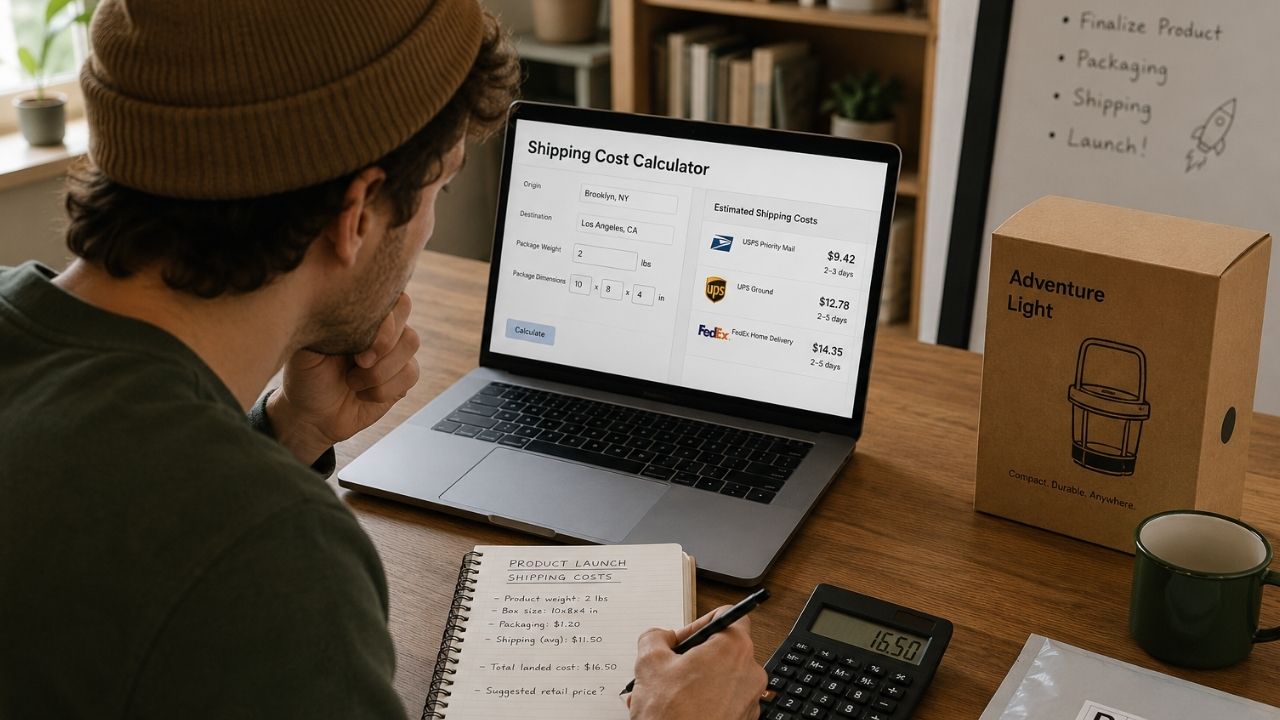
Postage is the line worth checking twice
eFulfillment Service can weigh and measure your finished reward box and quote postage on its billable weight before you set campaign shipping prices.
Costs creators forget to budget
- International duties and VAT. Shipping to the EU under DDP terms means the creator pays import VAT up front. Our guide to international shipping for Kickstarter rewards covers DDP vs. DAP.
- Replacements. Damaged and lost packages get reshipped at the creator’s cost. There’s no reliable public figure for how many to expect, and it varies with the product and how well it’s packed.
- Address changes and returned packages. Backer addresses are collected months before shipping, and a package returned as undeliverable pays postage twice.
- Rate increases over time. One tabletop publisher watched a single game’s delivered fulfillment cost rise from $14.41 to $22.82 with the same provider, about 58%.
- Stretch goals that change the box. A stretch goal that adds a component can push a reward into a bigger carton and a higher billable weight.
How to lower the bill without cutting corners
- Design the box around the carrier. A box a little smaller in every dimension can drop a full billable-weight tier, and kitting components into a right-sized box can cut billable weight further.
- Limit tier combinations. Every add-on combination is another kit layout. Fewer combinations mean faster kitting and fewer picking errors.
- Ship in one wave where possible. Receiving and setup cost less per unit when they happen once, and a single kitting run avoids staging the same components twice.
- Choose a 3PL without monthly minimums. The months after the backer wave are when minimums cost the most.
- Get a quote before the campaign launches. It’s the last point where a bad shipping number can be fixed by changing the tier price.
Our pre-launch fulfillment checklist covers what to have ready before asking for that quote.
Ship rewards and store orders from one warehouse
eFulfillment Service handles the reward wave and the daily store orders after it, with no long-term contract.
FAQs
Frequently asked questions
How much does Kickstarter fulfillment cost per backer?
The worked example in this guide lands at about $19 per backer for a domestic reward, with $12 of that being assumed postage. Your own number depends mostly on box size, weight, and destination.
Does Kickstarter charge for shipping?
Kickstarter’s 5% fee and payment processing apply to the funds collected, including any shipping charges backers paid during the campaign.
Should I charge shipping during the campaign or in the pledge manager?
Charging during the campaign locks the money in early but requires an estimate, and Kickstarter’s fees apply to it. Charging in the pledge manager allows exact rates once addresses are known, at the cost of the pledge manager’s transaction fee.
Is self-fulfillment cheaper than a 3PL?
For a few hundred small, light rewards, it can be. It’s hard to say where the breakpoint sits without knowing the product, so price your own hours, retail packaging, and retail postage against a 3PL quote and compare.
Is there a minimum campaign size for a 3PL?
It varies by provider. Many 3PLs set a minimum monthly spend rather than a minimum number of orders — the 2025 survey average was about $517 a month — so even a small campaign can qualify as long as it clears that floor. Ask any 3PL whether its minimum is a spend, an order count, or neither before you sign.
What’s the most common budgeting mistake?
The most common one is pricing shipping from the product’s weight instead of the billable weight of the box it ships in.
Key Takeaways
- Fees come off the top first. A $50,000 campaign keeps roughly $45,000 to $46,000 after Kickstarter’s 5% and payment processing.
- Postage dominates the per-backer bill. Twelve of the worked example’s nineteen dollars are postage.
- Watch kitting and monthly minimums. Kitting grows with tier complexity, and minimums keep charging after the wave ships.
- Pledge managers charge two fees. BackerKit takes a campaign fee on funds raised and a transaction fee on anything collected through the tool, including shipping.
- Quote before launch. Campaign shipping prices set from a quote protect margin as the backer count grows.
Whatever stage you’re in, the fastest way to find out if a provider will actually deliver what they promise is to ask the questions in this guide before you sign, not after your first invoice arrives. eFulfillment Service will walk through exact, itemized pricing and a real point of contact from the first conversation. Get a free quote and see how DTC fulfillment works when nothing is hidden until month two.

0 Comments