
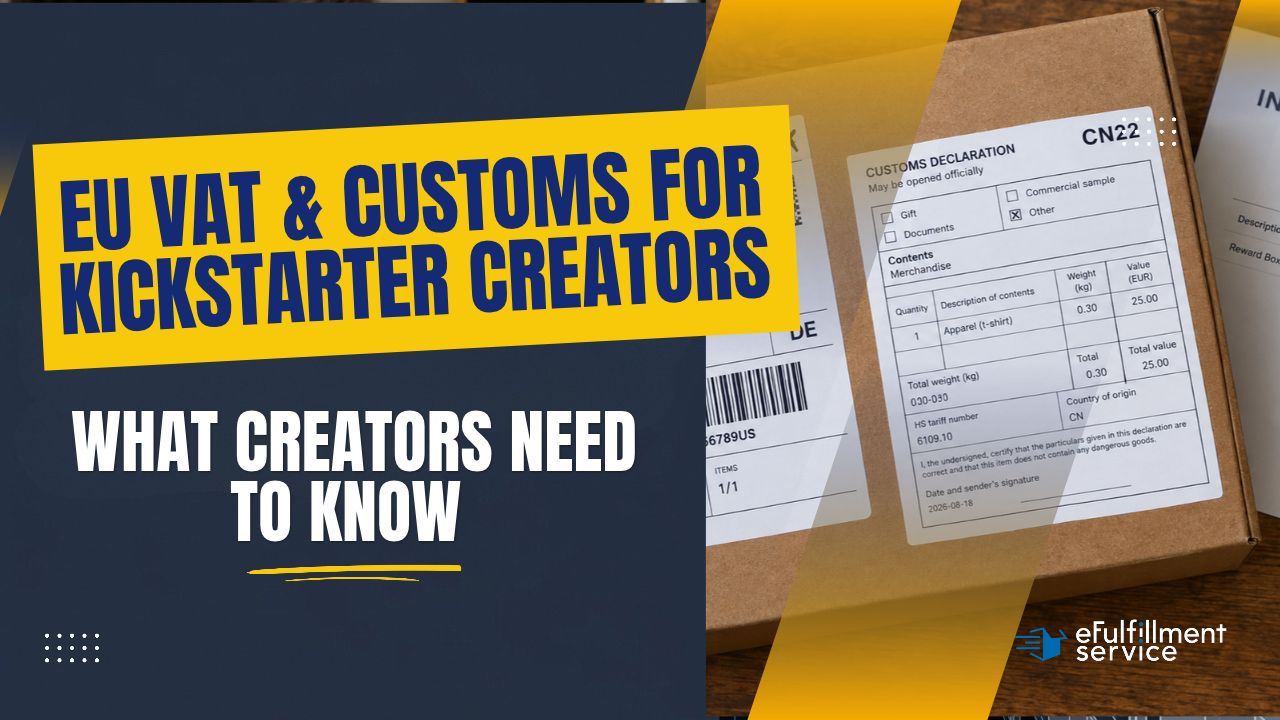
Every commercial package entering the European Union owes import VAT, regardless of its value. There is no minimum threshold anymore: a $12 keychain reward and a $200 board game pledge both owe VAT at the border, even though only the pricier one also risks customs duty. That rule has been in effect since July 1, 2021, when the EU closed the exemption that used to let low-value shipments cross duty-free, and it still catches first-time Kickstarter creators off guard every week.
Most of the confusion sits somewhere else: who ends up paying it, and when a creator finds out. With the wrong paperwork, a backer in Germany opens their door to a courier holding a customs bill for €30 on a product they already paid for; with the right paperwork, the same shipment clears without the backer ever seeing a customs form.
EU VAT & Customs for Kickstarter Creators: What Changed
What actually changed in EU import VAT
Before July 2021, any shipment valued under €22 entered the EU without import VAT. Creators shipping small reward tiers (stickers, pins, thin paperback books) routinely fell under that line and never thought about customs at all.
That exemption is gone. Since the reform:
- Every commercial shipment owes import VAT, no matter how small the declared value.
- VAT is calculated on the declared value of the goods plus shipping cost. The product price alone understates it.
The rate depends on the destination country rather than the country of origin. Hungary charges 27%, Germany charges 19%, Luxembourg charges 17%, and most other member states fall somewhere in between.
A creator who budgeted reward-tier pricing around pre-2021 assumptions is budgeting against a rule that no longer exists. If your last campaign shipped before 2021, or you’ve never shipped to the EU before, update your cost model first, using our broader guide to international shipping for Kickstarter rewards, before boxes get packed.
Most Kickstarter creators build their reward-tier budget around domestic shipping costs, then treat international shipping as “the same, but slower and more expensive.” VAT doesn’t work that way. It’s a tax owed to the destination country’s government, collected either by the creator in advance or by the courier at the door.

This is where most of the confusion starts, because two different charges apply at two different value thresholds:
|
Declared value |
Import VAT owed? |
Customs duty owed? |
|---|---|---|
|
Any value (including under €22) |
Yes, always |
No, if under €150 |
|
Over €150 |
Yes |
Yes, plus VAT |
Duty rates vary by product category. Tabletop games, apparel, and electronics each carry different tariff classifications under the EU’s Harmonized System (HS) codes, and UPS and FedEx can both help classify a product and estimate the duty it will carry. A creator shipping a $180 tech gadget reward tier isn’t just paying VAT; they’re paying duty on top of it, calculated against a different HS code than the one a $40 board game expansion would carry. It’s hard to say what that rate will be without actually looking up the specific HS code, since a small wording change in how a product is described can shift which tariff line the product falls under.
The practical takeaway: know your product’s HS code before you price your EU reward tiers. A wrong or missing HS code can trigger a manual customs review that holds the package for weeks while an angry backer watches a tracking number that hasn’t moved.
DDP vs. DAP: who actually pays these fees
Every international shipment carries one of two customs terms, and the difference determines whether your backer ever sees a bill.
DAP (Delivered At Place): The creator ships the package, and the courier collects VAT and any duty from the backer at delivery, or holds the package until they pay. This is cheaper for the creator upfront and is the default on many shipping platforms unless explicitly changed.
DDP (Delivered Duty Paid): The creator pays VAT and duty in advance, as part of fulfillment cost, and the backer receives the package with nothing owed at the door.
DAP feels cheaper until a backer refuses to pay and the package gets returned or destroyed at the border, a cost the creator absorbs anyway, on top of the original shipping spend. DDP costs more per unit. It also removes one of the most common sources of backer complaints in international crowdfunding fulfillment: a surprise bill for something they already paid for on the platform.
“For international backers, DDP is preferred over DAP because it avoids surprise VAT/duty fees and reduces refusal rates.” — BackerKit, in its guide to crowdfunding shipping strategy
A backer who pledged $60 and then gets asked for another €22 at the door doesn’t distinguish between “the courier’s fee” and “the creator’s mistake.” They post about it. On BoardGameGeek and in Kickstarter’s own comment sections, a wave of surprise customs bills reads as the creator hiding costs, even when the creator had no idea DAP was the default setting on their shipping account.
Ship late pledges with the original rewards
Once your production run lands, eFulfillment Service ships late pledges and pre-orders alongside the original backer rewards, so latecomers aren’t stuck in a separate queue.
The EU built a specific mechanism for exactly this problem: the Import One-Stop Shop (IOSS). It lets a non-EU seller register once, collect VAT from the buyer at the point of sale (or, for crowdfunding, at reward fulfillment), and remit it directly to the EU rather than leaving it to be collected at the border.
IOSS only applies to shipments valued at €150 or under. Above that threshold, the shipment goes through standard customs clearance regardless of registration.
IOSS only applies to shipments valued at €150 or under. Above that threshold, the shipment goes through standard customs clearance regardless of registration.
What IOSS solves:
- Backer sees one final price, with VAT built in, and no separate customs invoice later
- Package clears EU customs faster because VAT is already accounted for
- Creator remits VAT through a single monthly return instead of per-shipment guesswork
What IOSS doesn’t solve:
- Shipments over €150 still need full customs declarations and may owe duty
- Registration takes time, so it belongs on the pre-launch checklist rather than the week reward fulfillment starts
- A creator fulfilling through a 3PL needs to confirm the provider actually works with a VAT compliance partner that covers EU registrations rather than just claiming to
Plan storage for the surplus you do order
eFulfillment Service can quote your order volume, kit complexity, and climate-control needs as separate, itemized lines instead of one blended “premium storage” number.
Before locking reward-tier pricing, run the math on a representative EU shipment
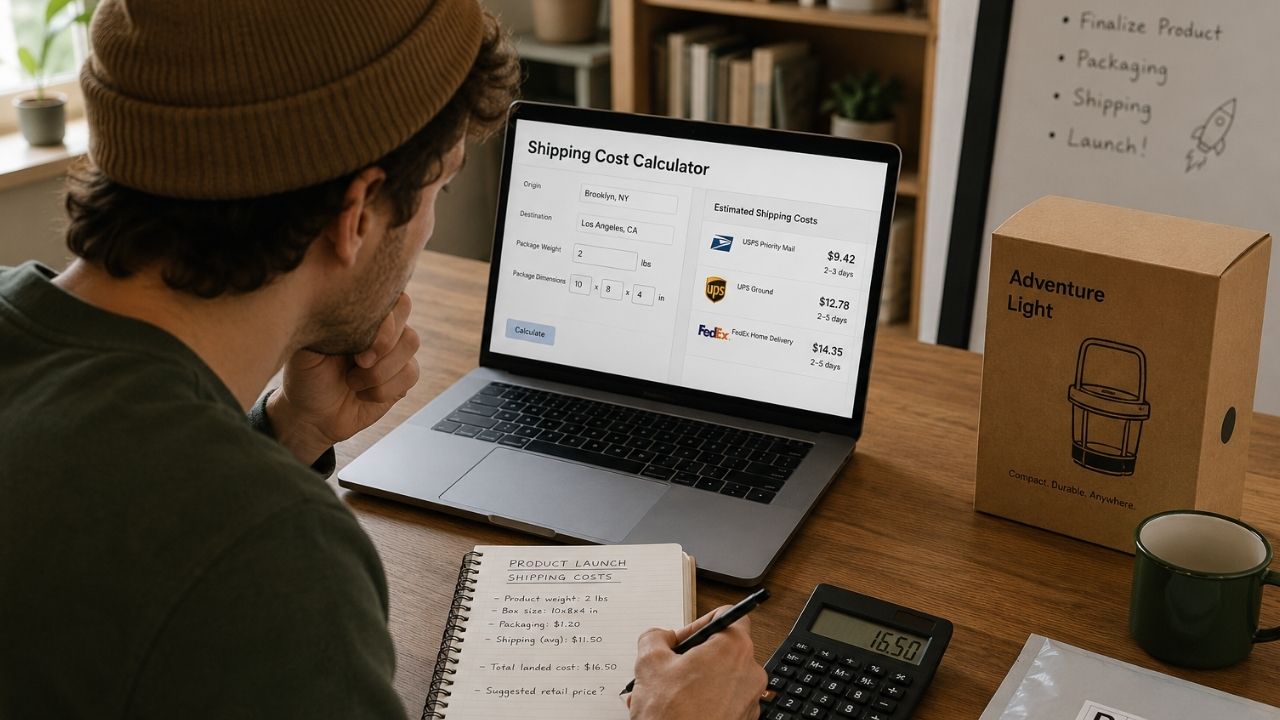
Our Kickstarter shipping cost calculator walks through the base version of this for domestic and international rewards alike:
- Declared value = product cost + shipping cost (not product cost alone)
- VAT owed = declared value × destination country’s VAT rate (17%–27%, varies by country)
- Duty owed (if declared value exceeds €150) = declared value × the applicable HS code’s duty rate
- Total landed cost = declared value + VAT + duty
A $50 reward shipped to France (20% VAT, under the €150 duty threshold) owes roughly $10 in VAT alone before any duty applies. Multiply that across a backer list with a meaningful EU share, and the total adds up fast: money that either comes out of the creator’s margin under DDP, or lands on the backer’s doorstep as a surprise under DAP.
Run this math while the campaign budget is still a spreadsheet, before funding closes and it turns into a margin problem. A reward-tier price set without it is a guess dressed up as a number.

Common mistakes creators make with EU customs
- Assuming small items are exempt. The €22 exemption ended in 2021, and there is no value low enough to skip VAT entirely.
- Leaving shipping terms on the default setting. Many carriers default to DAP unless a creator actively selects DDP, which means backers absorb the surprise unless someone changes it.
- Guessing at HS codes. An incorrect code can flag the shipment for manual review and add weeks of delay, on top of the wrong duty rate.
- Registering for IOSS too late. IOSS setup isn’t instant; waiting until reward fulfillment begins to explore it means the first wave of EU shipments goes out without it.
Pricing reward tiers before running the landed-cost math. Shipping and VAT get treated as a rounding error instead of a genuine line item, then blow the budget once EU orders ship.
The move from batch to daily orders is where some creators find out their campaign 3PL was a poor fit. Some fulfillment providers are built around one-time batches, and their pricing or minimums don’t suit a store shipping a few orders a day.
Ship rewards and store orders from one warehouse
eFulfillment Service handles the reward wave and the daily store orders after it, with no long-term contract.
FAQs
Does VAT apply even if my Kickstarter reward is a "gift" or has a low declared value?
Do I need to register for IOSS if I'm only running one campaign?
What happens if a backer refuses to pay customs fees under DAP terms?
Does the UK follow the same rules as the EU?
How do stretch goals and add-ons affect the VAT calculation?
Key Takeaways
- The €22 VAT exemption ended in 2021. Every commercial shipment into the EU owes VAT regardless of value, so there’s no small-item exception left to plan around.
- VAT and customs duty are separate charges with separate thresholds. VAT applies to everything; duty only kicks in above €150 declared value.
- DDP vs. DAP determines who gets the surprise bill. DAP is often the shipping platform’s default, and surprise customs bills are one of the most common sources of backer complaints on international rewards.
- IOSS lets you collect VAT upfront for shipments under €150, but registration takes time and doesn’t cover higher-value shipments.
- Landed cost math belongs in the campaign budget, before the post-funding scramble. VAT alone can add 17-27% to a reward’s declared value before duty is even considered, depending on the destination country.
- Stretch goals and add-ons can push a shipment over the €150 duty threshold even when the base reward tier was priced to stay under it.
Whatever stage you’re in, the fastest way to find out if a provider will actually deliver what they promise is to ask the questions in this guide before you sign, not after your first invoice arrives. eFulfillment Service will walk through exact, itemized pricing and a real point of contact from the first conversation. Get a free quote and see how DTC fulfillment works when nothing is hidden until month two.



0 Comments