
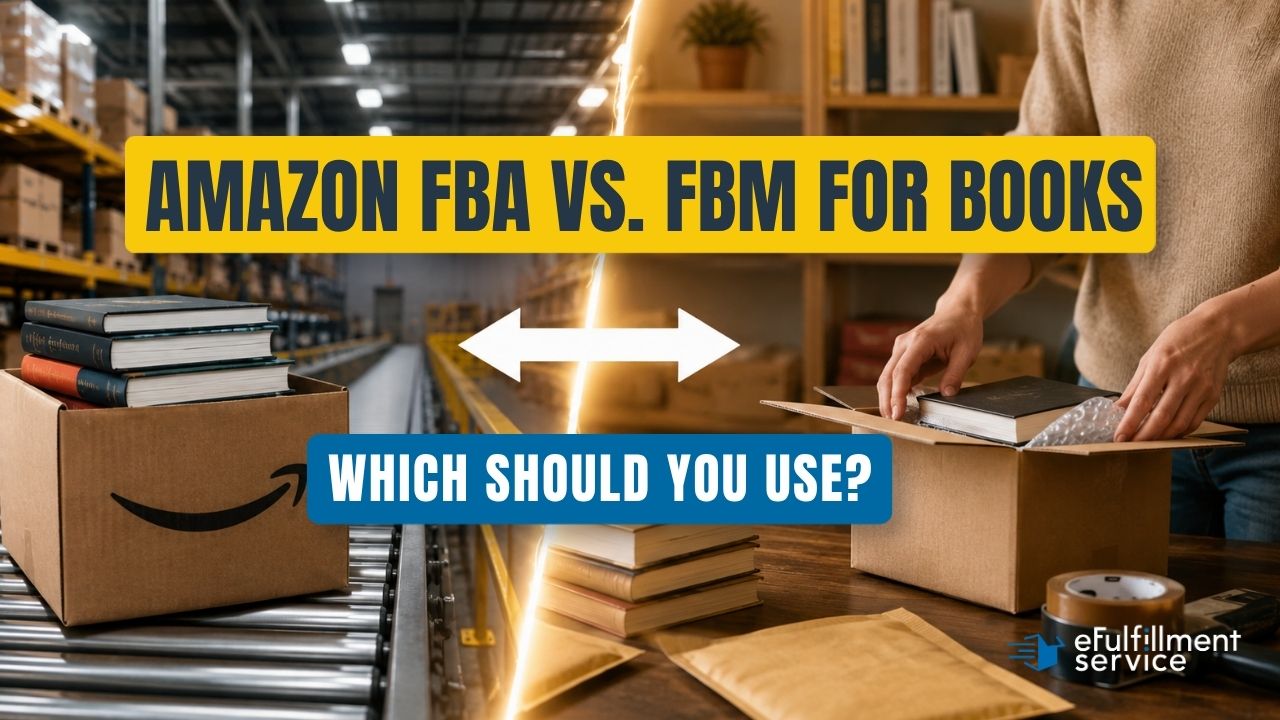
Amazon’s long-term storage fees catch a lot of publishers and self-published authors off guard. A backlist title that stopped selling twelve months ago doesn’t just stop earning, it starts costing you expensive storage fees. Every month it sits in an Amazon fulfillment center, it generates a storage charge. For sellers with large catalogs, those charges add up fast.
FBA works well when titles are moving. Prime eligibility drives sales, and Amazon handles the logistics. But FBA was designed for fast-moving inventory. It wasn’t built to warehouse slow-moving titles at a reasonable cost, and the fee structure reflects that.
This guide breaks down what FBA and FBM actually cost for books, where each model runs into trouble as a catalog grows, and when it makes sense to switch from one to the other—or to bring in a third-party logistics provider. It’s a companion piece to our complete guide to book fulfillment for publishers and authors, which covers the fulfillment landscape end to end.
Already know you need a book-specialist 3PL?
eFulfillment Service has shipped millions of books for indie authors, small presses, and subscription boxes with ISBN-level inventory tracking, Media Mail routing, and street date enforcement built in.
What FBA actually costs for books
Fulfillment by Amazon means you ship inventory to Amazon’s warehouses in bulk, and Amazon picks, packs, ships and handles customer service and returns for every order. For books, several fee types stack on top of each other.

Referral fee. Amazon takes 15% of the sale price on books, the standard media-category rate. This applies whether you fulfill the order yourself or Amazon does.
Fulfillment fee. Amazon charges a per-unit fee based on size and weight tier, every time a unit ships. For a standard paperback, this typically lands somewhere in the $3.00 to $6.50 range per unit, though Amazon’s periodic fee updates shift these tiers most years.
Storage fees. Amazon charges these monthly on the cubic footage your inventory occupies, and the rate isn’t flat across the year:
| Period | Standard-size rate | Oversize rate |
|---|---|---|
| January–September | ~$0.78 / cubic ft | ~$0.56 / cubic ft |
| October–December | ~$2.40 / cubic ft | ~$1.40 / cubic ft |
Then there’s the fee that catches most sellers off guard: long-term storage. Inventory sitting in an Amazon warehouse past 365 days gets hit with a surcharge of roughly $6.90 per cubic foot or $0.15 per unit, whichever is higher. An earlier aged-inventory surcharge, at a lower rate, can kick in as soon as 181 days. A backlist title that sells two copies a month is exactly the kind of SKU this fee was built to punish. Plenty of frontlist hits end up parked in exactly this spot a year or two later — just ordinary aging for a backlist title.
What FBM actually costs for books
Fulfilled by Merchant means the listing lives on Amazon, but fulfillment responsibility shifts to you, whether you pack orders yourself, hire a fulfillment vendor or route everything through a 3PL.

What goes away under FBM is Amazon’s fulfillment fee and storage fee, replaced by your own packing labor, materials and postage. The 15% referral fee stays regardless.
For books specifically, this is where FBM has a real structural advantage: USPS Media Mail. It’s slower than Amazon’s standard shipping speeds, but it’s built for exactly this category. FBM sellers are free to use it where Amazon’s delivery-speed requirements allow. (We cover Media Mail eligibility and its tradeoffs against faster services in our USPS Media Mail guide.)
The catch is, FBM sellers are held to Amazon’s own performance metrics: order defect rate, late shipment rate, valid tracking rate. Miss those consistently and you lose Buy Box eligibility, which for a commodity product like a book is often the difference between selling and not selling at all.
Save Time and Let us Handle Your Book Fulfillment!
See How Using a 3PL for saves Amazon sellers time. Get a Free Quote from eFulfillment Service Today!
The real cost comparison
Neither model is categorically cheaper. The answer depends entirely on how fast a specific title moves.
Fast-moving frontlist titles (multiple sales per week) tend to favor FBA. The fulfillment fee gets absorbed by volume, storage turns over before long-term fees apply, and the Prime badge tends to lift conversion on a title that’s already selling.
Slow-moving backlist titles (a handful of sales per month) tend to favor FBM. There’s no fulfillment fee tax on every unit, no storage rent accumulating on inventory that isn’t moving, and no risk of the long-term storage penalty at all.
Run the math on a $16.99 paperback selling two copies a month:
- FBA: $2.55 referral fee + ~$4.50 fulfillment fee, plus storage (small per unit, but compounding monthly). After twelve months of slow turnover, long-term storage fees start cutting into profit on top of that.
- FBM via 3PL: $2.55 referral fee + a modest per-order 3PL pick/pack fee + Media Mail postage (often under $4 for a standard paperback), with no rent charged on units that haven’t sold yet.
Amazon hasn’t published a fee schedule that stays fixed for long, so these exact figures could be a few cents off by the time you’re reading this. The structure holds regardless: FBA charges rent on inventory, FBM doesn’t. The gap isn’t dramatic on any single unit. It’s the accumulation over a fifty-title backlist, month after month, that turns into serious money.
Shipping special editions without the Media Mail guesswork
If your book releases regularly include bonus items, kitting them correctly and mailing them compliantly is exactly the kind of detail eFulfillment Service handles for author and publisher clients every day.
Where FBA breaks for book sellers
FBA rewards velocity and punishes patience, which is a problem for publishers, because backlists are inherently patient inventory.
- Long-term storage fees turn slow sellers into a cost center instead of a dormant asset.
- Multi-SKU catalogs compound the fulfillment fee across every title, every size variant, every edition.
- Removal or disposal of aging inventory carries its own per-unit fee if you decide to pull stock rather than keep paying rent on it.
- Seasonal storage spikes (Q4 standard-size rates roughly triple, oversize a bit less) hit hardest exactly when publishers are stocking up for holiday sales.
Where FBM breaks for book sellers
FBM’s flexibility comes with an operational bill that a lot of authors underestimate when they first switch off FBA.
- Packing and shipping time returns to your desk (or your kitchen table) the moment you flip the switch.
- Performance metrics are unforgiving. A slow week during a book launch, a vacation or an illness can tank your late-shipment rate and cost you the Buy Box.
- Returns processing becomes your responsibility again, including the customer-service side Amazon otherwise absorbs.
- Scaling past a few hundred orders a month without help usually means the founder is packing books instead of writing or acquiring the next title.
The authors who stay on DIY FBM longest tend to have fewer than a dozen titles, where the packing load never outgrows an evening or two a week.
The hybrid model most publishers land on

Almost no established publisher or multi-title author runs pure FBA or pure FBM once their catalog grows past a handful of titles. The pattern that shows up again and again:
- Keep FBA for the two or three titles that move fast (multiple sales per week or more): new releases, viral BookTok titles, anything selling daily. The Prime badge and hands-off fulfillment earn their cost here.
- Move backlist and slow-moving titles to FBM, fulfilled through a 3PL rather than DIY packing, so the performance metrics stay protected without consuming founder time.
- Route direct-to-reader and other-channel orders (a personal storefront, events, wholesale) through the same 3PL inventory pool instead of a second, disconnected stockpile. Selling direct also keeps more of the cover price. Our guide to selling self-published books online walks through what that margin difference looks like.
Titles move between categories as their sales velocity changes, so revisit this mix every quarter or two rather than setting it once. This quarter’s frontlist is next year’s backlist.
When a 3PL beats both FBA and DIY FBM

A third-party logistics provider fills the gap between “Amazon does everything” and “I do everything myself.” For book sellers specifically, a 3PL earns its cost once a few conditions are true:
- You’re selling on more than one channel (Amazon plus your own site, plus maybe a wholesale account) and don’t want three separate inventory counts to reconcile. (Our guide to selling beyond Amazon, eBay, and Walmart covers the multi-channel side of this in more depth.)
- Your backlist has grown past what you can store and access easily in a garage or a rented storage unit.
- You’re spending founder hours on packing and shipping that would pay off better spent sourcing new titles or running the business side of the press.
- A crowdfunding or pre-order spike is coming and you need surge capacity you don’t have to build and staff yourself. (Our Kickstarter and crowdfunded book campaign guide covers this specific scenario in depth.)
The referral fee stays no matter what; only leaving Amazon removes it. A 3PL’s real value is removing the choice between paying Amazon’s storage rent and doing every pack-out yourself.
Efficiency Tip: Partnering with an 3PL can free up your time to focus on what you do best, sell great products!
Get a Free Quote from eFulfillment Service and see how we can simplify your selling!
Decision framework: which model fits your catalog
| If this describes you… | Consider… |
|---|---|
| Under 5 titles, all selling fast, no backlist yet | Pure FBA |
| A backlist has formed and some titles sell under 5 units/month | Hybrid: FBA for frontlist, FBM/3PL for backlist |
| You’re packing orders yourself and it’s eating writing or business hours | FBM through a 3PL |
| You sell on Amazon and your own store, and inventory tracking is a mess | 3PL for all channels, one inventory pool |
| A pre-order or crowdfunding spike is coming | 3PL with surge capacity, regardless of your current model |
FAQs: FBA vs. FBA for Book Fulfillment
Can I use both FBA and FBM for the same title at the same time?
No. A single SKU can only be fulfilled one way at a given time on Amazon. Some sellers get around this by creating a second listing (a different edition or ISBN) fulfilled the other way, but that splits reviews and sales history across two listings, which usually isn't worth it for a single title.
Does switching a title from FBA to FBM hurt its ranking?
Not directly, but losing the Prime badge can reduce conversion, especially against competing listings that still have it. If the title sells fast enough to justify FBA's storage cost, the ranking risk from switching usually outweighs the savings.
How do I get my FBA inventory out without eating a huge removal fee?
Amazon periodically runs free or discounted removal windows; watch Seller Central notifications for these. Outside of a promotional window, removal and disposal fees are per unit and worth comparing against just letting slow stock finish selling out.
Can a 3PL ship directly into Amazon FBA for me?
Yes. This is a common setup called FBA prep, where your book fulfillment partner receives inventory from your printer, preps it to Amazon's requirements and ships cartons into Amazon's fulfillment network on your behalf, while also handling your FBM and direct-to-reader orders from the same stock.
Is Media Mail allowed for Amazon FBM book orders?
Generally yes, since it's a shipping method available to sellers who fulfill their own orders, but it's slower than Amazon's standard delivery windows. There's no single official Amazon policy page that settles this cleanly, and the answer sellers get from Seller Support depends on who picks up the ticket. Weigh Media Mail's cost savings against your performance-metric shipping-speed requirements before defaulting to it on every order.
What happens to my reviews and sales history if I switch fulfillment methods?
Nothing. Reviews and sales rank are tied to the listing (the ASIN), not the fulfillment method. Switching a title from FBA to FBM or back doesn't reset either one.
Key Takeaways
- FBA’s fulfillment fee is a tax on every unit, storage fees are a tax on every slow-moving one. Fast titles absorb both easily; backlist titles rarely do.
- A smaller aged-inventory surcharge starts at 181 days; the bigger long-term storage fee lands at 365. Check Seller Central’s aged-inventory report before either one shows up as a surprise.
- FBM doesn’t remove the 15% referral fee. Only the fulfillment and storage fees disappear, replaced by your own packing cost and postage.
- Media Mail costs less than Amazon’s standard fulfillment shipping, in exchange for slower delivery, within Amazon’s performance-metric limits.
- Most established publishers run a hybrid: FBA for fast frontlist titles, FBM through a 3PL for backlist and multi-channel orders.
- A 3PL is worth it once you’re multi-channel, packing eats founder time or a volume spike is coming — not before.

0 Comments