
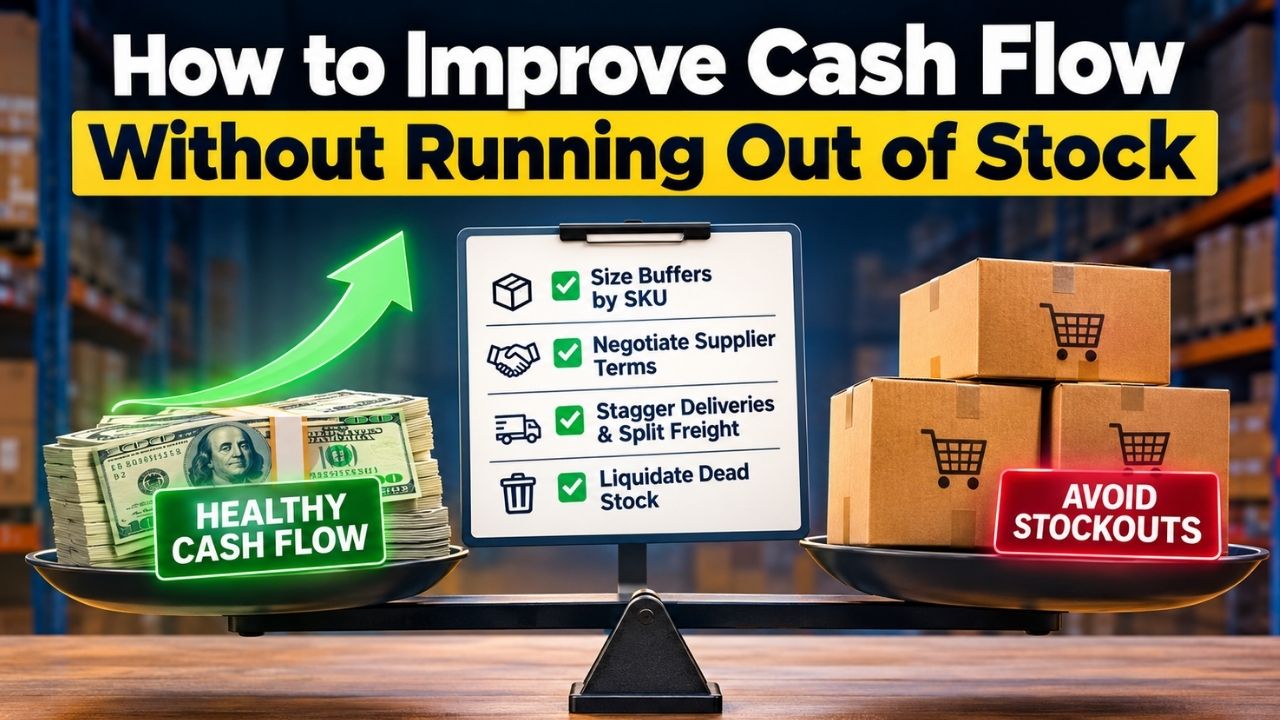
Every unit on your shelf is a dollar you already spent and cannot spend again until someone buys it. Which is how a business with healthy margins and a full warehouse misses payroll.
Good inventory positions are intentionally uneven. Deep on a handful of items, thin across most of the rest, with the split determined by the saleability of each item.
This article covers how to measure what stock is costing you, how to size buffers so the protection lands on the right SKUs, how supplier terms and freight choices move cash, and what to do about the pallets everyone avoids.
Measure Cash Days and Dollars Held per SKU
Picture this. A candle brand reports four turns across the catalog and feels fine about it.
Underneath that number, two scents are turning eleven times a year, and thirty-one others are sitting at 0.6. Roughly 70 percent of the company’s working capital is in a product that moves once every twenty months.
Two numbers per SKU are worth more than any catalog-wide metric:
- Days of cash: The gap between paying the supplier and collecting from the customer. In ecommerce, receivables land instantly, so it works out to inventory days minus payables days. A result of 90 means the business is self-funding three months of operations on every unit.
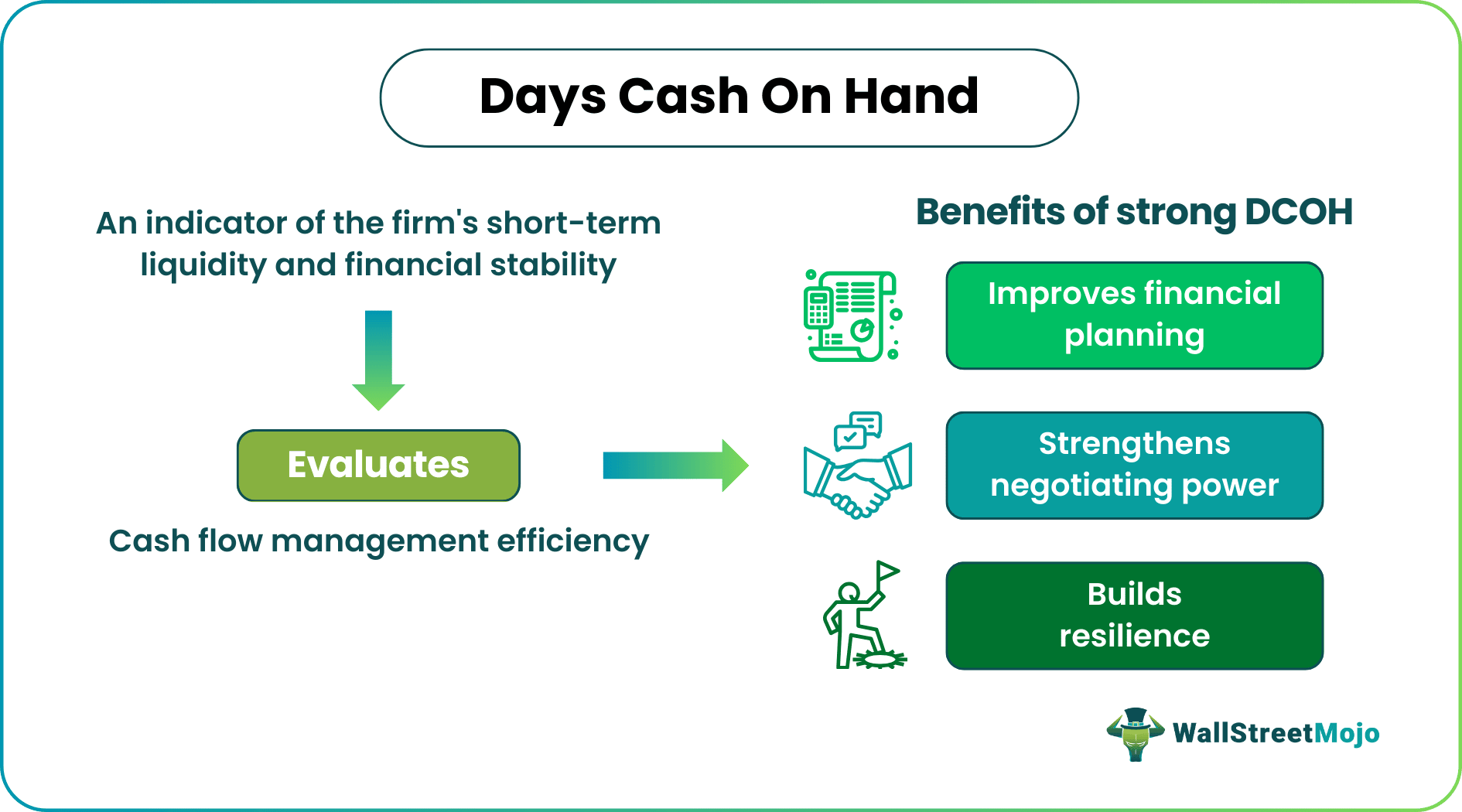
- Dollars held, at cost: Unit counts do not move anyone. A purchase plan gets rewritten the moment somebody says the grey colorway is holding $84,000 until March.
Run both and the two lists that come back are rarely the same. The SKUs producing margin and the SKUs consuming cash usually overlap less, so this decision is always quite so difficult.
Rebuild Your Safety Stock Rules SKU by SKU
Most operators pick one safety stock rule, usually a month of cover or 20 percent on top of forecast, and apply it to everything they sell. That rule overprotects the steady items and underprotects the volatile ones simultaneously.
To avoid this, follow these three simple rules.
Match the buffer to how erratic the item is
Take a pet supplements seller with two flagship products:
- The joint chew sells three a day, every day, for two years running.
- The calming chew sells nothing for a week and then eighty in an afternoon whenever a creator mentions it.
Both carry the same one-month buffer. The joint chew ends the year with about $30,000 in permanently idle stock. The calming chew stocks out five times.
Twelve months of daily sales and a standard deviation per SKU is enough to size buffers against actual volatility instead of a flat percentage.
Use the lead time you get, not the one you were quoted
Here is how the gap shows up. The factory says 45 days. The last eight purchase orders averaged 58, and one landed at 71.
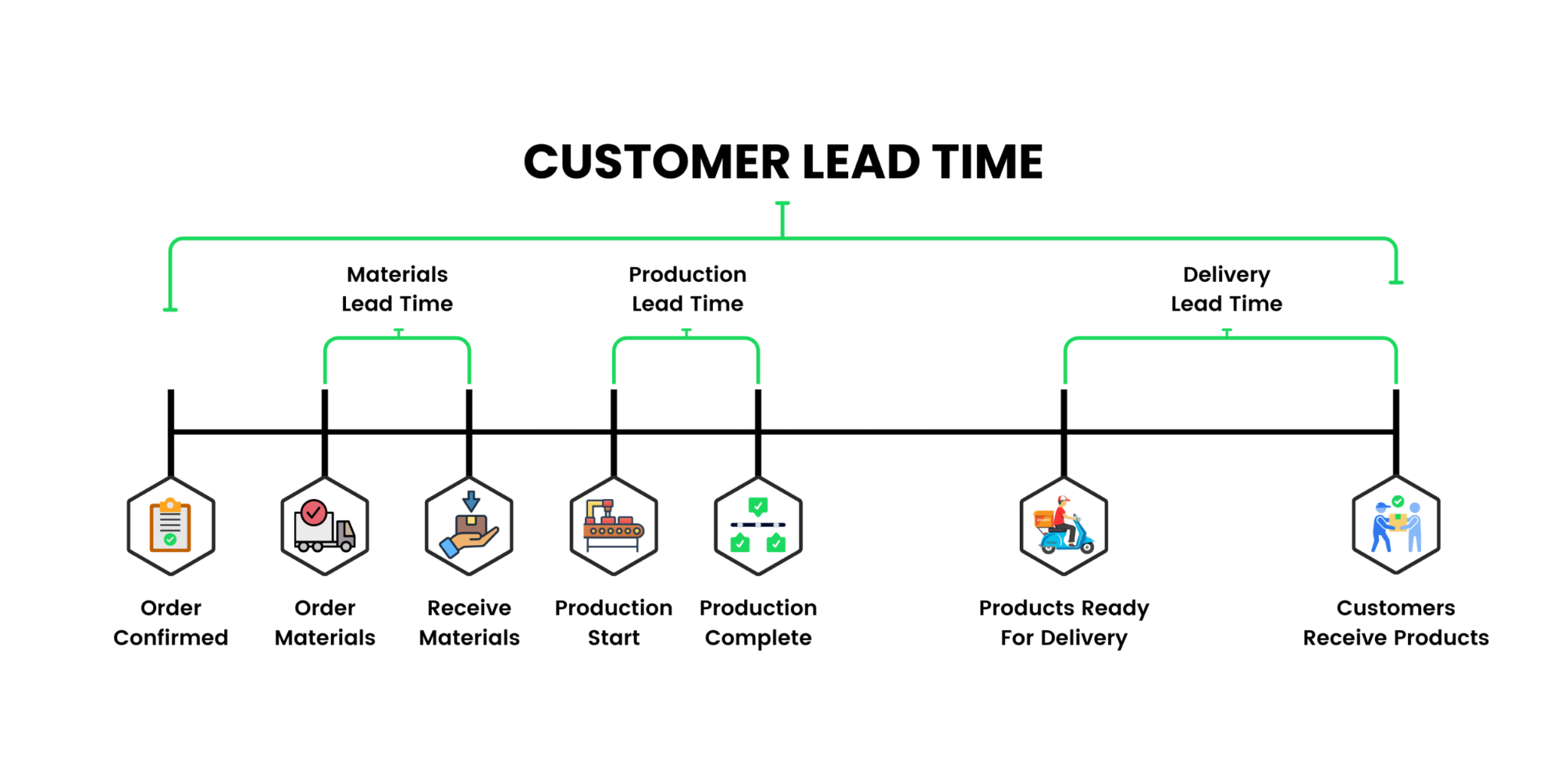
A reorder point built on the quoted number is a stockout with a date already attached to it.
Set service levels per SKU
Availability targets should differ by what the item is worth:
- Hero products: 98 to 99 percent. Going dark here is not recoverable.
- Mid-tier: 95 percent.
- Long tail and secondary colorways: 85 percent. Let them run out occasionally.
On a 300-SKU catalog, pulling the tail down from 99 to 85 percent typically releases a five-figure sum from the racking. The cost is a handful of orders on colors nobody was buying anyway.
Fulfillment with a Personal Touch.
See How Using a 3PL like eFulfillment Service sellers saves time. Get a Free Quote from eFulfillment Service Today!
Negotiate Supplier Terms Before Taking On Debt
Inventory financing and credit lines with covenants attached get considered before anyone calls the factory, which is backwards. Three things are usually available and rarely requested.
Push the payment terms
Net 30 moving to net 60 is thirty days of free working capital across the entire purchase volume, permanently, with no interest and no personal guarantee.
Suppliers say no the first time. They tend to say yes after four consecutive on-time payments and a conversation about next year’s volume. A brand that has paid reliably for a year and never asked is sitting on its largest untouched lever.
Move the deposit
The standard 30 percent down and 70 percent before shipment means the goods are fully paid for while they are still on a ship. Shifting the balance to arrival, or net 15 after arrival, buys back five or six weeks of cash and changes nothing about daily operations.
Do the MOQ math before agreeing to it
Picture the offer on the table. A factory quotes $3.60 a unit at 5,000 pieces, down from $4.00 at 1,200. The brand sells 400 a month.
- Saving: $2,000
- Additional cash locked: $13,200
- Time to sell through: twelve months
Doesn’t seem like a smart financial move anymore, does it? Supplier wants to push this math on you, to help their own business, for reasons listed below. Do your own math before you commit to anything.
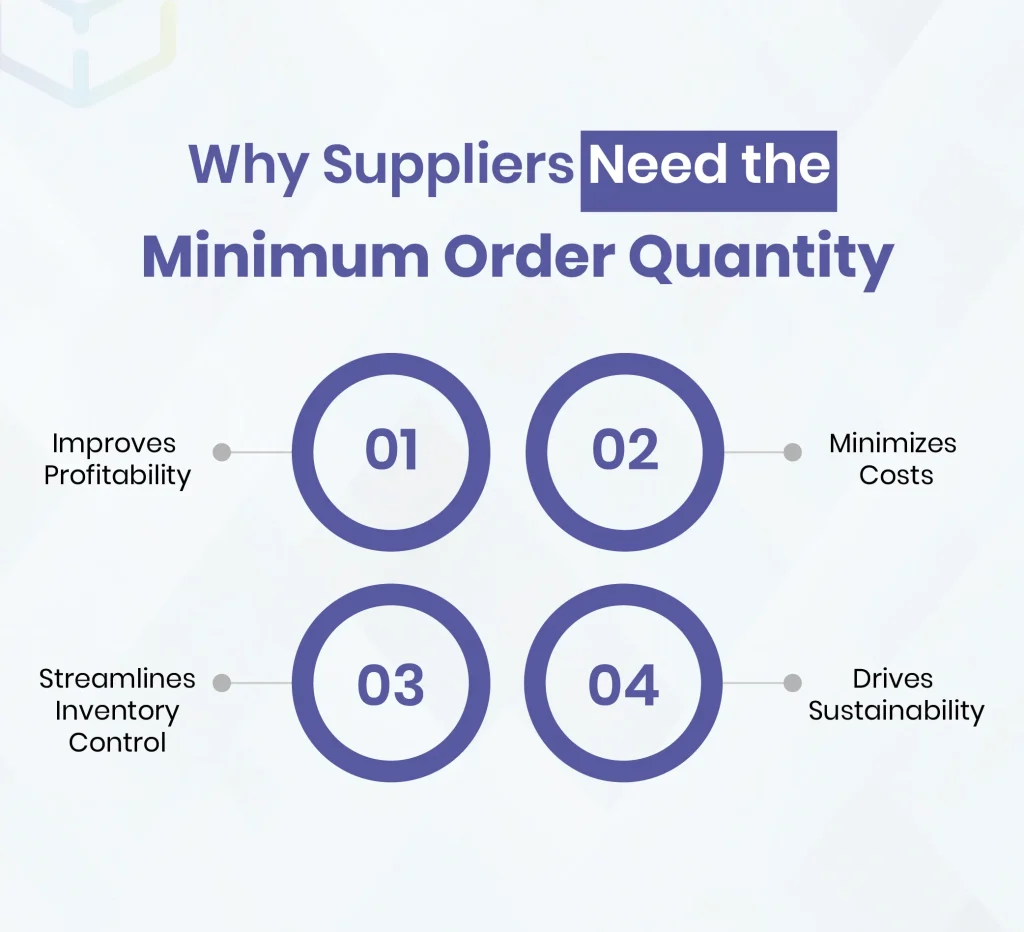
Nobody signs off on lending themselves $13,200 for a year to save two thousand. Plenty of people sign off on a 10 percent reduction in unit cost, which is the same decision as wearing better clothes.
Stagger Your Deliveries and Split Your Freight
Say you need 3,000 units. Instead of taking all 3,000 in one shipment, ask the factory to send 1,000 now, 1,000 in six weeks, and the last 1,000 six weeks after that. You pay for and store a third at a time.
The factory keeps the rest. If sales come in slower than expected, you are sitting on 1,000 units instead of 3,000.
Most suppliers agree to this without raising the price. They still make all 3,000 in one run. Only the shipping schedule changes.
The trades solved this long before ecommerce got to it. A crew handling bathroom remodeling in Tampa does not keep vanities and tile sitting in a warehouse hoping someone books a job. Materials get ordered against a signed contract with a delivery date on it, so the money goes out at roughly the same time it comes in. Most product businesses cannot get all the way there, but every delivery you push back moves you closer to it.
Freight carries the same tradeoff.
Sea is cheap per unit and expensive in cash terms, since the money sits on the water for six weeks. Consider a homewares seller that split its top ten SKUs across both modes, sending the bulk by container and 300 units of each by air. The extra cost ran about $4,000 a cycle, and the eighteen-day dark window on its best listing disappeared. That window had been costing considerably more than four thousand.
Liquidate Dead Stock on a Fixed Schedule
Greg McRoberts, Founder and CMO at Verde Fulfillment USA, has spent years storing other people’s inventory and watching which of it moves and which of it does not.
He says, “We can usually tell inside one quarter which pallets are never leaving the building. The brand cannot, or will not, because there is a purchase price attached to that inventory and writing it down feels like admitting a mistake. So it sits, and they pay storage on it, and the storage is honestly the smallest part of what it costs them.
The real cost shows up six months later when their bestseller sells out, and the money that would have covered the reorder is on a rack in the back of our facility.
Liquidating at thirty cents on the dollar hurts for a day, but being out of stock on the product that actually works hurts for a quarter. And by then the decision has already been made for you.”
Setting the rule in advance takes the courage out of it. Anything above nine months of cover goes to markdown, bundle, or liquidation on a fixed schedule, no meeting required.
Forecast the top 20 items by hand with the promotional calendar and seasonality in front of you. Everything else runs on trailing velocity with a quarterly review. Equal effort spread across 400 SKUs produces 400 mediocre forecasts.
One calendar trap catches brands every year. Factory shutdowns around Chinese New Year and Golden Week, plus the freight crunch that starts in August, mean Q4 orders have to be placed a full cycle earlier than spring ones. Ordering on the same rhythm all year is how a brand discovers in November that its October container is stuck in a port queue.
Review Five Inventory Numbers Every Week
You don’t need to overhaul everything at once. Focus on one aspect weekly, like:
- Days of cover at trailing 30-day velocity
- Dollars currently held
- Sell-through against the last order quantity
- Auto-flag at anything above 180 days of cover
- Auto-flag, louder, at anything below its reorder point
Watching these numbers closely also depends on a fulfillment partner that reports at the SKU level and does not tie you to storage you no longer want.
eFulfillment Service works with ecommerce brands on exactly that footing, with no long-term contracts and no order minimums, which keeps the inventory decisions where they belong.

About the Author
Jesse Galanis is a professional writer who decomposes complex concepts of business information and working online. He provides quality content that assists people in everyday life.



0 Comments