Book fulfillment costs break down into a handful of predictable line items, but almost no one sees all of them quoted in the same place before they sign anything. Storage gets mentioned. Pick and pack gets mentioned. Receiving tends to show up later, and so does the minimum monthly fee some providers bolt on regardless of volume, after the relationship has already started.
This guide covers that gap between what gets quoted and what gets billed, walking through what self-fulfillment, Amazon FBA, print-on-demand, and a third-party logistics (3PL) partner each cost for books specifically, with per-unit and per-order figures wherever a clean number exists (receiving is the one line item that resists a simple figure, since it’s usually billed by the hour or the carton and varies by how a shipment arrives). It’s a companion piece to our complete guide to book fulfillment for publishers and authors, which covers the fulfillment landscape end to end; this piece narrows in on the money.
Already know you need a book-specialist 3PL?
eFulfillment Service has shipped millions of books for indie authors, small presses, and subscription boxes with ISBN-level inventory tracking, Media Mail routing, and street date enforcement built in.
What typically shows up on a fulfillment invoice

Whether the fulfillment is happening at home or through Amazon or a 3PL, the same handful of cost categories apply. What changes is who’s charging for them and how much.
- Receiving: getting new stock checked in and shelved, typically billed by the hour or the unit
- Storage: rent for the space books sit in while waiting to sell, usually billed per cubic foot or per shelf/pallet position per month
- Pick fee: the labor to pull the right title off the shelf for an order, often priced per item with the first item in an order costing more than each additional one
- Pack and materials: a per-order charge that may or may not include the mailer and other packing materials
- Outbound shipping: passed through at whatever carrier rate applies, which for books usually means comparing USPS Media Mail against faster classes
- Returns processing: inspecting whatever comes back, then restocking or disposing of it
- Account or minimum fee: some providers charge a flat monthly minimum regardless of how many orders shipped
Every option below has a version of these line items. The differences are in who’s doing the work and which fees only appear after volume crosses a threshold nobody mentioned up front. Our general guide to 3PL cost and fee structures goes deeper on how to read a quote, for sellers outside books too.
What self-fulfillment really costs
DIY fulfillment looks free because there’s no invoice. There’s still a cost. It’s just distributed across time and mistakes instead of itemized on a bill.
An author packing 30 orders a week at ten minutes each is spending five hours a week on labor that doesn’t move the next manuscript forward. Time is the biggest hidden line item, and multiplying those hours by an hourly rate, even a conservative one, turns into money that never shows up as an expense but is spent all the same.
USPS Media Mail currently runs $4.13 for a package up to one pound at the retail counter, and that’s the cheap shipping option. Retail shipping rates cost more than negotiated ones: a 3PL or a platform like Amazon buys postage at volume discounts most individual sellers can’t access on their own, so paying retail rates one label at a time adds up across hundreds of orders a year.

Mistakes get expensive at volume, and the numbers make the case why. There’s no book-specific mispick-rate study to point to, but our apparel fulfillment guide shows that manual pick-and-pack, without barcode scan-verify, at roughly a 2% error rate. Push a DIY setup well past the volume where it still makes sense (say, 500 orders a month, ten times the rough threshold below) and that 2% rate works out to about 10 mispicks, each running roughly $28 in direct waste: the outbound shipping already spent, plus the return label and reship it takes to fix it. Restocking time and customer-service handling aren’t part of that per-mistake figure, and once they’re added in, the same source puts the fully loaded monthly cost north of $400, climbing fastest during a launch-week rush when every order still gets packed by hand.
Padded mailers, tape, and void fill all cost money too, at retail prices unless bought in bulk — which requires storage space most home-based sellers don’t have. Printed inserts for signed or special editions add another line to that bill.
None of this means DIY is the wrong choice below a certain volume. An author shipping under 50 orders a month can usually absorb the time cost, and the mistake rate stays low enough not to matter — a different story from the 500-order example above, which is closer to what happens after a DIY setup has been stretched well past that point. Nobody knows the exact order count where the math flips for every author, since it depends on an author’s own hourly rate and what unwinding a mispick costs, so treat 50 orders as a rough marker rather than a hard line.
Save Time and Let us Handle Your Book Fulfillment!
See How Using a 3PL for saves Amazon sellers time. Get a Free Quote from eFulfillment Service Today!
What Amazon FBA costs for books specifically
FBA has its own fee structure, and it’s worth understanding on its own terms since a lot of authors start there by default.
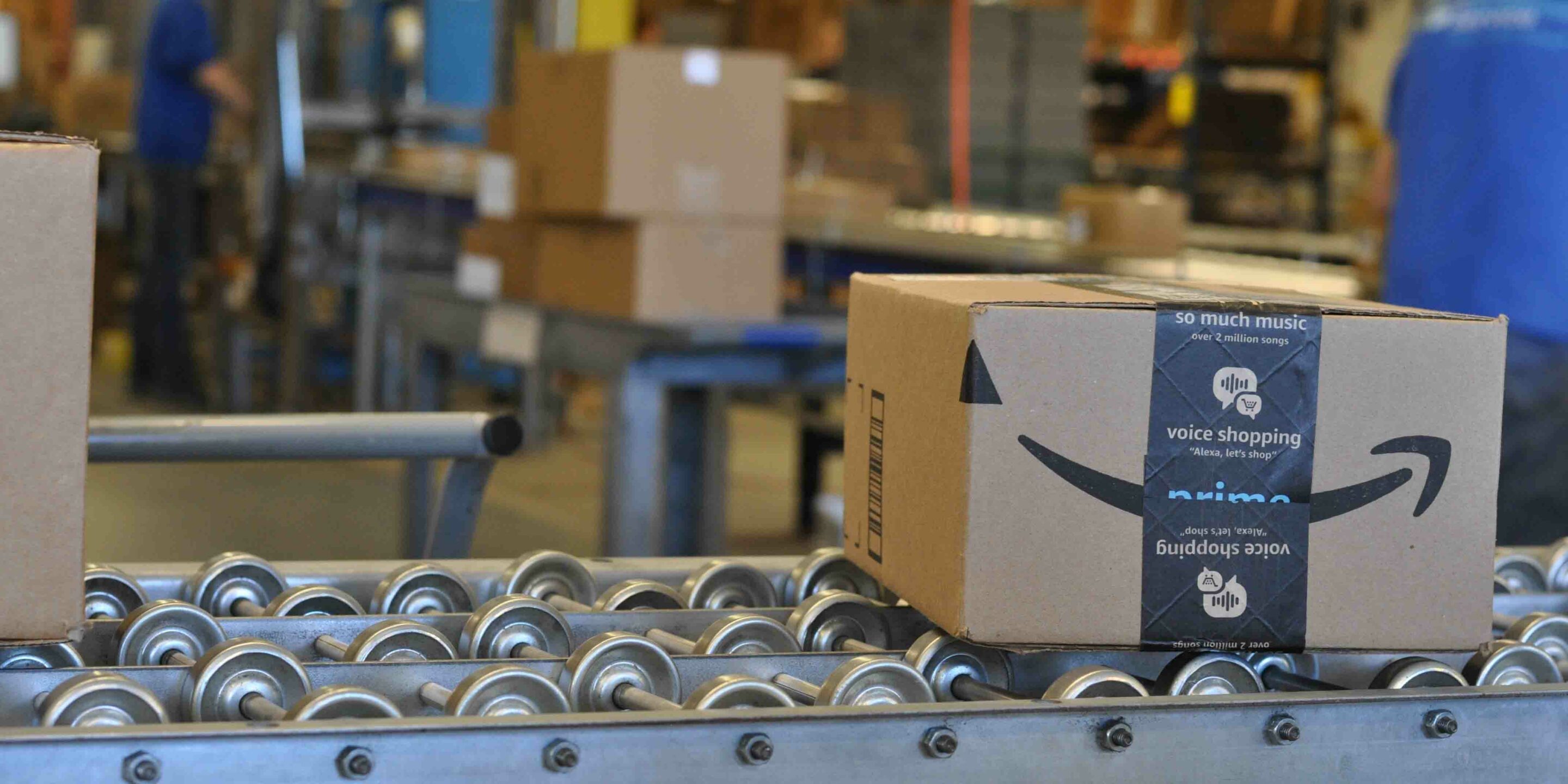
- Referral fee. Amazon takes 15% of the sale price on books, the standard media-category rate, whether Amazon fulfills the order or the seller does.
- Fulfillment fee. For a standard paperback, this typically runs $3.00 to $6.50 per unit, charged every time a copy ships, regardless of how long that copy sat in the warehouse first.
- Storage fee. Standard-size inventory runs about $0.78 per cubic foot from January through September, then jumps to roughly $2.40 per cubic foot from October through December, a seasonal spike that catches sellers who don’t plan their inventory levels around it.
- Long-term storage surcharge. Inventory sitting past 365 days gets hit with a surcharge of roughly $6.90 per cubic foot or $0.15 per unit, whichever is higher. A backlist title selling a couple of copies a month fits the profile this fee targets.
Shipping special editions without the Media Mail guesswork
If your book releases regularly include bonus items, kitting them correctly and mailing them compliantly is exactly the kind of detail eFulfillment Service handles for author and publisher clients every day.
What a 3PL charges for books

A 3PL’s rate card looks similar to FBA’s on paper, but the numbers land differently because pricing isn’t structured around punishing slow-moving inventory. The ranges below reflect typical rates across the 3PL market broadly, not EFS’s own pricing — we don’t publish our rates publicly, though our clients typically pay less than these figures.
| Cost category | Typical range* | Notes |
|---|---|---|
| Storage | ~0.45–0.75* per cubic foot/month | No seasonal spike, no long-term storage penalty at most 3PLs |
| Pick and pack | ~2.50–4.50* per order (standard single-item) | Additional items in the same order usually cost less than the first |
| Returns | 2–6* per returned item | Plus separate restock or disposal fees if the item can’t go back on the shelf |
| Monthly minimum | 1,000–5,000* at many 3PLs | Charged regardless of order volume — worth confirming before signing |
*Figures reflect general 3PL industry pricing, not EFS rates. We don’t publish our rates publicly, but they typically run lower than these ranges.
The minimum-fee row matters more than it looks. Plenty of 3PLs quote attractive per-order rates, then attach a flat monthly floor that a low-volume author or small press ends up paying even in a slow month. A no-minimum provider isn’t automatically the cheapest one either, so the full rate card deserves a look before deciding, not just that single line.
Efficiency Tip: Partnering with an 3PL can free up your time to focus on what you do best, sell great products!
Get a Free Quote from eFulfillment Service and see how we can simplify your selling!
For books specifically, shipping is where a book-savvy 3PL earns its markup back. Media Mail only applies to disqualifying-content-free packages, and a partner who applies that eligibility check automatically avoids the postage penalties that come from misclassifying a mixed-content special edition.
The mispick math from the DIY section cuts the other way too: well-run 3PLs using barcode scan-verify on every pick keep error rates below 0.1%, against the roughly 2% manual-packing rate cited earlier. At volume, that gap is most of what a 3PL’s pick fee is paying for.
What print-on-demand costs instead of storage
Print-on-demand (POD) trades a storage bill for a permanently higher per-unit print cost. Warehouse rent disappears because there’s no inventory sitting anywhere; each copy gets printed only after it sells.

The tradeoff shows up on the manufacturing side instead. A POD-printed paperback typically costs more per copy to produce than the same title run through an offset print job at volume, because offset pricing improves with print-run size and POD by definition never gets that economy of scale. For a title selling steadily at meaningful volume, that per-unit gap compounds fast enough that traditional printing plus paid storage often wins on margin, even after the storage bill. Where exactly that crossover sits moves with print-run size, trim size, and page count, so it’s worth pricing offset-plus-storage against POD for a specific title rather than trusting guesswork.
POD wins outright at very low or unpredictable volume: a debut title with no sales history, a backlist title selling a handful of copies a month, or a catalog too small to justify tying up cash in a print run. There’s no storage fee, no long-term storage penalty, and no unsold inventory to write off in that scenario.

A few costs get discovered after the contract is signed.
- Kitting fees for special editions. A signed copy bundled with an enamel pin, a printed art card, or bonus content isn’t a single-SKU pick anymore. It’s an assembly step, and most 3PLs charge for it separately from a standard pick fee.
- Amazon’s long-term storage penalty, covered above, is easy to forget about until the twelve-month mark arrives and the surcharge hits.
- Dimensional-weight surcharges on shipping quotes that only account for weight create a common gap between a quoted rate and the rate that appears on the invoice, since box size factors into the carrier’s charge too.
- Kickstarter and crowdfunding spikes run on entirely different unit economics than steady-state selling. A campaign shipping thousands of reward packages in a single window needs its own cost model, not the monthly-average math this guide covers.
Asking any provider for a fully loaded sample invoice before signing, beyond the quoted rate card, is the single best way to catch these before they become a surprise.
Cost comparison by order volume
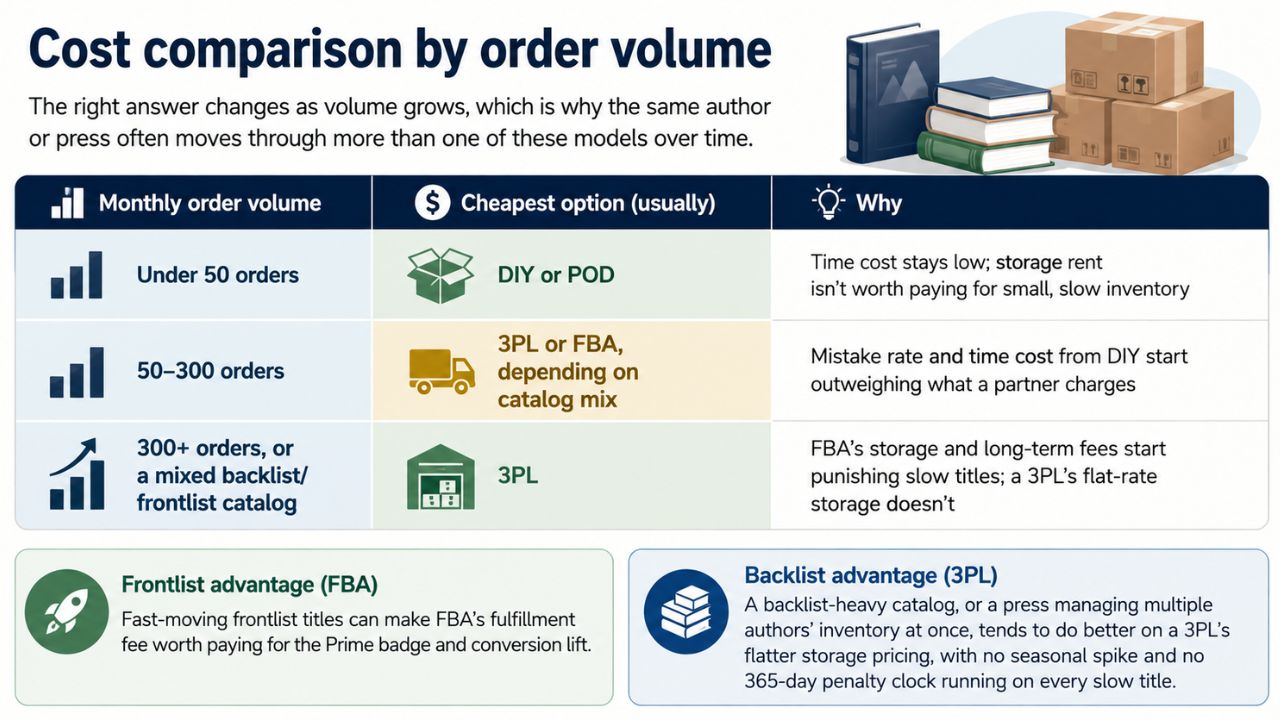
The right answer changes as volume grows, which is why the same author or press often moves through more than one of these models over time.
|
Monthly order volume |
Cheapest option (usually) |
Why |
|
Under 50 orders |
DIY or POD |
Time cost stays low; storage rent isn’t worth paying for small, slow inventory |
|
50–300 orders |
3PL or FBA, depending on catalog mix |
Mistake rate and time cost from DIY start outweighing what a partner charges |
|
300+ orders, or a mixed backlist/frontlist catalog |
3PL |
FBA’s storage and long-term fees start punishing slow titles; a 3PL’s flat-rate storage doesn’t |
Fast-moving frontlist titles can make FBA’s fulfillment fee worth paying for the Prime badge and conversion lift. A backlist-heavy catalog, or a press managing multiple authors’ inventory at once, tends to do better on a 3PL’s flatter storage pricing, with no seasonal spike and no 365-day penalty clock running on every slow title.
When each option makes financial sense

- Choose DIY if the catalog is small, orders are infrequent, and the time cost of packing is still cheaper than any provider’s per-order fee.
- Choose POD if sales are unpredictable or volume is too low to justify a print run and the storage rent that comes with it.
- Choose FBA if the catalog is frontlist-heavy, sells fast enough that inventory turns before storage fees compound, and the Prime badge measurably lifts conversion.
- Choose a 3PL if the catalog includes backlist titles, orders have crossed the point where mistakes and time cost are eating into margin, or a mixed-content special edition needs Media Mail eligibility handled correctly every time.
None of these are permanent choices. Plenty of authors run POD for a debut title, move fast-sellers into FBA, and shift a growing backlist to a 3PL once it’s large enough to justify flat-rate storage.
FAQs: FBA vs. FBA for Book Fulfillment
What does it typically cost to fulfill one book order?
For a standard single-item order through a 3PL, expect roughly $2.50 to $4.50 in pick-and-pack labor plus postage, on top of whatever storage rent the inventory accrues that month. FBA's per-unit fulfillment fee runs a comparable $3.00 to $6.50, plus the 15% referral fee that applies either way.
Is Amazon FBA cheaper than a 3PL for books?
It depends heavily on how fast the catalog turns over, and it's hard to say in general terms which one wins without knowing the catalog mix. Fast-selling frontlist titles often do fine on FBA's fee structure. Backlist-heavy catalogs tend to do better on a 3PL's flat storage rate, since FBA's long-term storage surcharge specifically targets inventory that sits past 365 days.
Does print-on-demand eliminate fulfillment costs entirely?
No. It trades a storage bill for a higher per-unit print cost. POD makes sense at low or unpredictable volume; it stops making financial sense once a title sells consistently enough that offset printing plus storage would cost less per copy.
What hidden fees should I ask about before signing with a 3PL?
Ask specifically about monthly minimums, kitting fees for bundled or signed editions, and dimensional-weight shipping surcharges. Requesting a fully loaded sample invoice beyond the rate card surfaces most of these before they show up on the bill.
Does fulfilling a Kickstarter or crowdfunding campaign cost the same as ongoing sales?
No. A campaign shipping a large volume of reward packages in a short window runs on different unit economics than steady monthly sales, and needs its own cost planning rather than the per-order averages in this guide.
Do signed copies or special editions cost more to fulfill?
Usually, yes. Bundling a book with merchandise turns a single-SKU pick into an assembly step, which most providers price as a separate kitting fee. If the bundle includes non-book items, it can also disqualify the package from Media Mail shipping rates.
Key Takeaways
- The same cost categories apply everywhere. Receiving, storage, pick and pack, shipping, and returns processing show up whether fulfillment happens at a kitchen table, inside Amazon, or through a 3PL. The differences are in who charges what.
- DIY’s cost is time and mistakes, not materials. A 2% mispick rate at 500 orders a month runs a fully loaded $400+ a month once restocking and customer service are counted; that number only grows with volume.
- FBA punishes slow-moving inventory specifically. The 365-day long-term storage surcharge and seasonal storage spike make FBA better suited to fast-turning frontlist titles than backlist catalogs.
- 3PL minimums can erase an attractive per-order rate. Some providers charge $1,000 to $5,000 a month regardless of volume; confirm this before comparing rate cards.
- POD trades storage cost for per-unit cost. It wins at low or unpredictable volume and loses once a title sells enough to make offset printing plus storage cheaper per copy.
- The right option changes with volume and catalog mix. Most authors and presses move through more than one model as their backlist and order volume grow.


0 Comments