

Apparel return rates run 20 to 40 percent of shipped volume, closer to the 40 percent end for most brands, against roughly 19.3 percent for ecommerce overall. Packaging plays a role in that gap. A customer who pulls a wrinkled shirt out of an overstuffed poly mailer starts out distrusting the fit before they’ve tried it on. Tissue paper and a garment folded flat and sized correctly buy some benefit of the doubt on a fit that runs slightly off.
Packaging is not a luxury add-on for apparel brands the way it can be for other categories. Folding standard and tissue choice shape how a garment reads to the person unwrapping it, before a single stitch gets inspected. Box structure matters too, particularly for anything structured or delicate. Get the presentation wrong at volume and it shows up downstream as returns, one-star reviews complaining the product looked cheaper than the photos suggested, and declining repeat-purchase rates.
This guide covers what actually drives apparel unboxing quality: folding standards that survive shipping, packaging materials suited to garments specifically, the size-and-color insert problem unique to apparel, and how to keep that experience intact once volume outgrows what a founder can pack by hand.
Why apparel unboxing carries more weight than other categories
Packing quality shows on a folded shirt in a way it never does on a supplement bottle, which looks the same whether a founder or a warehouse temp packed it. A wrinkled shirt is visible the moment the box opens, and so is a stretched neckline from careless folding, or an embellishment crushed in transit. Any one of these reads as a quality problem even when the garment itself is fine.

Fashion and apparel brands also compete on a dimension most categories don’t: the unboxing moment is part of the product experience people photograph and post. A brand that treats the box as an afterthought is leaving free marketing on the table, and one that gets it right converts a delivery into content.
Apparel presentation carries more risk than in most other verticals:
- Fit anxiety starts before the garment is touched. A sloppy first impression primes the customer to expect a bad fit, which raises the odds they return a garment that would have fit fine.
- Size and color variants multiply the chance of a visible error. A folded box with the wrong size tag showing, or a mismatched color liner, reads as carelessness even when it’s a one-off mistake.
- Social sharing rewards apparel specifically. Clothing and accessories are among the most-photographed unboxing categories, because the product itself is visual and wearable. Shoppers generally are primed for this: an estimated 40 percent of shoppers share a memorable unboxing moment on social media when the packaging earns it, and a garment is well-positioned to earn it.
Folding standards for Apparel Brands
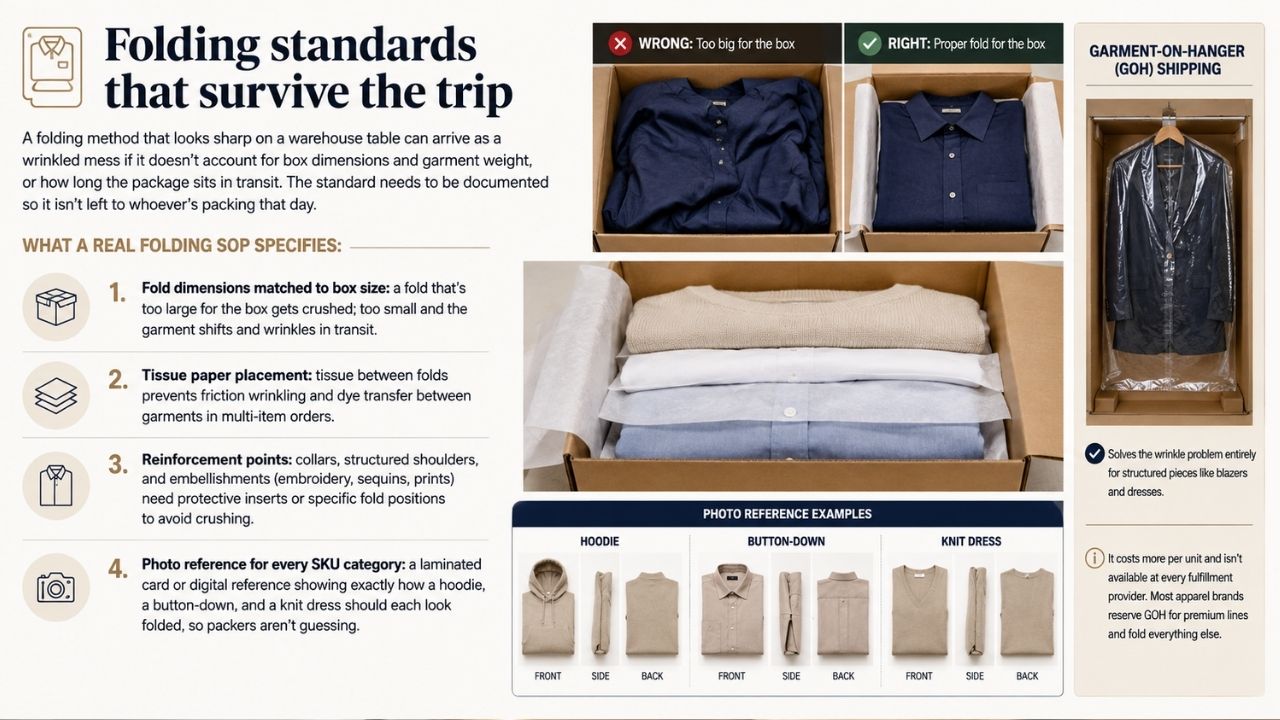
A folding method that looks sharp on a warehouse table can arrive as a wrinkled mess if it doesn’t account for box dimensions and garment weight, or how long the package sits in transit. The standard needs to be documented so it isn’t left to whoever’s packing that day.
What a real folding SOP specifies:
- Fold dimensions matched to box size: a fold that’s too large for the box gets crushed; too small and the garment shifts and wrinkles in transit.
- Tissue paper placement: tissue between folds prevents friction wrinkling and dye transfer between garments in multi-item orders.
- Reinforcement points: collars, structured shoulders, and embellishments (embroidery, sequins, prints) need protective inserts or specific fold positions to avoid crushing.
- Photo reference for every SKU category: a laminated card or digital reference showing exactly how a hoodie, a button-down, and a knit dress should each look folded, so packers aren’t guessing.
Garment-on-hanger (GOH) shipping solves the wrinkle problem entirely for structured pieces like blazers and dresses, but it costs more per unit and isn’t available at every fulfillment provider. Most apparel brands reserve GOH for premium lines and fold everything else.
Presentation problems compound at volume
If folding, tissue, and inserts are already slipping as order volume climbs, that’s usually a sign the packaging standard was never written down. eFulfillment Service builds apparel packaging to a documented, photo-referenced SOP, not a generic poly mailer.
Packaging materials that hold up in transit — and hold up on camera

Generic poly mailers are the default for a reason: they’re cheap and lightweight. But they crush structured items, and they photograph badly if unboxing content is part of the brand’s marketing: packaging demands differ enough between apparel, footwear, and other categories that a one-size-fits-all mailer strategy usually shows the seams.
| Material | Best for | Tradeoff |
|---|---|---|
| Poly mailer | Basic tees, soft goods, budget-conscious brands | Crushes structured pieces, minimal unboxing impact |
| Rigid mailer box | Mixed orders, brands prioritizing presentation | Higher cost per unit, heavier to ship |
| Branded tissue + sticker seal | Any tier as an upgrade layer | Low cost, high visual impact, easy to add without changing the outer box |
| Garment bag inside box | Structured or delicate pieces | Adds packing time and material cost |
The upgrade that delivers the most visual impact for the least cost is usually the cheapest one: branded tissue paper with a sticker seal, inside whatever outer packaging the brand already uses. It photographs well and it’s inexpensive per unit. It also doesn’t require renegotiating box specs with a supplier.
A mispick caught at unboxing beats a mispick caught after wear
Size-confirmation inserts help, but they’re a patch on a picking process without barcode-level verification. eFulfillment Service scan-verifies style, size, and color on every pick before it ships.
The size-and-color insert problem
This is the piece of apparel unboxing that other categories don’t deal with. A branded insert card that says “thank you for your order” is generic. One that also confirms the size and color the customer ordered does double duty: it reinforces the brand and gives the customer an immediate, visible check that they got what they paid for.
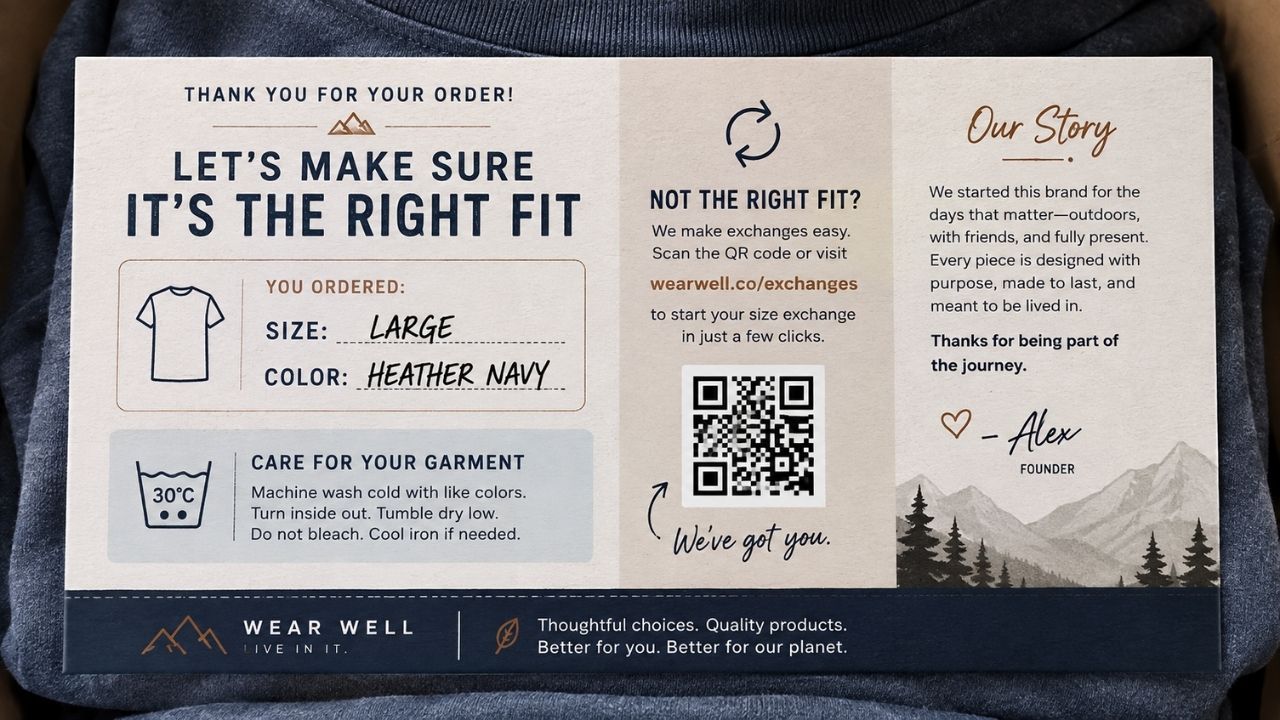
That matters because apparel mispicks are usually invisible until the box is open: a shirt looks identical to another shirt in a different size from across a warehouse aisle. A size-confirmation insert, or a hang tag positioned so the size is the first thing visible, catches the error at the moment it’s cheapest to fix, while it’s still just an immediate exchange request, instead of after the customer has already tried it on and formed an opinion about the fit being wrong.
A well-designed apparel insert card typically includes:
- Size and color ordered, printed or handwritten, positioned to be seen first
- A short care instruction relevant to the specific fabric
- A QR code or short link to size-exchange instructions (cuts support tickets for the single most common apparel return reason)
- Brand story or founder note, kept short, since it’s a bonus rather than the card’s primary job
Building the SOP so it survives beyond the founder
A founder can hold folding standards in their head while they’re packing every order personally. There’s no published benchmark for exactly where that stops working, since it depends on order complexity and how many SKUs are in rotation, but for most apparel brands it falls somewhere between 100 and 500 orders a month, which is also right when the operational strain that pushes them toward a 3PL usually starts. See our complete guide to apparel fulfillment and choosing a 3PL for the full picture of that transition.
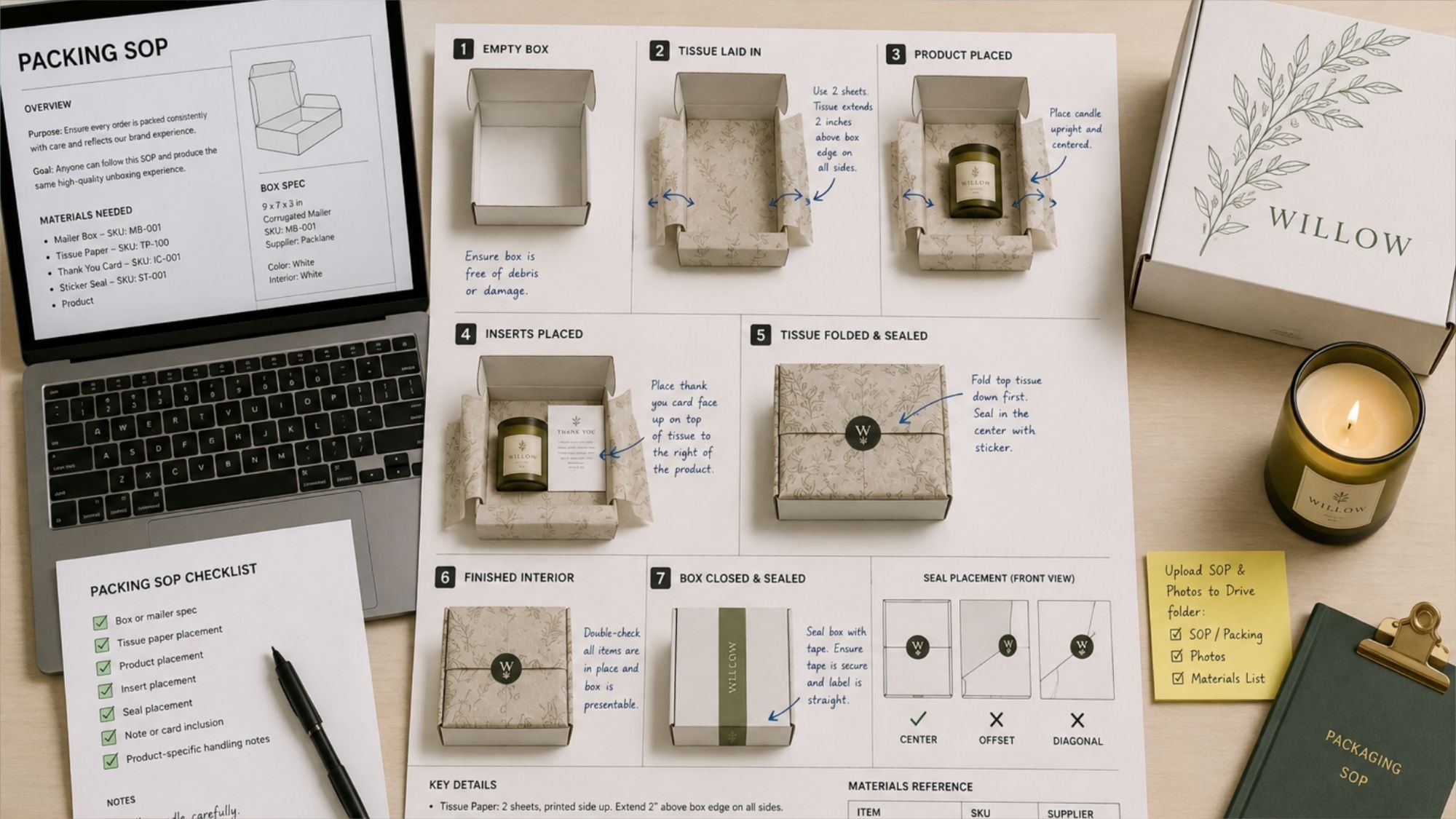
Write these down instead of trusting memory:
- Fold specification per garment category, with photos
- Tissue and insert placement, step by step
- Which SKUs get GOH treatment versus folded packing
- Box size selection rules by order composition (single item vs. multi-item, structured vs. soft goods)
- Quality check step before sealing: a 10-second visual check catches most presentation errors before they ship
A packaging SOP that lives only in a founder’s head can’t be handed to a second packer or a temp hire, let alone an outside 3PL. Writing it down is what makes the unboxing experience portable instead of fragile.
Handing this off to a 3PL without losing what makes it work
The most common fear apparel founders raise about outsourcing fulfillment is that a warehouse will flatten the brand experience into generic packaging. That fear is reasonable: it happens when a brand hands over a vague instruction like “please make it look nice” instead of a documented SOP.
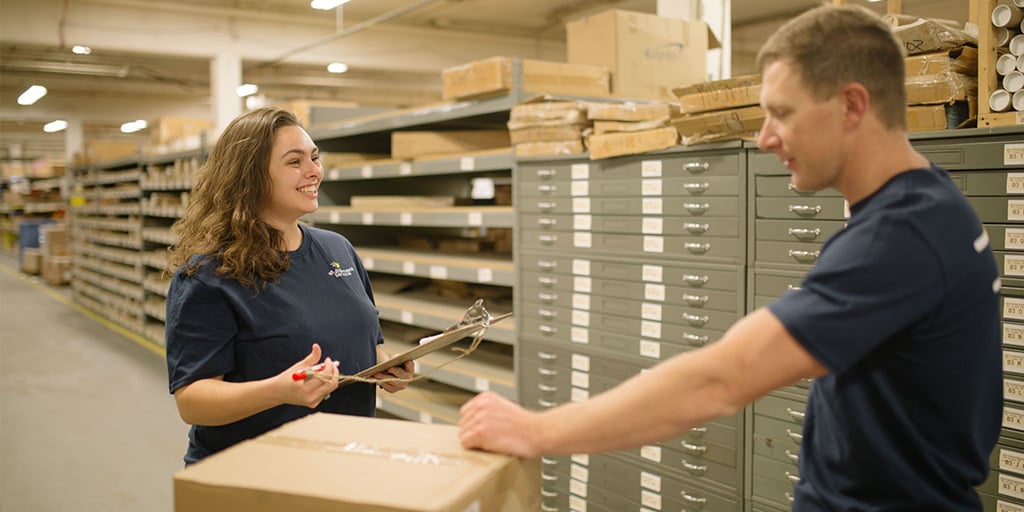
Bring these four things to a 3PL conversation:
- The written folding SOP, with photos, per garment category
- Sourcing specs for tissue, mailers, and inserts (or ask the 3PL to source to those specs)
- Insert card artwork and placement rules
- Sample packed orders the 3PL can use as a reference standard
A 3PL that can’t execute custom packaging to a documented standard, or that charges unpredictable per-order fees for anything beyond a plain poly mailer, isn’t a fit for an apparel fulfillment partnership where presentation is part of the product. Ask directly during evaluation: can they show a sample of custom-packed output before a contract is signed, and what does a folding or insert-placement error cost to correct if one slips through?
Frequently asked questions
On its own, no. A presentation that reinforces correct sizing at the moment of unboxing (through insert cards, hang tag placement, or fold quality that doesn't distort fit) removes one of the triggers that turns a borderline fit decision into a return. It won't fix a sizing chart that's wrong; for the operational side of cutting returns, see our guide to apparel returns management.
Custom mailers and printed inserts typically run somewhere between $0.50 and $3.00 per order depending on print runs and material choice, with branded tissue and stickers at the low end and rigid custom boxes at the high end. Order in bulk to bring the per-unit cost down as volume grows. See our cost breakdown for building a luxury unboxing experience on a startup budget for a tier-by-tier comparison.
Most 3PLs that work with apparel brands can execute a documented folding SOP, including tissue placement and insert cards. The requirement is a written, photo-referenced standard: a verbal preference doesn't transfer reliably to a warehouse team.
GOH keeps a garment on its hanger through the entire shipping process, which is the only way to guarantee zero fold wrinkles. It's worth the added per-unit cost on pieces where a wrinkle would visibly hurt the product, like blazers or structured dresses. For basics and knits, a good fold gets you most of the same result for less.
It's hard to say with precision, since packaging rarely gets tracked as its own return-reason category. Watch for return reasons that mention appearance or fit distrust rather than an objective sizing miss, and check whether unboxing photos of your product show up organically on social media. A near-total absence of user-generated unboxing content is a signal the packaging isn't earning attention.
Most brands scale the treatment: a baseline of tissue and an insert card on every order, with upgraded boxes or extras reserved for higher-ticket items or first-time customers. Applying luxury-tier packaging to every order regardless of price often doesn't pay back the added cost.
Key Takeaways
- A folding SOP needs to live on paper, outside any one packer’s head. Verbal preferences don’t transfer to a second hire, a temp, or a 3PL; a photo-referenced standard does.
- Size and color insert cards catch mispicks at the cheapest possible moment, before the customer has tried the garment on and formed an opinion about the fit.
- Branded tissue and a sticker seal deliver the best visual impact per dollar. It’s the cheapest upgrade in the packaging tier and doesn’t require renegotiating outer box specs.
- GOH shipping isn’t offered everywhere, so budget for both fold and hanger capacity. Reserve it for the structured pieces where wrinkling actually matters and fold the rest.
- The 100-to-500-order range is typically where hand-packing stops holding together, though the exact point varies by order complexity. A second packer or a 3PL usually enters the picture right around there, which is when a written SOP stops being optional.
- Evaluate any 3PL against a sample-packed order, since a stated capability alone proves nothing. A provider that can’t show a sample-packed garment to a documented standard before signing is one worth walking away from.


0 Comments