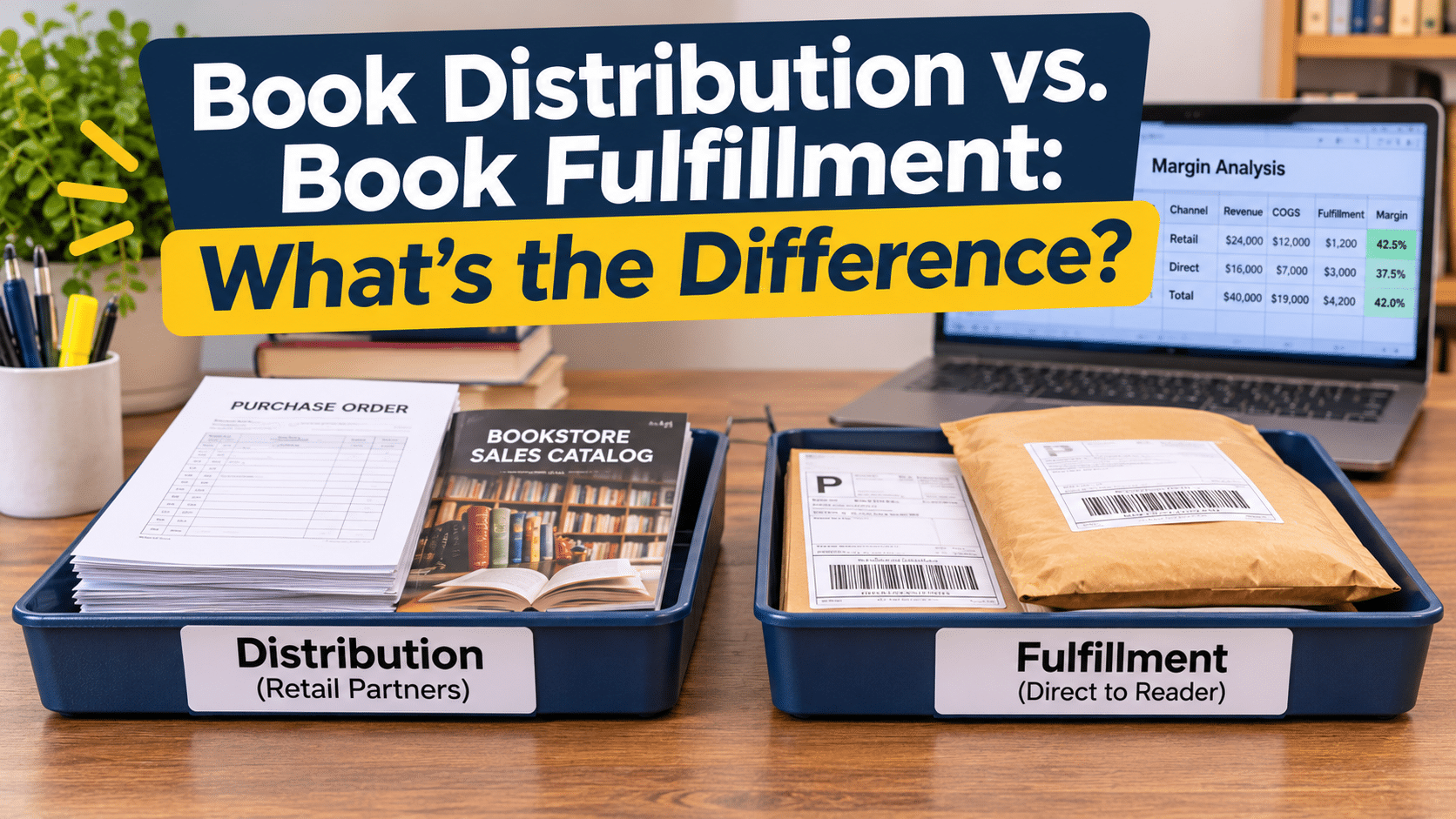
Book distribution and book fulfillment are often confused, especially among independent publishers trying to determine how to manage their inventory and reach customers. Although the two services share some responsibilities, they serve different purposes.
A book distributor helps publishers get their titles into bookstores, libraries, and other retail channels. In exchange, the distributor typically takes a percentage of the revenue from those sales. A fulfillment provider, on the other hand, stores your books and handles picking, packing, and shipping when orders come in. You pay for those services through storage and per-order fees rather than giving up a percentage of each sale.
Understanding the difference can have a meaningful impact on your publishing business. If you’re already generating sales through your website, Amazon, or your own wholesale relationships, you may need help getting books out the door rather than another company to sell them. For smaller presses, choosing the right arrangement can also help protect already-tight margins.
This guide explains what each service includes, how their pricing models compare, and how to decide which one makes sense for your press. For a closer look at the operational side, see our complete guide to book fulfillment for publishers and authors.
What book distribution actually does
Book distribution helps publishers reach bookstores, libraries, wholesalers, and other trade buyers they might not be able to reach on their own.
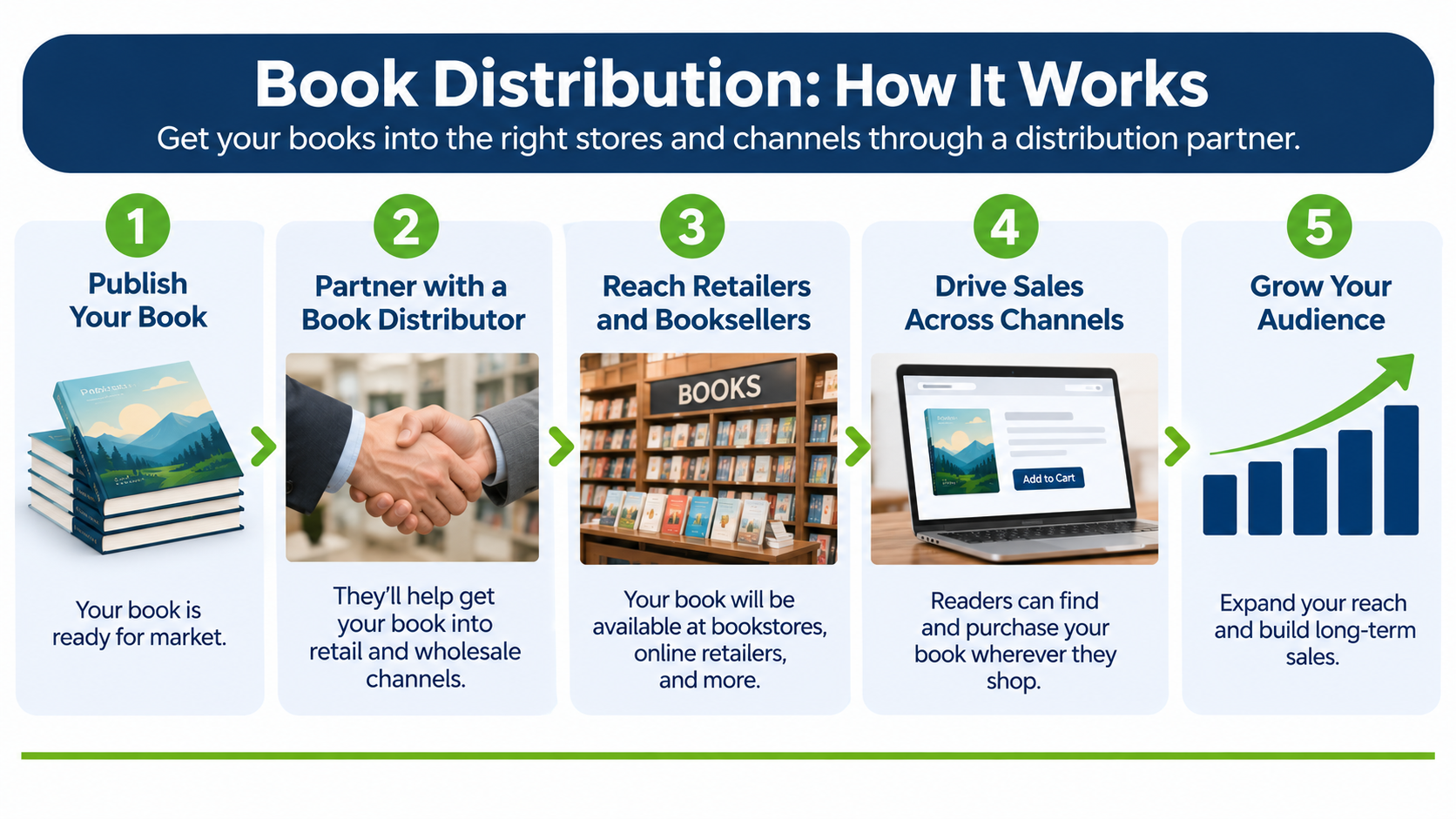
A full-service distributor typically has established relationships with these buyers and a sales team responsible for presenting new titles, maintaining catalog visibility, and generating wholesale orders. Distribution agreements often include several additional services:
- Trade sales representation. A sales force that pitches your frontlist to bookstore buyers, chains, wholesalers, and library suppliers.
- Catalog and metadata presence. Your titles are listed in the ordering systems retailers rely on, with accurate metadata feeding platforms such as Ingram, Baker & Taylor successors, and others.
- Warehousing and order processing. The distributor stores your inventory and fulfills the wholesale orders generated through its sales efforts.
- Invoicing and collections. The distributor bills retail accounts and manages payment collection under trade terms.
- Returns handling. Bookstores can return unsold inventory under standard trade arrangements. The distributor processes those returns and manages the associated inventory.
These services can be valuable for publishers looking to expand their retail presence. Rather than building a sales operation and establishing relationships with bookstore buyers from scratch, a publisher gains access to an existing network.
That access comes at a cost. Distributors typically take a percentage of net receipts, in addition to the wholesale discount retailers already expect. Distribution fees commonly run from about 10% to 30%, with smaller presses generally toward the higher end of that range.
Companies in this space include PSSC, Independent Publishers Group, and Penguin Random House Publisher Services. Small Press Distribution was one of the few distributors built specifically for small presses before it closed abruptly in 2024.
Ultimately, distribution is about more than storing and shipping books. You’re paying for a company to represent your catalog, build relationships with retail buyers, and help generate sales.
Keep more of what you earn from direct sales
When you manage your own sales channels, fulfillment lets you pay for the warehouse services you need without handing over a percentage of every sale. Our complete book fulfillment guide explains how the process works and what publishers should consider.
What book fulfillment actually does
Book fulfillment focuses on the physical side of getting books to customers. Instead of managing inventory and shipping orders in-house, publishers can work with a third-party logistics (3PL) partner to handle those responsibilities.
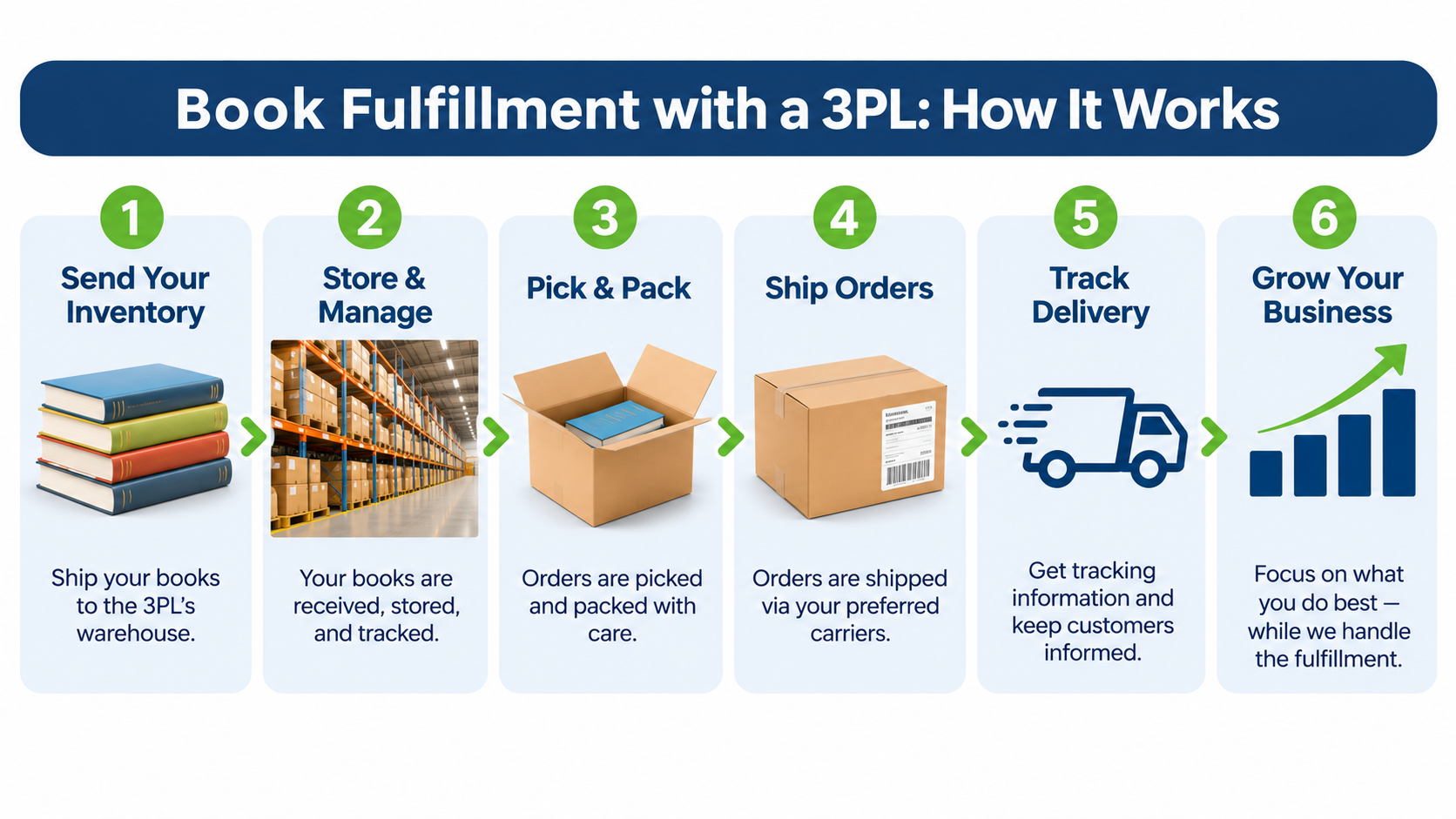
Once your inventory arrives at the fulfillment warehouse, the provider receives and organizes your books, tracks available quantities, and stores them until an order comes in. When someone purchases a book through your website, Amazon, or another sales channel, the 3PL picks the correct title, packages it, and ships it to the customer.
Typical book fulfillment services include:
- Storage. Your inventory is held in warehouse storage, with fees based on the space it occupies.
- Pick, pack, and ship. Each order is picked and packed when it comes in, regardless of which sales channel generated it.
- Carrier and rate management. Orders ship through appropriate services for books, including USPS Media Mail when eligible.
- Returns processing. Returned copies are received, inspected, and restocked when appropriate.
- Inventory visibility. You can monitor inventory counts and reconcile them against your own records.
The important distinction is that the orders come from you. They might originate through your website, Amazon seller account, direct wholesale relationships, a Kickstarter campaign, or event sales. The 3PL handles the physical work in the warehouse, but it doesn’t generate the sale or manage the relationship with the buyer.
Fulfillment pricing reflects that narrower scope. Rather than taking a percentage of what each book sells for, a 3PL typically charges itemized fees for storage, picking and packing, and shipping. That means the fulfillment provider earns the same handling fee whether your book sells for $14.99 or $34.99.
The real difference: who controls the sale?
The biggest difference between distribution and fulfillment comes down to who generates the sale and manages the relationship with the buyer.

With distribution, you’re relying on the distributor’s sales team and established retail relationships to help get your books into the marketplace. The distributor manages the trade accounts and handles much of the work involved in selling to bookstores and other wholesale buyers. In return, it earns a percentage of the revenue.
With fulfillment, those relationships remain yours. You decide where and how to sell your books, manage your own sales channels, and send orders to the fulfillment warehouse for processing. The 3PL handles the physical work of getting each order out the door for a flat fee.
Neither arrangement is inherently better. A publisher trying to establish a presence in bookstores and libraries may benefit considerably from a distributor’s sales network. A publisher with an established direct-to-consumer business may get more value from outsourcing storage and shipping while keeping control of its sales.
The difference becomes easier to understand when you consider what each service replaces. A distributor provides access to a sales operation and retail relationships. A 3PL takes over the warehouse work you would otherwise handle yourself.
That distinction should guide your decision. If you need help generating sales and reaching new retail accounts, distribution may be worth the cost. If you already have demand and need someone to store and ship your books, fulfillment is likely the more appropriate service.
Plan storage for the surplus you do order
eFulfillment Service can quote your order volume, kit complexity, and climate-control needs as separate, itemized lines instead of one blended “premium storage” number.
Where distribution and fulfillment overlap
Part of the confusion between these services comes from the fact that distribution often includes fulfillment.

A full-service distributor typically warehouses inventory and ships orders as part of a larger package of services. Along with storage and shipping, that package may include sales representation, catalog management, invoicing, collections, and trade returns.
A fulfillment provider handles the warehousing and shipping but generally doesn’t provide the sales and trade-account services that come with distribution.
For example, a publisher with boxes of books taking up space in an office might assume it needs a distributor. But if the publisher is already selling through its website and managing its own wholesale relationships, it may only need help storing inventory and shipping orders. In that situation, paying for a full distribution arrangement could mean paying for sales services the publisher isn’t using.
There are also companies whose services don’t fit neatly into either category. Some businesses market distribution services that primarily involve warehousing and shipping, with limited channel support. Some 3PLs offer EDI connections to retail accounts, giving publishers additional ways to manage wholesale orders without providing a traditional sales operation.
When comparing providers, look beyond the service label. Ask whether the company actively sells your titles on your behalf and earns a percentage of those sales, or whether it charges a flat fee for storing and handling inventory. Understanding exactly what you’re paying for is more useful than relying on whether a company calls itself a distributor or fulfillment provider.
Cost: A percentage of every sale vs. a flat fee
One of the most important differences between distribution and fulfillment is how each service charges for its work.

Distribution fees are generally calculated as a percentage of net receipts. Fulfillment providers, by comparison, charge for specific warehouse and shipping services. The table below summarizes the differences. These figures are rough industry norms rather than quotes; actual terms depend on the provider, your volume, and the agreement you sign.
|
Book distribution |
Book fulfillment (3PL) |
|
|---|---|---|
|
How you’re charged |
Percentage of net receipts (commonly ~10–30%), on top of the retailer’s wholesale discount |
Flat fees: storage + pick/pack per order + actual shipping |
|
What you’re buying |
Sales reps, trade access, metadata, invoicing, returns, warehousing |
Storage and order handling |
|
Who manages the customer relationship |
Distributor manages the trade account |
You manage your sales channels and customer relationships |
|
Scales with |
Your sale price — higher-priced books cost more in absolute terms |
Order volume and storage footprint, not sale price |
|
Best when |
You need a sales force to reach accounts you can’t reach yourself |
You already have demand and need warehouse support |
|
Typical fit |
Presses pursuing broad bookstore and library placement |
Presses selling direct, online, or managing their own wholesale |
The difference in pricing can become especially important when you consider how much revenue is left after a wholesale sale.
For books sold to the trade, wholesale discounts commonly range from 40% to 55%. A distributor’s additional 10% to 30% share of net receipts can take a meaningful portion of what’s left before printing costs and other expenses are accounted for.
That doesn’t automatically make distribution a poor investment. If a distributor’s sales team helps you reach new accounts and generate enough additional orders, the added volume may more than justify the fee. But if most of your sales come through channels you already manage, you may be paying for access and sales services that aren’t contributing much to your business.
There’s no universal break-even point. It depends on your sales volume, margins, distribution agreement, and the value of the retail relationships a distributor brings. Be cautious of anyone who promises a specific answer without looking at those numbers.
You wrote the book. You shouldn't have to live with 800 copies of it.
EFS offers clean, climate-stable storage billed to the space you use (a cubic foot or a full pallet), with no minimums and no long-term contract. Your spare room goes back to being a spare room.
Which one does your press actually need?
The right choice depends largely on where your orders come from and what kind of support your publishing business needs.

Here are some common situations that can help you determine which service makes sense.
You likely need distribution if:
- Your growth depends on getting into physical bookstores and library systems at scale, and you don’t have the relationships to do it yourself.
- You want your frontlist actively presented to trade buyers by people who already have those accounts.
- The additional sales a distributor generates would more than offset the percentage it takes.
- Your publishing business meets a distributor’s acceptance requirements. Many look for a minimum title count and an established sales history before taking on a new publisher.
You likely need fulfillment if:
- Most of your sales already come through your own website, Amazon, or wholesale accounts you manage directly.
- Books are taking up space in your office, you’re packing orders yourself, or shipping is taking time away from acquiring and editing titles.
- You want to retain more of the revenue from each sale while paying a predictable fee for storage and handling.
- You’ve reached roughly 10 to 20 active titles or enough order volume that managing fulfillment in-house is no longer practical, but you don’t need someone else to manage your sales operation.
You may fall somewhere in between.
Some independent presses reach a point where they’re too established to keep shipping orders from an office or spare room, but aren’t ready for a full-service distributor or don’t need the sales services one provides.
This is where a flat-fee 3PL can make sense. You get help managing inventory and shipping without committing to a larger distribution arrangement.
One pile of books, every channel in sync
Selling direct plus Amazon plus events means several ways to oversell the same copy. EFS connects to your store and marketplaces, draws down a single inventory count, and sends tracking and stock levels back automatically, so your reorder point triggers on accurate counts.
Using both: Distribution for the trade, fulfillment for direct sales
Publishers don’t necessarily have to choose between distribution and fulfillment. In fact, some presses use both services to manage different parts of their business.

A common arrangement is to have a distributor handle trade and wholesale sales, including bookstore and library orders that benefit from an established sales network. A separate 3PL handles direct-to-consumer and direct-wholesale orders, where the publisher manages the customer relationship and wants to retain more of the margin.
This approach allows each partner to focus on the work it’s best equipped to handle. The distributor provides access to trade buyers, while the fulfillment provider manages the physical work behind direct orders.
There are some operational considerations, though. Inventory may need to be divided between the two warehouses, and publishers must keep stock counts accurate across both locations. That adds some complexity and requires careful inventory management.
For a press with an established trade presence and a growing direct sales channel, however, the arrangement can make sense. It allows the publisher to benefit from distribution where it adds value while avoiding distribution costs on sales it generates independently.
If your direct sales are growing quickly, that may be the first part of your business to outsource. It’s often where in-house shipping becomes difficult to manage as order volume increases.
Get back to writing. Let EFS handle the boxes.
No minimums, free setup, no long-term contract, and a quote built around your own titles and volume. Tell EFS what you are shipping and get solid numbers back.
Frequently asked questions
Is a distributor the same as a wholesaler?
No. A wholesaler, such as Ingram or the accounts that replaced Baker & Taylor, buys and resells books and responds to orders it receives. A distributor works for the publisher, representing its catalog and actively placing titles with retail and library buyers, usually in exchange for a percentage of sales. A 3PL does neither; it stores and ships books according to the publisher’s instructions.
Can a fulfillment 3PL get my books into bookstores?
Not in the same way a distributor can. A 3PL can ship wholesale orders you’ve already secured, but it doesn’t employ a sales force to pitch your titles to bookstore buyers. If your goal is broad bookstore placement, you’ll likely need distribution services.
Do I have to choose just one?
No. Many publishers use a distributor for trade sales and a 3PL for direct-to-consumer and direct-wholesale fulfillment. The two arrangements can operate alongside each other as long as you keep inventory counts accurate across both providers.
Why would I pay a 3PL instead of using a distributor that also warehouses books?
It depends on which services you need. A distributor charges a percentage of sales for a package that includes selling your books and managing trade relationships. If you’re already generating demand through your own channels, you may not need those additional sales services. A 3PL charges for storage and handling, allowing you to outsource the physical work while keeping control of your sales.
What if my distributor shuts down? Does that affect fulfillment too?
It can. If your distributor also warehouses your inventory, a closure may leave your books stranded or make it difficult to access your stock. This was a concern for publishers following the closure of Small Press Distribution in 2024 and Baker & Taylor’s wind-down.
Working with a separate fulfillment provider establishes an independent warehouse relationship, so your inventory isn’t tied to the continued operation of your trade distributor.
Does book fulfillment include Media Mail shipping?
It should be an option worth asking about. USPS Media Mail is a lower-cost shipping service for eligible book shipments. Confirm that your fulfillment provider offers it and can use it for qualifying orders before signing an agreement.
Key Takeaways
- Distribution helps sell books; fulfillment gets them shipped. A distributor represents your catalog to trade buyers, while a 3PL stores and ships the orders you generate.
- The pricing models are different. Distribution generally takes a percentage of net receipts, while fulfillment charges for storage, handling, and shipping.
- You don’t necessarily need to choose one. A distributor can manage bookstore and library sales while a 3PL handles direct-to-consumer and direct-wholesale orders.
- Choose based on the work you need done. If you need help reaching retail buyers, distribution may be worthwhile. If you already have sales and need help managing inventory and shipping, fulfillment may be the better fit.
Whatever stage you’re in, the fastest way to find out if a provider will actually deliver what they promise is to ask the questions in this guide before you sign, not after your first invoice arrives. eFulfillment Service will walk through exact, itemized pricing and a real point of contact from the first conversation. Get a free quote and see how DTC fulfillment works when nothing is hidden until month two.


0 Comments